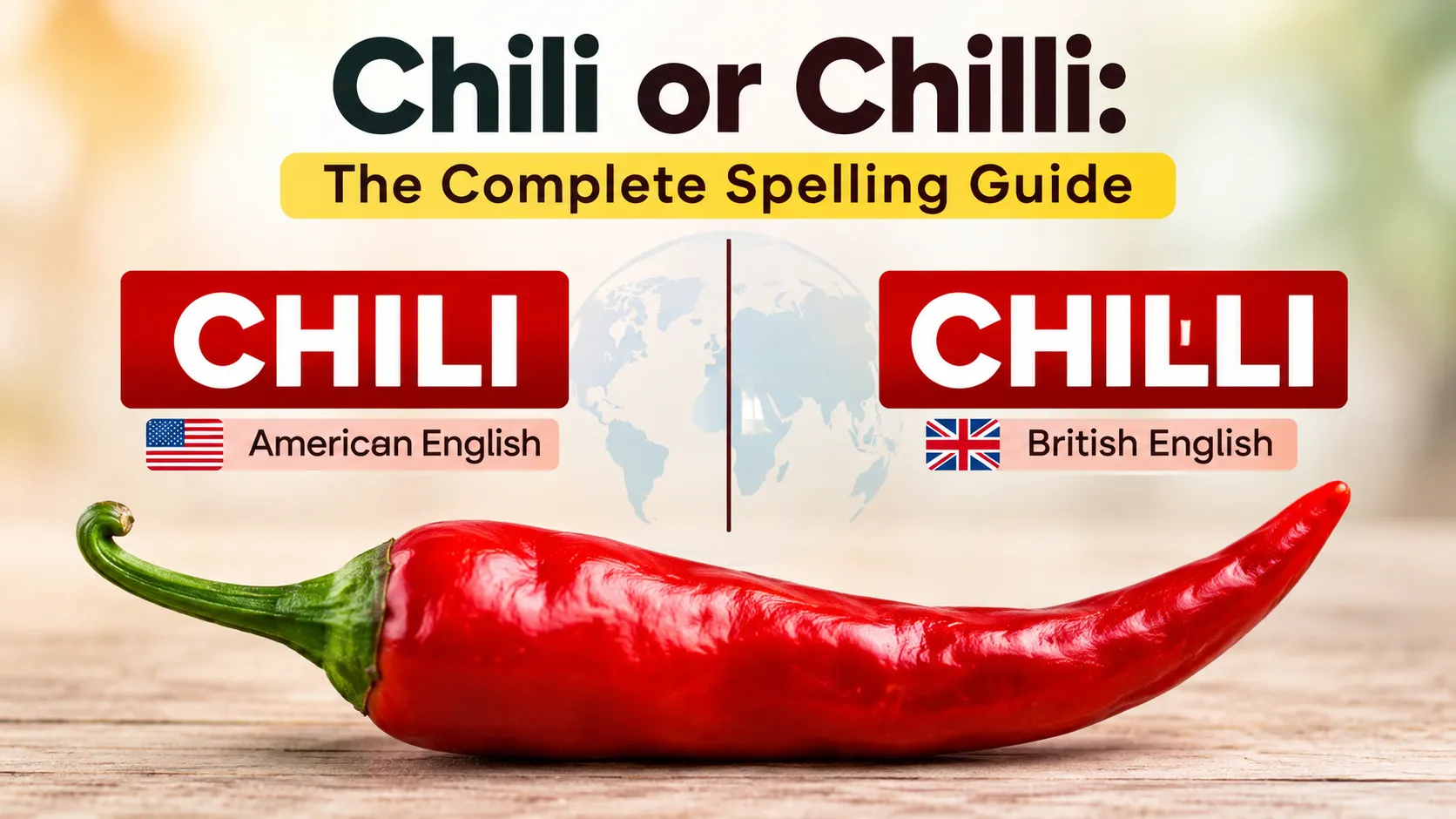
Chili or chilli refers to the hot pepper, but the spelling depends on the variety of English: chili is common in American English, while chilli is common in British English and many other varieties.
Have you ever typed chili and wondered if you should add another l?
You are not alone. This is a small spelling choice that can cause real confusion. You may see chili pepper on an American website, then find chilli pepper in a British recipe. Both can be correct.
The difference is mainly about regional English.
As an English teacher, I often see learners stop at this word because they think one spelling must be wrong. The truth is much simpler. English has several regional forms, and chili and chilli are a good example.
The same pattern appears in many words. American English may use one form, while British English uses another. Neither form is automatically better.
This guide explains exactly when to use chili, when to use chilli, where the word comes from, and how the spelling changes by region. You will also see simple examples for emails, headlines, social posts, and formal writing.
By the end, choosing the right spelling should feel easy.
Chili or Chilli
Chili and chilli have the same basic meaning: a hot pepper or a food made with hot peppers.
The main difference is regional spelling.
- Chili is the usual spelling in American English.
- Chilli is common in British English.
- Chilli is also widely used in countries and regions influenced by British English.
- Chile is another form you may see, especially for the pepper in some contexts.
Simple examples
American English:
I added one chili pepper to the sauce.
British English:
I added one chilli pepper to the sauce.
Both sentences are correct in their intended English variety.
There is also chili as a name for a spicy dish, especially in American English.
We had beef chili for dinner.
In British English, you may see chilli con carne instead.
The Origin and Background of Chili or Chilli
The history of chili or chilli goes back much further than modern English spelling.
The word is linked to Nahuatl, the language spoken by the Aztecs and other people in central Mexico. The Nahuatl word chīlli referred to a hot pepper.
When Spanish explorers encountered these peppers in the Americas, the word entered Spanish in forms such as chile.
The pepper then spread around the world.
This is one reason the word has several forms today. Languages borrow words, change their sounds, and adapt their spelling. English then developed its own regional patterns.
The food itself also has a long history.
Chili peppers are native to the Americas. After European contact with the Americas, they spread to Africa, Asia, and other parts of the world. They became important in many cuisines.
Today, you can find chili or chilli peppers in dishes from Mexico, India, Thailand, Pakistan, China, Korea, and many other places.
So the spelling may be English, but the story behind the word is global.
Chili or Chilli Explained: Key Differences
The biggest difference is not meaning. It is English variety and context.
| Term | Meaning | When to Use | Region/Context |
|---|---|---|---|
| chili | Hot pepper or spicy dish | American English | United States |
| chilli | Hot pepper or spicy food | British style English | UK and many other regions |
| chile | Hot pepper | Common in some regional and Spanish influenced contexts | Mexico, U.S. regional usage |
| chili pepper | A hot pepper | When you want to be very clear | Especially common in American English |
| chilli pepper | A hot pepper | When following British spelling | British English and related varieties |
| chili con carne | Spicy meat and bean dish | Common American spelling | American English |
| chilli con carne | Spicy meat and bean dish | Common British spelling | British English |
One useful point is that chili can have two common uses in American English.
It can mean the pepper:
This chili is very hot.
It can also mean the cooked dish:
My mother makes excellent chili.
Context usually makes the meaning clear.
Chili vs. chilli in one sentence
Think of it this way:
American English → chili
British English → chilli
That simple rule will solve most spelling questions.
Which Version Should You Use?
Your choice should depend on your audience.
If you are writing for American readers
Use chili.
Examples:
- chili pepper
- chili powder
- chili sauce
- chili flakes
- chili con carne
If your website targets readers in the United States, consistency matters more than trying to use every regional spelling.
If you are writing for British readers
Use chilli.
Examples:
- chilli pepper
- chilli powder
- chilli sauce
- chilli flakes
- chilli con carne
The same choice usually works well for other audiences that follow British English.
If you are writing for a global audience
Pick one English variety and stay consistent.
For a general international website, chilli may feel familiar to readers in many countries. However, chili is widely recognized too.
If SEO is your goal, you can naturally include both forms when useful.
For example:
Chili or chilli is a common spelling question. American English usually uses chili, while British English often uses chilli.
This gives readers both terms without stuffing keywords into the page.
If you are a student
Follow the spelling used by your school, teacher, or required English variety.
If your class uses British English, write chilli.
If your course uses American English, write chili.
The key is consistency.
Common Mistakes with Chili or Chilli
Here are some mistakes learners often make.
| Mistake | Correction | Why? |
|---|---|---|
| Mixing chili and chilli in one document | Choose one style | Consistency makes writing cleaner |
| Assuming chilli is always wrong | Chilli is correct in many English varieties | British English commonly uses it |
| Assuming chili is always wrong | Chili is correct in American English | Regional spelling differs |
| Writing chilli for an American audience | Use chili | It matches standard American usage |
| Changing the spelling halfway through an article | Keep one regional form | Readers expect consistent English |
Mistake 1: Mixing both spellings
You might write:
I bought chili powder and chilli sauce.
This is not always grammatically wrong, but it can look inconsistent if both words are being used under the same English style.
A cleaner American version is:
I bought chili powder and chili sauce.
A British style version is:
I bought chilli powder and chilli sauce.
Mistake 2: Thinking one spelling is “more correct”
This is one of the most common misunderstandings.
Chili is not a misspelling of chilli.
Chilli is not a misspelling of chili.
The correct choice depends on regional English.
Chili or Chilli in Real World Examples
Seeing the word in real situations makes the difference easier to remember.
1. Professional email
American English:
Subject: Chili Sauce Order
Hi Sarah,
Could you please confirm the quantity of chili sauce needed for next week’s event?
Thanks.
British English:
Subject: Chilli Sauce Order
Hi Sarah,
Could you please confirm the quantity of chilli sauce needed for next week’s event?
Thanks.
Both are professional. The spelling simply follows the chosen English variety.
2. News headline
American style:
Local Restaurant Adds New Chili Dish to Menu
British style:
Local Restaurant Adds New Chilli Dish to Menu
The headline can use either spelling depending on the publication’s style guide.
3. Social media post
American English:
🌶️ This homemade chili sauce is seriously hot!
British English:
🌶️ This homemade chilli sauce is seriously hot!
The message stays the same.
4. Formal report
American English:
The study examined consumer demand for chili peppers in urban markets.
British English:
The study examined consumer demand for chilli peppers in urban markets.
Again, both can be correct.
5. Recipe
American style:
Add two chopped chili peppers.
British style:
Add two chopped chilli peppers.
Recipe writers should follow the spelling style used throughout the cookbook or website.
Chili or Chilli: Data, Trends and Usage
Searches for chili or chilli are mainly informational. People usually want to know which spelling is correct, why the forms differ, or which version they should use.
The topic attracts several groups:
- Students checking English spelling
- Bloggers writing for international readers
- Recipe writers choosing a consistent style
- English learners comparing American and British English
- Editors and copywriters checking regional usage
- Website owners targeting readers in different countries
The strongest regional split is between American English and British English.
American websites commonly use chili. British style publications commonly use chilli. Other countries may favor one form based on their education system, media, or local English conventions.
This matters for SEO because people do not always search with the same spelling.
A U.S. reader may search for:
chili pepper
A British reader may search for:
chilli pepper
That does not mean you should repeat both spellings throughout your page. Instead, use the main spelling for your audience and mention the alternative naturally.
Good SEO starts with helping the reader, not repeating a keyword.
Chili vs. Chilli: Standalone Comparison
| Term/Variant | Meaning | Region/Context | Best Used When |
|---|---|---|---|
| Chili | Hot pepper; also a spicy dish | American English | Writing for U.S. readers |
| Chilli | Hot pepper; also used in names of spicy foods | British English | Writing for UK or British style audiences |
| Chile | Hot pepper | Spanish and some regional English contexts | Referring to specific regional usage |
| Chili pepper | Hot pepper | Mainly American English | Explaining the ingredient clearly |
| Chilli pepper | Hot pepper | British English and related varieties | Following British spelling |
| Chili powder | Ground chili pepper or spice blend | American English | U.S. style recipes and writing |
| Chilli powder | Ground chilli pepper or spice blend | British English and many international contexts | British style recipes and writing |
| Chili con carne | Spicy meat dish | American English | U.S. food writing |
| Chilli con carne | Spicy meat dish | British English | UK food writing |
FAQ About Chili or Chilli
Q: What does chili or chilli mean?
A: It usually means a hot pepper or food made with hot peppers. The spelling changes mainly by English variety.
Q: How do you use chili or chilli correctly?
A: Use chili for American English and chilli for British English. Then keep that spelling consistent throughout your writing.
Q: Chili vs. chilli: what is the difference?
A: There is usually no major difference in meaning. Chili is the standard American spelling, while chilli is common in British English and many other varieties.
Q: Is chili acceptable in formal writing?
A: Yes. Chili is fully acceptable in formal American English. It is also widely understood internationally.
Q: Which is correct, chili or chilli?
A: Both are correct. Choose the spelling that matches your audience and the English style you are using.
Q: Where does the word chilli come from?
A: The word is connected to Nahuatl, a language spoken in central Mexico. The term later entered Spanish and then spread into other languages.
Q: Can I use chilli in an American English article?
A: You can, but chili is the more natural standard choice for American readers. If you are writing for a U.S. audience, consistency with American spelling is usually best.
Q: Is chili also the name of a dish?
A: Yes. In American English, chili can refer to a cooked dish often made with meat, beans, tomatoes, and chili peppers. British English often uses chilli con carne for a similar dish.
Conclusion
The chili or chilli question looks harder than it really is.
The main rule is simple: chili is the usual American English spelling, while chilli is common in British English and many other varieties.
The word has an interesting history. It is linked to Nahuatl, passed through Spanish, and then spread across the world with the pepper itself. Today, the spelling changes from region to region.
If you are writing for Americans, choose chili. If your readers use British English, choose chilli. For a global audience, either can work, but consistency is essential.
Do not treat one spelling as right and the other as wrong. Think about your reader first.
When in doubt, check the English style guide you are following and use that form throughout your work.
Now you know exactly when to use chili and chilli. Bookmark this guide so you never second guess the spelling again.
Related Words: Levelling vs Leveling: Easy Spelling Guide

I studied English literature and have spent years editing content for blogs and digital platforms. I noticed most people struggle with choosing between two similar words. At WordsCombo, I make that choice simple and clear.