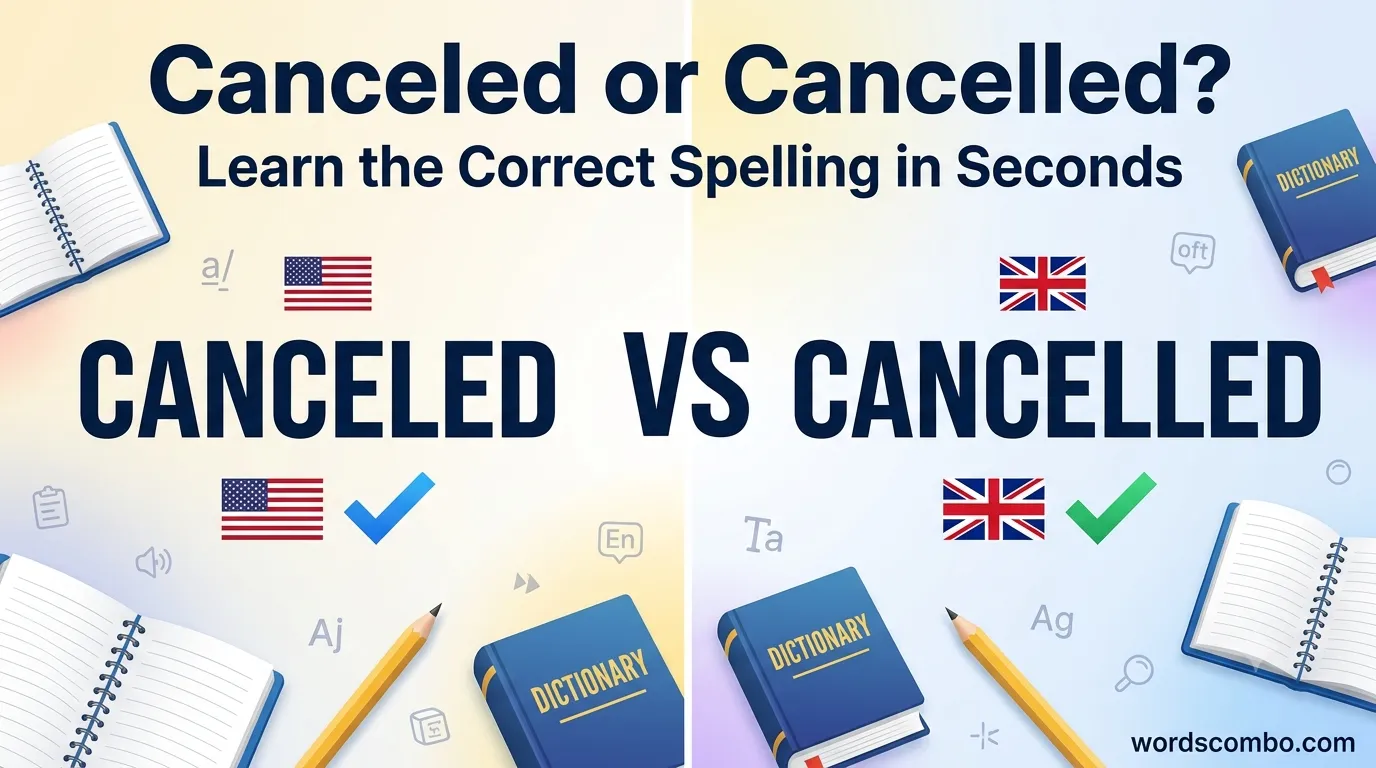
Canceled and cancelled are both correct spellings of the same word. Canceled is the preferred spelling in American English, while cancelled is the standard spelling in British English and most other English-speaking countries.
Have you ever stopped while writing an email because you couldn’t decide whether to type canceled or cancelled? I have. Years ago, I edited content for clients from both the United States and the United Kingdom. One client marked cancelled as an error, while another rejected canceled for the exact same reason. That small spelling difference taught me an important lesson: English changes depending on where your readers live.
Many writers face this confusion every day. Students wonder which spelling will earn full marks. Business owners want their websites to look professional. Bloggers simply want to avoid mistakes.
The good news is that this isn’t a grammar problem. It is a difference between American and British English. Once you understand the rule, you’ll never second-guess yourself again.
In this guide, you’ll learn why both spellings exist, where each one is used, common mistakes to avoid, and how to choose the right spelling for your audience.
Canceled or Cancelled: Quick Answer
Both canceled and cancelled mean that something has been called off, stopped, or ended before it happened.
The only real difference is the spelling.
- Canceled → Preferred in American English
- Cancelled → Preferred in British English, Canadian English, Australian English, and many other countries
Examples
American English
- Our flight was canceled because of bad weather.
- The meeting has been canceled.
British English
- Our flight was cancelled because of heavy rain.
- The concert was cancelled yesterday.
Both sentences mean exactly the same thing.
The Origin of Canceled or Cancelled
The word cancel comes from the Latin word cancellare, which meant to cross out with lines. Over time, the meaning changed to include ending, stopping, or withdrawing something.
The spelling difference appeared much later.
British English often doubles the final “l” before adding endings such as:
- -ed
- -ing
- -er
Examples:
- Travel → Travelled
- Cancel → Cancelled
- Label → Labelled
American English simplified many spellings during the 1800s.
That is why Americans usually write:
- Traveled
- Canceled
- Labeled
Neither spelling is newer or more correct. They simply follow different spelling traditions.
Canceled or Cancelled Explained
Although the spellings differ, the meaning never changes.
| Term | Meaning | When to Use | Region |
|---|---|---|---|
| Canceled | Something was called off | American writing | United States |
| Cancelled | Something was called off | British writing | UK, Canada, Australia, New Zealand |
Example 1
American:
The football game was canceled.
British:
The football match was cancelled.
Example 2
American:
My subscription was canceled yesterday.
British:
My subscription was cancelled yesterday.
The action is identical.
Only the spelling changes.
Which Version Should You Use?
Your audience should decide your spelling.
If you’re writing for Americans
Use canceled.
This is the spelling readers expect.
If you’re writing for British readers
Use cancelled.
It matches British spelling rules.
If you’re writing for Canadians
Either spelling appears, but cancelled is generally more common.
If you’re writing for Australians or New Zealanders
Choose cancelled.
If your audience is worldwide
Stay consistent.
If your website follows American English, always write canceled.
If your brand uses British English, always write cancelled.
Consistency looks professional.
Common Mistakes with Canceled or Cancelled
Many writers mix spellings without realizing it.
Mistake 1
❌ The event was cancelled. Our website says all events are canceled.
✅ Choose one style and use it throughout.
Mistake 2
❌ She cancelled her appointment. (American website)
✅ She canceled her appointment.
Mistake 3
❌ The flight was canceled. (British newspaper)
✅ The flight was cancelled.
Mistake 4
❌ Switching between American and British spelling in one document.
✅ Pick one English style before writing.
Mistake 5
❌ Thinking one spelling is wrong.
✅ Both spellings are correct.
Canceled or Cancelled in Real-World Examples
Professional Email
Due to unexpected maintenance, tomorrow’s training session has been canceled. We apologize for the inconvenience.
(British companies would usually write cancelled.)
News Headline
Hundreds of Flights Canceled After Severe Storm
British version:
Hundreds of Flights Cancelled After Severe Storm
Social Media Post
We’re sorry! Today’s livestream has been canceled. We’ll be back tomorrow.
British version:
Today’s livestream has been cancelled.
Business Report
Three projects were canceled during the second quarter to reduce costs.
British report:
Three projects were cancelled during the second quarter.
School Notice
Sports Day has been cancelled because of heavy rain.
Customer Service Message
Your order has been canceled and your payment will be refunded within five business days.
Canceled or Cancelled: Data, Trends & Usage
People search canceled or cancelled because they want a quick answer before publishing something important.
Search Intent
Primary intent: Informational
Readers want to know:
- Which spelling is correct?
- Is one wrong?
- Which version should I use?
Popular Audiences
- Students
- Teachers
- Bloggers
- Journalists
- Copywriters
- Business professionals
- English learners
Regions
Canceled dominates searches in:
- United States
Cancelled dominates searches in:
- United Kingdom
- Australia
- Canada
- Ireland
- New Zealand
Why It Matters Today
Businesses now write for global audiences.
A company may have readers from both London and New York.
Knowing which spelling fits your audience improves trust and professionalism.
Comparison Table
| Term/Variant | Meaning | Region/Context | Best Used When |
|---|---|---|---|
| Canceled | Called off | American English | Writing for U.S. readers |
| Cancelled | Called off | British English | Writing for UK, Australia, Canada, New Zealand |
| Cancel | Base verb | Universal | Present tense |
| Cancelling | Present participle | British English | British spelling |
| Canceling | Present participle | American English | American spelling |
Quick Tips to Remember
Remember this simple rule:
- 🇺🇸 America → One L
- Canceled
- Canceling
- 🇬🇧 Britain → Two Ls
- Cancelled
- Cancelling
Think:
British English loves doubling the “L.”
Similar Words That Follow the Same Pattern
The same spelling pattern appears in many English words.
| American English | British English |
|---|---|
| Traveled | Travelled |
| Labeled | Labelled |
| Modeled | Modelled |
| Fueling | Fuelling |
| Canceling | Cancelling |
Learning one rule helps you remember many others.
Frequently Asked Questions
Q: What does canceled or cancelled mean?
Both words mean something has been stopped, called off, or ended before completion. The meaning never changes. Only the spelling differs by region.
Q: Which spelling is correct, canceled or cancelled?
Both are correct. Canceled is American English, while cancelled is British English.
Q: How do I use canceled correctly?
Use canceled if you’re writing for American readers or following American spelling rules.
Example:
My reservation was canceled.
Q: How do I use cancelled correctly?
Use cancelled if you’re writing in British English.
Example:
The concert was cancelled because of bad weather.
Q: Is canceled acceptable in formal writing?
Yes. It is completely acceptable in formal American writing, business documents, newspapers, and academic work.
Q: Why do Americans spell it canceled?
American English often removes one final L before adding endings like -ed or -ing. This spelling became common through American spelling reforms.
Q: Can I mix canceled and cancelled in the same article?
No. Pick one spelling style and use it consistently throughout your document. Mixing spellings looks unprofessional and may confuse readers.
Conclusion
The debate over canceled or cancelled is much simpler than it first appears. Both spellings are correct, and both mean exactly the same thing. The only difference is where they are used.
If you’re writing for an American audience, choose canceled. If your readers are in the UK, Australia, Canada, or other countries that follow British English, use cancelled. The most important rule is to stay consistent throughout your writing.
Whenever you feel unsure, think about your audience first. One small spelling choice can make your writing feel more natural and polished.
Now you know exactly when to use canceled and cancelled. Bookmark this guide so you never second-guess the spelling again, and share it with anyone who has ever wondered which version is correct.
Read more: Counselled or Counseled: Which Spelling Is Correct?

I studied English literature and have spent years editing content for blogs and digital platforms. I noticed most people struggle with choosing between two similar words. At WordsCombo, I make that choice simple and clear.