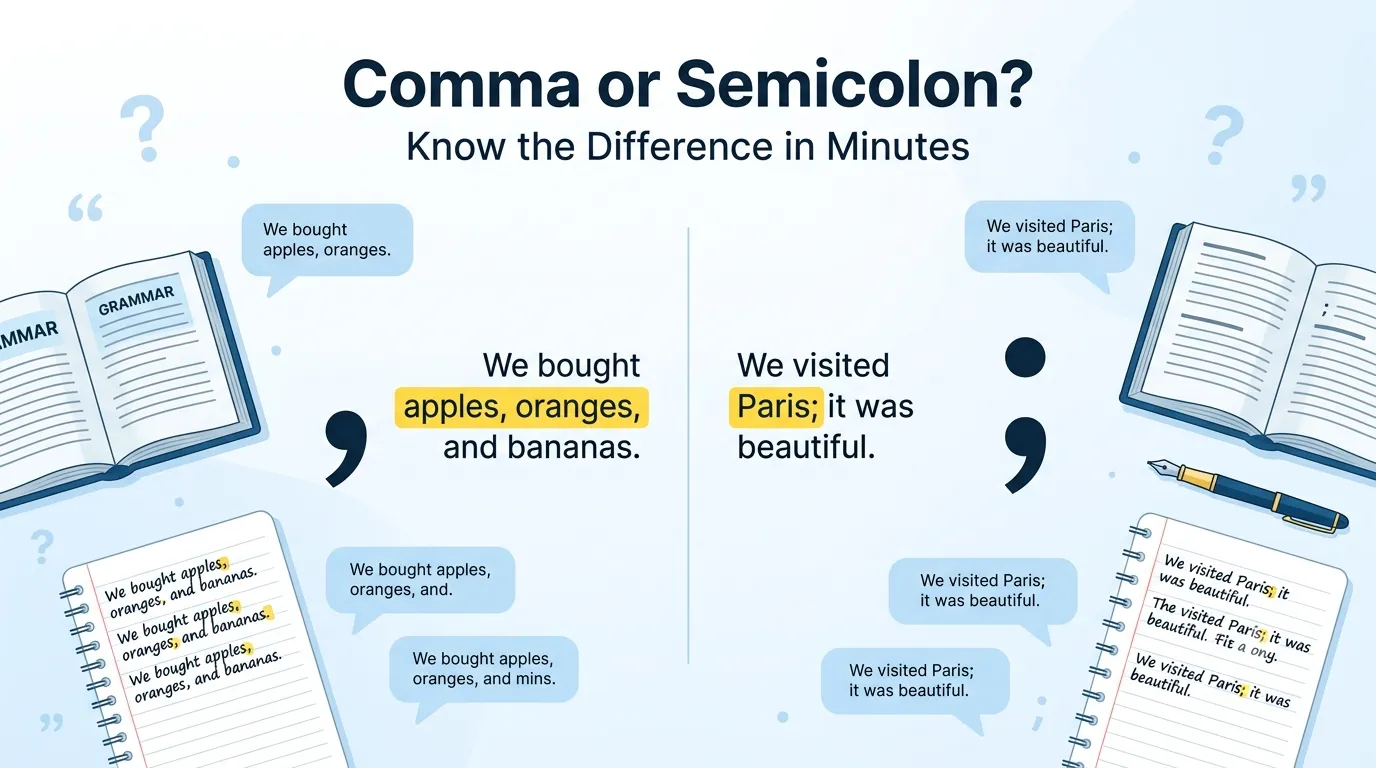
✏️ Comma (,) separates parts of a sentence, while semicolon (;) connects closely related independent clauses. 💡 Easy trick: Comma = shorter pause; semicolon = stronger pause.
Have you ever stared at a sentence and wondered, Should I use a comma or a semicolon here? You’re not alone. Even experienced writers stop and think before choosing one.
I remember grading student essays early in my teaching career. One mistake appeared again and again. Students used commas where they needed semicolons. Others avoided semicolons completely because they looked confusing. After explaining the difference with simple examples, everything started to click. That experience taught me that grammar becomes much easier when you focus on meaning instead of memorizing rules.
Many people search for comma or semicolon because both punctuation marks separate ideas. At first glance, they seem similar. In reality, each one has a different job. Choosing the wrong one can make your writing unclear or even change its meaning.
The good news is that you do not need to be a grammar expert to use them correctly. Once you understand a few simple rules, you will know exactly which punctuation mark fits your sentence.
Let’s start with the basics.
Comma or Semicolon: Quick Answer
A comma (,) creates a short pause or separates words, phrases, and clauses. It keeps writing smooth and easy to read.
A semicolon (;) links two complete sentences that are closely connected. It shows a stronger relationship than a period but a clearer break than a comma.
Example 1
✔ I bought apples, oranges, bananas, and grapes.
The commas separate items in a list.
Example 2
✔ The rain finally stopped; we decided to go for a walk.
Each part is a complete sentence. The semicolon joins them because they share one idea.
Simple rule to remember:
- Use a comma for short pauses and lists.
- Use a semicolon to connect related complete thoughts.
The Origin and Background of Comma or Semicolon
Punctuation has been around for hundreds of years. Early writers needed ways to help readers understand where to pause while reading aloud.
The word comma comes from the Greek word komma, meaning a piece cut off. Over time, the comma became a way to separate parts of a sentence and make writing easier to understand.
The semicolon appeared much later. It was introduced during the Renaissance by the Italian printer Aldus Manutius. He wanted a punctuation mark that was stronger than a comma but weaker than a full stop. The semicolon solved that problem.
This history explains why many people still confuse the two marks today. Both create pauses, but they do different jobs.
Today:
- Commas appear in almost every paragraph.
- Semicolons are less common but remain important in formal writing, essays, reports, and books.
Understanding where each punctuation mark came from makes their purpose much easier to remember.
Comma or Semicolon Explained: Key Differences
The easiest way to choose between a comma and a semicolon is to ask one question:
Are you joining complete sentences or simply separating parts of one sentence?
If you are separating items, phrases, or dependent clauses, use a comma.
If you are joining two complete sentences that could stand alone, use a semicolon.
Comparison Table
| Term | Meaning | When to Use | Region/Context |
| Comma (,) | Separates words, phrases, or clauses | Lists, introductory words, joining clauses with conjunctions | Used worldwide in everyday writing |
| Semicolon (;) | Connects closely related complete sentences | Formal writing, essays, reports, complex lists | Used worldwide, especially in academic and professional writing |
Example Using a Comma
✔ She studied hard, so she passed the exam.
The conjunction so joins the clauses. The comma comes before it.
Example Using a Semicolon
✔ She studied hard; she passed the exam.
Both parts are complete sentences. The semicolon connects them without using a conjunction.
Another Comma Example
✔ Before dinner, we finished our homework.
The comma follows an introductory phrase.
Another Semicolon Example
✔ My brother loves football; my sister prefers tennis.
Each side could stand as its own sentence.
A Common Mistake
❌ I finished my homework, I watched television.
This is called a comma splice because two complete sentences cannot be joined with only a comma.
Correct versions:
✔ I finished my homework. I watched television.
✔ I finished my homework; I watched television.
✔ I finished my homework, and I watched television.
Remember this simple trick:
- Comma = smaller pause
- Semicolon = stronger connection between two complete ideas
When you think about the relationship between your ideas instead of the punctuation mark itself, choosing the correct one becomes much easier.
Which Version Should You Use?
Choosing between a comma and a semicolon is easier than many people think. Start by looking at your sentence. Ask yourself one simple question:
Can each part stand alone as a complete sentence?
If the answer is no, you probably need a comma.
If the answer is yes, a semicolon may be the right choice.
For Beginners
Use a comma most of the time. It is the punctuation mark you will use every day.
A comma helps you:
- Separate items in a list
- Add a short pause
- Join clauses with words like and, but, or, so, and because
- Set off introductory words or phrases
Example:
✔ We packed snacks, water, and maps.
✔ After lunch, we visited the museum.
For Students
Students often write essays and reports. This is where semicolons become useful.
Use a semicolon when:
- Two complete sentences share one idea.
- You want smoother writing than using a full stop.
- You write complex lists with commas inside each item.
Example:
✔ The test was difficult; everyone studied harder for the next one.
For Business Professionals
Business writing should be clear and easy to read.
Use commas for emails, instructions, and everyday communication.
Use semicolons sparingly in reports, proposals, or formal documents where related ideas belong together.
Example:
✔ Sales increased in April; customer satisfaction also improved.
For Creative Writers
Creative writing gives you more freedom.
A comma keeps the story moving.
A semicolon creates a thoughtful pause and links ideas without breaking the flow.
Example:
✔ The sun disappeared behind the hills; darkness arrived quietly.
Best Choice for Most People
If you are unsure, choose the punctuation that makes your sentence easiest to understand.
A comma is usually the safer choice.
A semicolon is powerful, but only when both sides are complete sentences.
Common Mistakes with Comma or Semicolon
Even skilled writers make punctuation mistakes. Here are the most common ones and how to fix them.
| Mistake | Correct Version | Why It Happens |
| I was tired, I went home. | I was tired; I went home. | Two complete sentences cannot be joined by only a comma. |
| I bought apples; oranges; bananas. | I bought apples, oranges, and bananas. | Semicolons should not replace commas in a simple list. |
| Because it rained; we stayed inside. | Because it rained, we stayed inside. | The first part is not a complete sentence. |
| She studied hard, therefore she passed. | She studied hard; therefore, she passed. | Transitional words often need a semicolon before them. |
| We visited Paris, France, London, England, and Rome, Italy. | We visited Paris, France; London, England; and Rome, Italy. | Semicolons make complex lists easier to read. |
Why These Mistakes Are Common
Many people think punctuation is only about pauses.
It is not.
Punctuation also shows how ideas connect.
Once you focus on the meaning of the sentence, choosing between a comma and a semicolon becomes much easier.
A Helpful Memory Trick
Think of punctuation like roads.
- A comma is a small bend in the road.
- A semicolon is a bridge connecting two roads.
- A period is the end of one road before another begins.
This simple image helps many students remember the difference.
Comma or Semicolon in Real World Examples
Grammar rules make more sense when you see them in everyday writing.
Professional Email
Dear Team,
We finished the first phase of the project, and the results look promising. The client has approved our proposal; we can begin the next phase on Monday.
Thank you.
Notice how the comma joins clauses with and, while the semicolon links two complete thoughts.
News Headline
Heavy Rain Ends Across the City; Schools Reopen on Monday
The semicolon connects two closely related pieces of information in a compact way.
Social Media Post
We reached 10,000 followers, and we couldn’t have done it without you! Thank you for your amazing support.
A comma keeps the sentence friendly and natural.
Formal Report
Customer demand increased by 18% during the second quarter; operating costs remained stable throughout the same period.
The semicolon makes the relationship between the two findings clear without breaking the sentence.
Everyday Conversation
✔ I cleaned the kitchen, folded the laundry, and cooked dinner.
✔ I finished my work; now I can relax.
Both examples sound natural because each punctuation mark matches its purpose.
Comma or Semicolon: Data, Trends & Usage
The topic comma or semicolon remains one of the most searched grammar questions online.
People search for it because punctuation affects school assignments, workplace writing, emails, blog posts, and even social media.
Who Searches Most?
- Students preparing essays and exams.
- Teachers explaining grammar.
- Content writers creating articles.
- Business professionals writing reports and emails.
- English learners improving their writing skills.
Search Intent
Primary intent: Informational.
Most readers simply want a quick answer to questions like:
- Which one is correct?
- When should I use a semicolon?
- Can a comma replace a semicolon?
- How do I avoid punctuation mistakes?
Why This Topic Matters Today
Clear writing matters more than ever.
Every email, message, assignment, and online post shapes how people see your ideas.
Good punctuation helps readers understand you faster. It also makes your writing look more professional and trustworthy.
Learning the difference between a comma and a semicolon is a small step that can make a big improvement in your communication.
Comma or Semicolon: Standalone Comparison Table
| Term/Variant | Meaning | Region/Context | Best Used When |
| Comma (,) | Separates words, phrases, or clauses | Used worldwide in everyday writing | Writing lists, adding short pauses, or joining clauses with conjunctions |
| Semicolon (;) | Connects closely related complete sentences | Common in formal, academic, and professional writing | Linking two independent clauses without a conjunction |
| Period (.) | Ends a complete sentence | Universal | You want a full stop between ideas |
| Colon (:) | Introduces a list, explanation, or example | Formal and informal writing | Presenting details after a complete sentence |
Frequently Asked Questions (FAQs)
Q: What does comma or semicolon mean?
A: A comma creates a short pause and separates words, phrases, or clauses. A semicolon joins two closely related complete sentences without using a coordinating conjunction.
Q: How do you use a comma or semicolon correctly?
A: Use a comma for lists, introductory phrases, and before words like and, but, or so when joining clauses. Use a semicolon only when both sides are complete sentences that are closely related.
Q: Comma vs. semicolon: what’s the difference?
A: A comma separates parts of a sentence, while a semicolon connects two complete thoughts. Think of a comma as a light pause and a semicolon as a stronger bridge between ideas.
Q: Is a semicolon acceptable in formal writing?
A: Yes. Semicolons are widely accepted in academic papers, business reports, legal documents, and professional writing. They help connect related ideas clearly and elegantly.
Q: Which is correct: a comma or a semicolon?
A: It depends on your sentence. If the ideas cannot stand alone, use a comma. If both parts are complete sentences, a semicolon is often the better choice.
Q: Where does the semicolon come from?
A: The semicolon was introduced during the Renaissance by the Italian printer Aldus Manutius. It was designed to create a pause stronger than a comma but weaker than a period.
Q: Can I use a semicolon in emails and everyday writing?
A: Yes, but use it sparingly. Most everyday messages work well with commas and periods. A semicolon is useful when you want to connect two closely related ideas without making them separate sentences.
Conclusion
Choosing between a comma and a semicolon does not have to be difficult. Once you know what each punctuation mark does, the decision becomes much easier.
Remember these key points:
- Use a comma to separate items, introduce short pauses, and join clauses with conjunctions.
- Use a semicolon to connect two closely related complete sentences.
- Avoid comma splices by checking whether each part of your sentence can stand on its own.
- Keep your reader in mind. The best punctuation is the one that makes your writing clear and easy to follow.
Like any writing skill, punctuation improves with practice. Read well-written books, articles, and newspapers. Pay attention to how experienced writers use commas and semicolons. Soon, choosing the right one will feel natural.
Now you know exactly how to use a comma or semicolon. Try these rules in your next email, essay, or social media post. Bookmark this guide so you never second-guess your punctuation again, and share it with someone who wants to write with more confidence.
Read more: Wont or Won’t: Complete Guide to the Correct Usage

I have a background in academic writing and spent several years as a proofreader for digital publications. Spotting differences between easily confused words became second nature to me. At WordsCombo, I share that knowledge so readers can write with confidence.