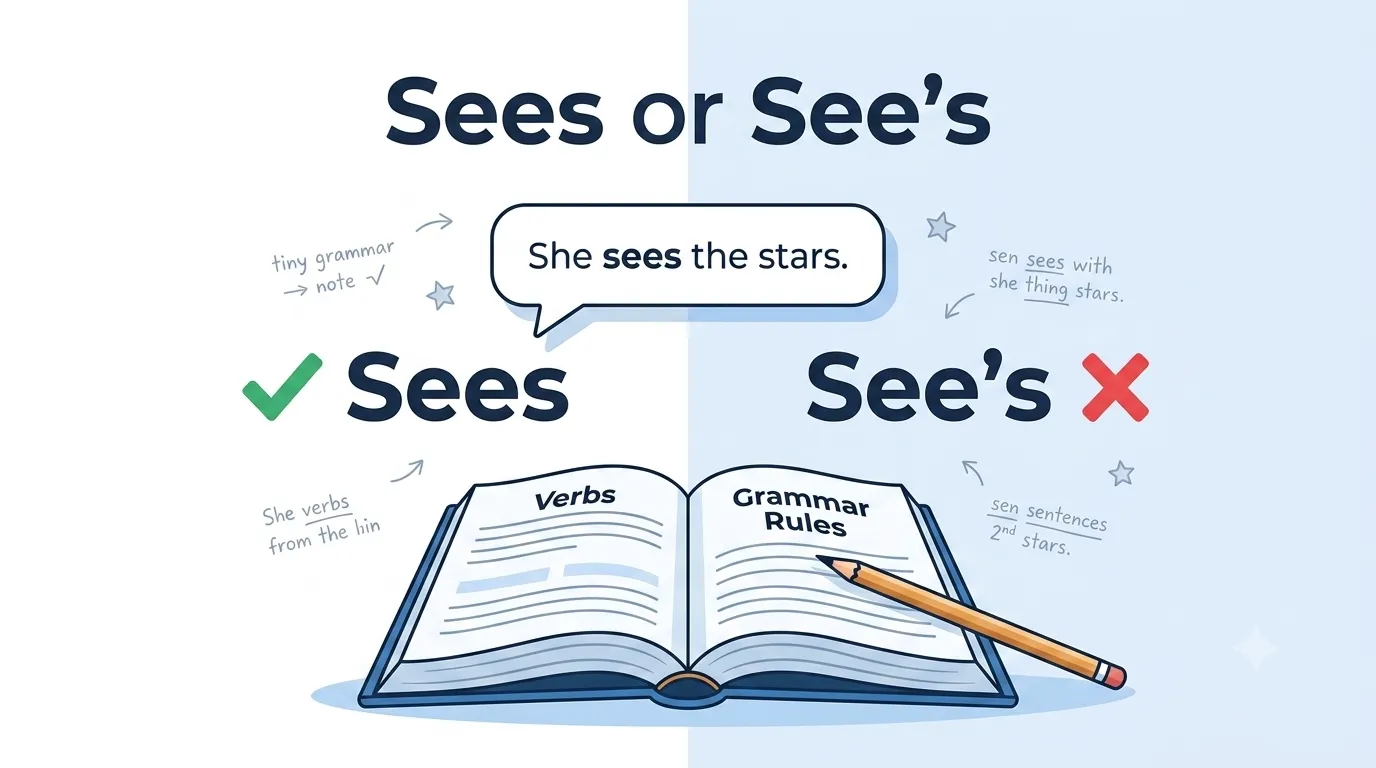
“Sees” is correct, while “see’s” is incorrect. We use sees when someone sees something, but we do not use an apostrophe in a regular verb.
A few years ago, I was proofreading a student’s essay when one tiny word kept appearing again and again: “see’s.” At first glance, it looked harmless. After all, English is full of apostrophes. But that single punctuation mark changed a correct word into a spelling mistake.
I have seen this confusion hundreds of times. Students write it. Professionals type it in emails. Social media posts are full of it. Even people with strong English skills sometimes stop and wonder, “Should it be sees or see’s?”
The confusion makes sense. English spelling has many tricky rules. Apostrophes can show possession or contractions, so it is easy to think they belong here too.
The good news is that this rule is simple once you know it. By the end of this guide, you will know which spelling is correct, why people mix them up, and how to avoid this mistake forever.
Let’s clear it up.
Sees or See’s: Quick Answer
The correct spelling is sees.
Use sees when talking about someone looking at something in the present tense.
Examples
- She sees the mountains every morning.
- He sees his grandparents every weekend.
- My teacher sees the mistake immediately.
The spelling see’s is incorrect in normal grammar.
The Origin and Background of “Sees”
The word see comes from the Old English word seon, which meant “to look at” or “to perceive.”
Over many centuries, English changed, but the verb remained simple.
Today its forms include:
- See
- Sees
- Saw
- Seen
- Seeing
The confusion usually comes from the apostrophe.
People often think adding ‘s makes a word singular or present tense. It does not.
An apostrophe has two main jobs:
- Show possession
- Show missing letters in contractions
It is not used to create regular verb forms.
Sees Explained: Key Differences
Many people compare these forms.
| Term | Meaning | When to Use | Region/Context |
|---|---|---|---|
| See | Base verb | I, you, we, they | All English |
| Sees | Third person singular verb | He, she, it | All English |
| See’s | Usually incorrect | Avoid | Not standard English |
Examples
Correct:
- Emma sees birds every day.
- My father sees patients.
- The camera sees movement.
Incorrect:
- Emma see’s birds.
- My father see’s patients.
Which Version Should You Use?
The answer is simple.
For students
Use sees whenever the subject is he, she, or it.
Example:
- She sees the answer.
For business writing
Always use sees.
Example:
- The manager sees strong growth this quarter.
For academic writing
Use sees according to normal grammar rules.
For global English
Both British English and American English use sees.
There is no accepted spelling see’s as a verb.
Common Mistakes with Sees
Here are the mistakes people make most often.
| Mistake | Correct |
|---|---|
| She see’s happy. | She sees happiness. |
| He see’s the car. | He sees the car. |
| My dog see’s everything. | My dog sees everything. |
| The teacher see’s progress. | The teacher sees progress. |
| Everyone see’s the problem. | Everyone sees the problem. |
Why does this happen?
People often confuse apostrophes with grammar endings.
Remember:
- Dog’s = something belongs to the dog.
- It’s = it is.
- Sees = correct verb.
Sees in Real World Examples
Professional email
Our supervisor sees great potential in the new project.
News headline
Mayor sees strong economic growth ahead.
Social media post
She finally sees why everyone loves this movie!
Formal report
The committee sees clear evidence of improvement.
Notice that every example uses sees without an apostrophe.
Sees: Data, Trends and Usage
Many people search for “sees or see’s” because grammar checkers flag the mistake.
Search intent
Informational
People want to know:
- Which spelling is correct.
- Why the apostrophe is wrong.
- How to avoid mistakes.
Popular audiences
- English learners
- Students
- Teachers
- Bloggers
- Writers
- Professionals
Regions with high interest
- United States
- United Kingdom
- Canada
- Australia
- India
Why it matters now
People write more online than ever before. Emails, blogs, social media, and work messages all need clear grammar. A small spelling mistake can make writing look less professional.
Standalone Comparison Table
| Term/Variant | Meaning | Region/Context | Best Used When |
|---|---|---|---|
| See | Base verb | Worldwide | I see, You see |
| Sees | Third person singular verb | Worldwide | He sees, She sees |
| Saw | Past tense | Worldwide | Yesterday |
| Seen | Past participle | Worldwide | Have seen |
| See’s | Usually incorrect | Avoid | Never as a verb |
Frequently Asked Questions
Q: What does “sees” mean?
A: Sees is the present tense form of see used with he, she, or it. It means to look at or notice something.
Q: How do you use “sees” correctly?
A: Use sees when the subject is singular and in the third person.
Example:
- She sees the stars.
Q: Sees vs see: what’s the difference?
A: See is the base verb. Sees is used only with he, she, or it in the present tense.
Q: Is “see’s” acceptable in formal writing?
A: No. See’s is not correct as a verb. Professional, academic, and everyday writing should use sees.
Q: Which version is correct: sees or see’s?
A: Sees is correct. See’s is almost always a spelling mistake.
Q: Where does “see” come from?
A: The word comes from Old English seon, meaning “to perceive” or “to look.”
Q: Can “sees” be used in business writing?
A: Yes. It is the standard verb form for professional emails, reports, presentations, and formal documents.
Conclusion
The rule is much easier than it first appears. Sees is the correct spelling whenever you need the third person singular form of the verb see. The spelling see’s is almost always wrong because apostrophes do not create regular verb forms.
Remember these key points:
- Sees is correct.
- See’s is incorrect as a verb.
- Apostrophes show possession or contractions, not verb endings.
- This rule is the same in British and American English.
Once you remember that simple pattern, you will stop second guessing yourself every time you write. Your emails, essays, reports, and social media posts will all look cleaner and more professional.
Now you know exactly how to use “sees” correctly. Bookmark this guide so you never confuse “sees” and “see’s” again, and share it with anyone who still makes this common mistake.
Read more: Mommies or Mommy’s: Easy Guide to Correct Usage

I have a background in academic writing and spent several years as a proofreader for digital publications. Spotting differences between easily confused words became second nature to me. At WordsCombo, I share that knowledge so readers can write with confidence.