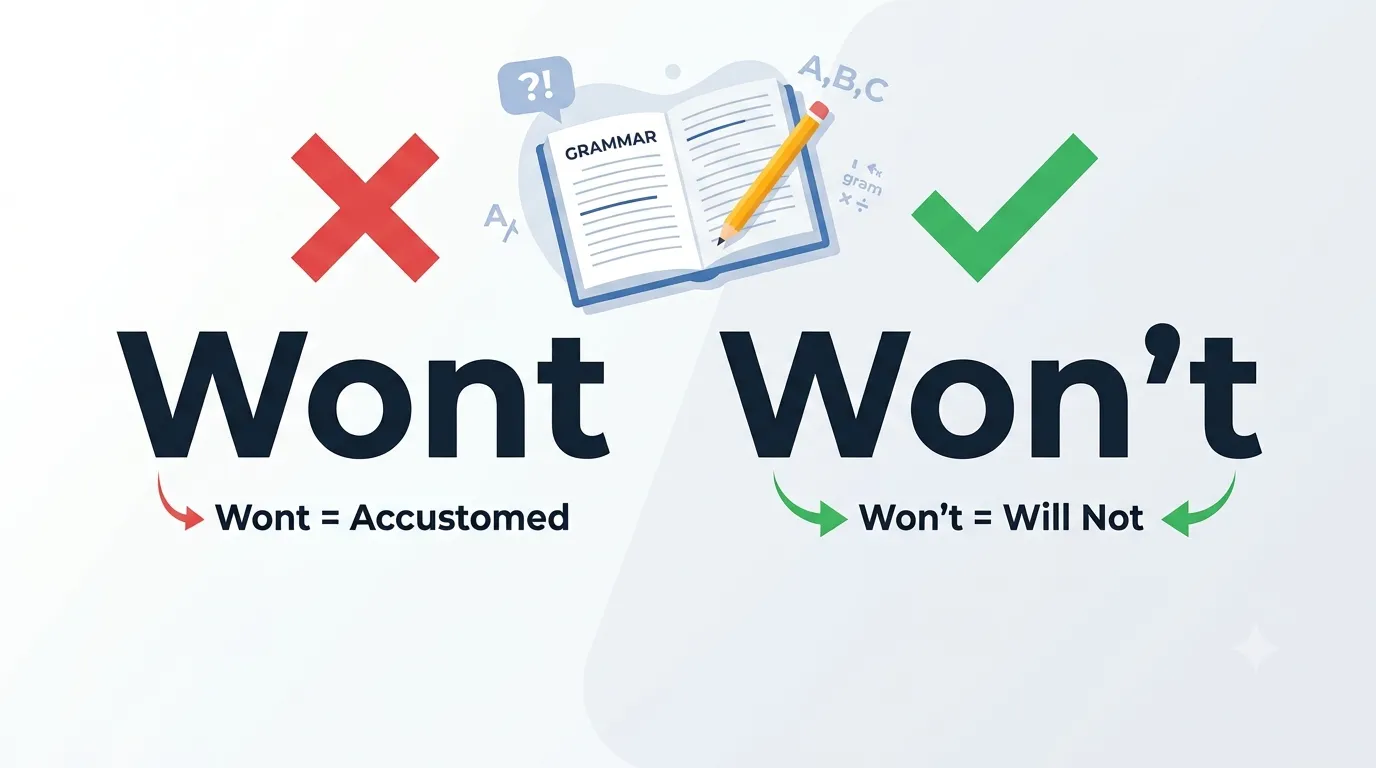
“Won’t” is the correct contraction of “will not.” “Wont” is a different English word that means accustomed to or used to doing something, so the two words are not interchangeable.
A few years ago, I was editing an article from a talented writer. The content was excellent, but one small spelling mistake appeared again and again. The writer used “wont” instead of “won’t.” It looked tiny, yet it completely changed the meaning of several sentences.
That mistake is more common than you might think. Many people type quickly and miss the apostrophe. Others simply do not know that wont and won’t are two different words.
If you have ever paused while writing an email, school assignment, blog post, or social media update, you are not alone. English contractions can be confusing.
By the end of this guide, you will know the difference between wont and won’t, when to use each one, and how to avoid this mistake forever.
Wont or Won’t: Quick Answer
The correct choice depends on what you mean.
- Won’t = will not
- Wont = accustomed or used to
Examples
- I won’t attend the meeting tomorrow. ✅
- She is wont to wake up early every day. ✅
Most people actually mean won’t, not wont.
The Origin and Background of Wont or Won’t
Understanding where these words came from makes them much easier to remember.
Where did won’t come from?
English contractions usually combine two words.
For example:
- do not → don’t
- cannot → can’t
- is not → isn’t
But will not became won’t.
This looks strange because the spelling changes. The reason is historical. Long ago, English used another form of will, called woll. Over time, the contraction changed into the modern won’t.
Although it looks unusual, won’t has been accepted for hundreds of years.
Where did wont come from?
The word wont comes from Old English. It means habit, custom, or accustomed to.
Today, it appears mostly in:
- classic books
- formal writing
- academic texts
- historical writing
It is much less common in everyday English.
Wont or Won’t Explained: Key Differences
The biggest difference is simple.
| Term | Meaning | When to Use | Region/Context |
|---|---|---|---|
| Won’t | Will not | Everyday writing and speech | Worldwide English |
| Wont | Accustomed or in the habit of | Formal or literary writing | Mostly literature and academic English |
Example using won’t
- I won’t forget your birthday.
- They won’t arrive today.
- We won’t be late.
Example using wont
- He is wont to exercise before sunrise.
- The professor was wont to begin class with a joke.
Notice how rare wont sounds in everyday conversation.
Which Version Should You Use?
Your audience matters.
For students
Use won’t almost every time.
It is the correct contraction for will not.
For business professionals
Use won’t in emails, presentations, and reports whenever you want to shorten will not.
Example:
We won’t release the update until Friday.
For writers and authors
Use wont only if you truly mean accustomed.
Example:
The old captain was wont to inspect the ship every morning.
For global English
Choose won’t unless your sentence specifically needs the literary word wont.
Common Mistakes with Wont or Won’t
These mistakes appear every day.
| Mistake | Correct Version | Why It Happens |
|---|---|---|
| I wont go. | I won’t go. | Missing apostrophe |
| She wont call. | She won’t call. | Typing too quickly |
| He is won’t to smile. | He is wont to smile. | Confusing meanings |
| We wont attend. | We won’t attend. | Auto-correct missed it |
| They wont agree. | They won’t agree. | Apostrophe forgotten |
Easy memory trick
Ask yourself:
Can I replace the word with “will not”?
If yes, write won’t.
If no, check whether you mean accustomed.
Wont or Won’t in Real World Examples
Professional email
We won’t be able to attend tomorrow’s meeting because of a scheduling conflict.
News headline
Experts Say Inflation Won’t Slow This Month
Social media post
I won’t give up. Big things take time.
Formal report
The committee won’t recommend changes until further evidence is available.
Literary example
The judge was wont to examine every detail before making a decision.
Wont or Won’t: Data, Trends & Usage
People search for wont or won’t because they want the correct spelling.
Search intent
Informational
Readers usually want:
- the correct spelling
- grammar help
- writing examples
- punctuation rules
Who searches most?
- Students
- Bloggers
- Content writers
- English learners
- Office workers
- Teachers
Regions with high interest
- United States
- United Kingdom
- Canada
- Australia
- India
- Other English-learning countries
Why this matters now
More people write online than ever before. A missing apostrophe may seem small, but it can make professional writing look careless.
Comparison Table
| Term/Variant | Meaning | Region/Context | Best Used When |
|---|---|---|---|
| Won’t | Will not | Everyday English | Conversations, emails, blogs, articles |
| Wont | Accustomed | Literary English | Books, formal writing, historical texts |
| Will not | Full form | Formal writing | Academic papers and official documents |
Quick Tips to Remember
- Won’t always contains an apostrophe.
- Won’t means will not.
- Wont is a real word.
- Wont means accustomed.
- Most people need won’t, not wont.
- Read your sentence aloud if you are unsure.
Frequently Asked Questions
Q: What does “won’t” mean?
A: Won’t is the contraction of will not. It is one of the most common contractions in English.
Q: What does “wont” mean?
A: Wont means accustomed, habitual, or used to doing something. It is mostly found in formal or literary writing.
Q: How do you use “won’t” correctly?
A: Use won’t whenever you mean will not. Example: I won’t forget your advice.
Q: Is “wont” correct without an apostrophe?
A: Yes, but only when you mean accustomed. It is not a misspelling, but it has a completely different meaning.
Q: Which version is correct: “wont” or “won’t”?
A: If you mean will not, the correct spelling is won’t. Use wont only when referring to a habit or custom.
Q: Can “wont” be used in formal writing?
A: Yes. It appears in formal, academic, and literary writing, but it is uncommon in everyday communication.
Q: Why is “won’t” spelled differently from “will not”?
A: The spelling comes from the historical development of English. Although it looks unusual, won’t has been the accepted contraction for centuries.
Conclusion
The difference between wont and won’t is simple once you know what each word means.
Remember these key points:
- Won’t means will not.
- Wont means accustomed.
- Most everyday writing requires won’t.
- Wont belongs mainly in literary or formal contexts.
Whenever you are unsure, replace the word with will not. If the sentence still makes sense, won’t is the correct choice.
Small grammar details can make a big difference. They help your writing look clear, professional, and trustworthy.
Now you know exactly how to use wont and won’t. Bookmark this guide so you never second-guess the correct spelling again, and share it with someone who has made this common mistake.
Read more: Cant or Can’t: The Complete Guide to Correct Usage

I have a background in academic writing and spent several years as a proofreader for digital publications. Spotting differences between easily confused words became second nature to me. At WordsCombo, I share that knowledge so readers can write with confidence.