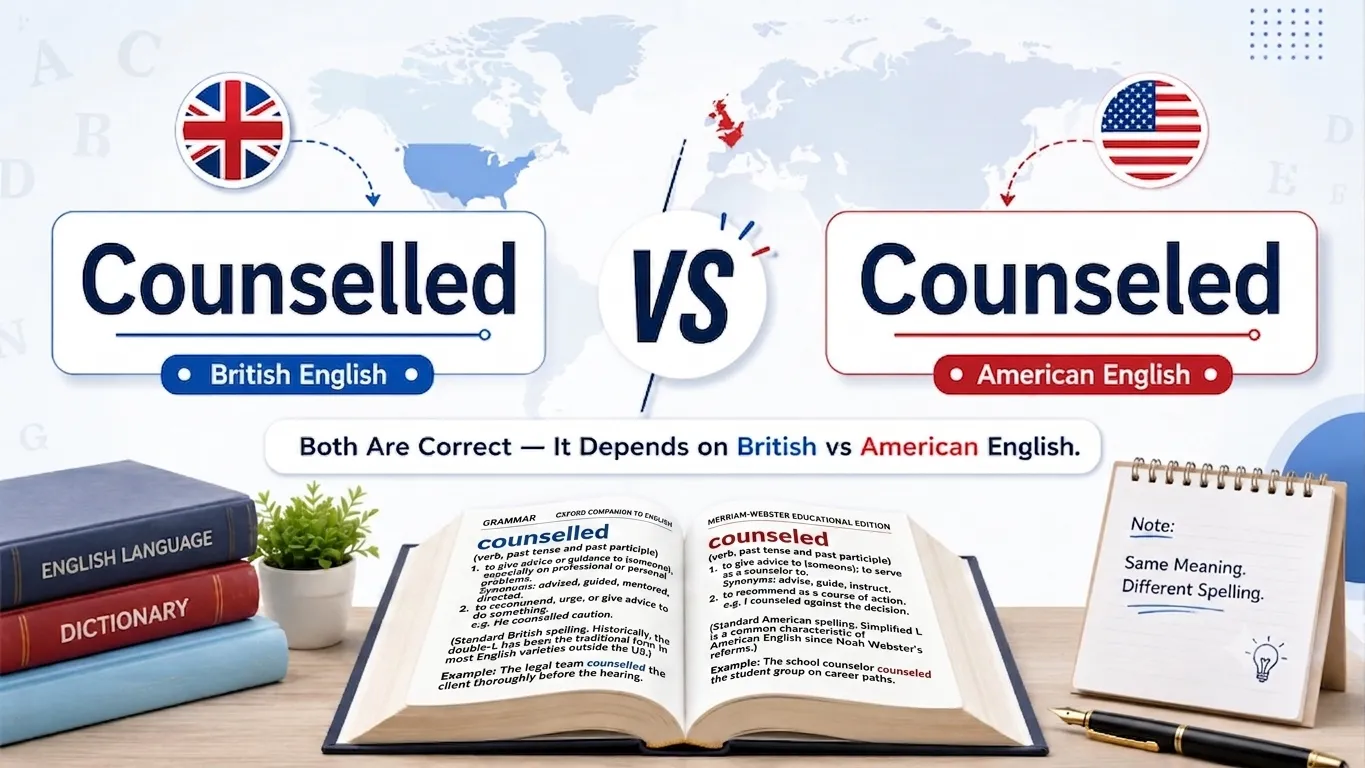
Counselled and counseled mean the same thing: gave advice or guidance. The only real difference is spelling. Counselled is the preferred spelling in British English, while counseled is the standard spelling in American English.
I still remember editing an article for an international client a few years ago. Everything looked perfect until one small word stopped me in my tracks: counselled. My spell checker wanted counseled instead. The client insisted the original spelling was right. We were both correct.
That tiny spelling difference taught me an important lesson. English is full of regional variations, and they often confuse even experienced writers. Whether you’re writing an email, a school paper, a business report, or a blog post, choosing the wrong version can make your writing look inconsistent.
Many people search for “counselled or counseled” because they want a simple answer. They wonder which spelling is correct, whether one is more formal, and if using the wrong version matters.
The good news is that the answer is much easier than you might think. Once you understand the rule, you’ll never need to second guess this word again.
Let’s clear up the confusion.
Counselled or Counseled: Quick Answer
Both counselled and counseled are correct spellings of the past tense of counsel.
The only difference is the variety of English you use.
- Counselled → British English
- Counseled → American English
Examples
- The therapist counselled the family after the accident. (British English)
- The therapist counseled the family after the accident. (American English)
Both sentences have exactly the same meaning.
The Origin and Background of Counselled or Counseled
The word counsel comes from the Latin word consilium, meaning advice, guidance, or deliberation.
Later, it entered Old French as conseil before becoming part of Middle English.
Originally, counsel referred to giving thoughtful advice. Over time, it also became a legal term referring to a lawyer or legal adviser.
So why do we have two spellings?
The answer lies in spelling traditions.
British English often doubles the L when adding endings like ed or ing after a stressed syllable.
Examples include:
- travel → travelled
- cancel → cancelled
- model → modelled
American English usually keeps a single L.
Examples include:
- traveled
- canceled
- modeled
That same pattern gives us:
- counselled (British)
- counseled (American)
Counselled or Counseled Explained
Although the meanings are identical, choosing the correct version depends on your audience.
| Term | Meaning | When to Use | Region/Context |
|---|---|---|---|
| Counselled | Gave advice or guidance | British publications | UK, Australia, New Zealand |
| Counseled | Gave advice or guidance | American publications | United States |
Example (British)
The school counselled students after the incident.
Example (American)
The school counseled students after the incident.
Notice that only the spelling changes.
Which Version Should You Use?
Your audience should decide.
If you’re writing for British readers
Use counselled.
Examples include:
- UK universities
- British newspapers
- Government documents
- British businesses
If you’re writing for American readers
Use counseled.
Examples include:
- US companies
- American schools
- US media
- Academic writing in the United States
If you’re writing for an international audience
Either spelling is acceptable.
The important thing is consistency.
Don’t switch between counselled and counseled in the same document unless you’re quoting another source.
Common Mistakes with Counselled or Counseled
Here are mistakes people make most often.
| Mistake | Correct |
|---|---|
| He counselled me. (US document) | He counseled me. |
| She counseled me. (UK document) | She counselled me. |
| Mixing both spellings | Choose one style and stay consistent. |
| Confusing council with counsel | Council is a governing group. Counsel means advice. |
| Using counsel when a noun is needed | “She gave good counsel.” |
Why these mistakes happen
- British and American spellings look very similar.
- Spell checkers automatically change words.
- Many writers confuse counsel and council because they sound alike.
Counselled or Counseled in Real World Examples
Professional Email
Our HR manager counselled several employees during the workplace transition.
American version:
Our HR manager counseled several employees during the workplace transition.
News Headline
School psychologist counseled students after severe weather.
British newspaper:
School psychologist counselled students after severe weather.
Social Media Post
Our volunteer team counseled over 200 families this year. We’re proud to help.
Formal Report
Staff members were counselled before returning to work following the restructuring.
Counselled or Counseled: Data, Trends & Usage
Searches for “counselled or counseled” usually come from people who want to know the correct spelling.
Search Intent
Informational
Users want:
- the correct spelling
- regional differences
- grammar rules
- writing examples
Regions Where It’s Most Common
- United Kingdom
- United States
- Canada
- Australia
- India
Who Searches for It?
- Students
- Bloggers
- Teachers
- Copywriters
- Journalists
- Business professionals
Why It Matters Today
Many people write for international audiences. Using the right regional spelling helps your writing look professional and trustworthy.
Counselled vs Counseled Comparison Table
| Term/Variant | Meaning | Region/Context | Best Used When |
|---|---|---|---|
| Counselled | Past tense of counsel | British English | Writing for UK, Australia, or New Zealand audiences |
| Counseled | Past tense of counsel | American English | Writing for US readers |
| Counsel | Advice or guidance | Universal | As a noun or verb |
| Counselling | Giving professional advice | British English | UK spelling |
| Counseling | Giving professional advice | American English | US spelling |
Frequently Asked Questions
Q: What does counselled or counseled mean?
Both words mean gave advice, support, or guidance to someone. Their meanings are exactly the same.
Q: How do you use counselled or counseled correctly?
Choose the spelling based on your audience. Use counselled for British English and counseled for American English.
Q: Counselled vs advised—what’s the difference?
Advised usually means giving recommendations. Counselled often suggests thoughtful guidance, emotional support, or professional advice over time.
Q: Is counselled acceptable in formal writing?
Yes. It is the correct British English spelling and appears in academic papers, government documents, and professional reports.
Q: Which version is correct—counselled or counseled?
Both are correct. The difference depends entirely on whether you’re using British or American English.
Q: Where does the word counsel come from?
It comes from the Latin word consilium, meaning advice, consultation, or guidance. It entered English through Old French before becoming part of Middle English.
Q: Can counselled or counseled be used in medical or legal writing?
Absolutely. Both spellings are widely used in healthcare, psychology, education, and law. Simply match the spelling to the regional style guide you’re following.
Conclusion
Choosing between counselled and counseled is much simpler than it first appears. Both spellings are correct, and both mean giving advice or guidance. The only real difference is the variety of English you are using.
Remember these key points:
- Counselled is the preferred spelling in British English.
- Counseled is the standard spelling in American English.
- The meaning never changes.
- Stay consistent throughout your writing.
Whether you’re preparing a school assignment, drafting a business report, writing a blog post, or sending a professional email, using the correct regional spelling helps your work look polished and credible.
Now you know exactly how to use “counselled or counseled.” Bookmark this guide so you never second guess the spelling again, and share it with anyone who has ever been puzzled by this common English variation.
Read more: Counselling or Counseling: The Complete Easy Guide

I studied English literature and have spent years editing content for blogs and digital platforms. I noticed most people struggle with choosing between two similar words. At WordsCombo, I make that choice simple and clear.




1 thought on “Counselled or Counseled: Which Spelling Is Correct?”