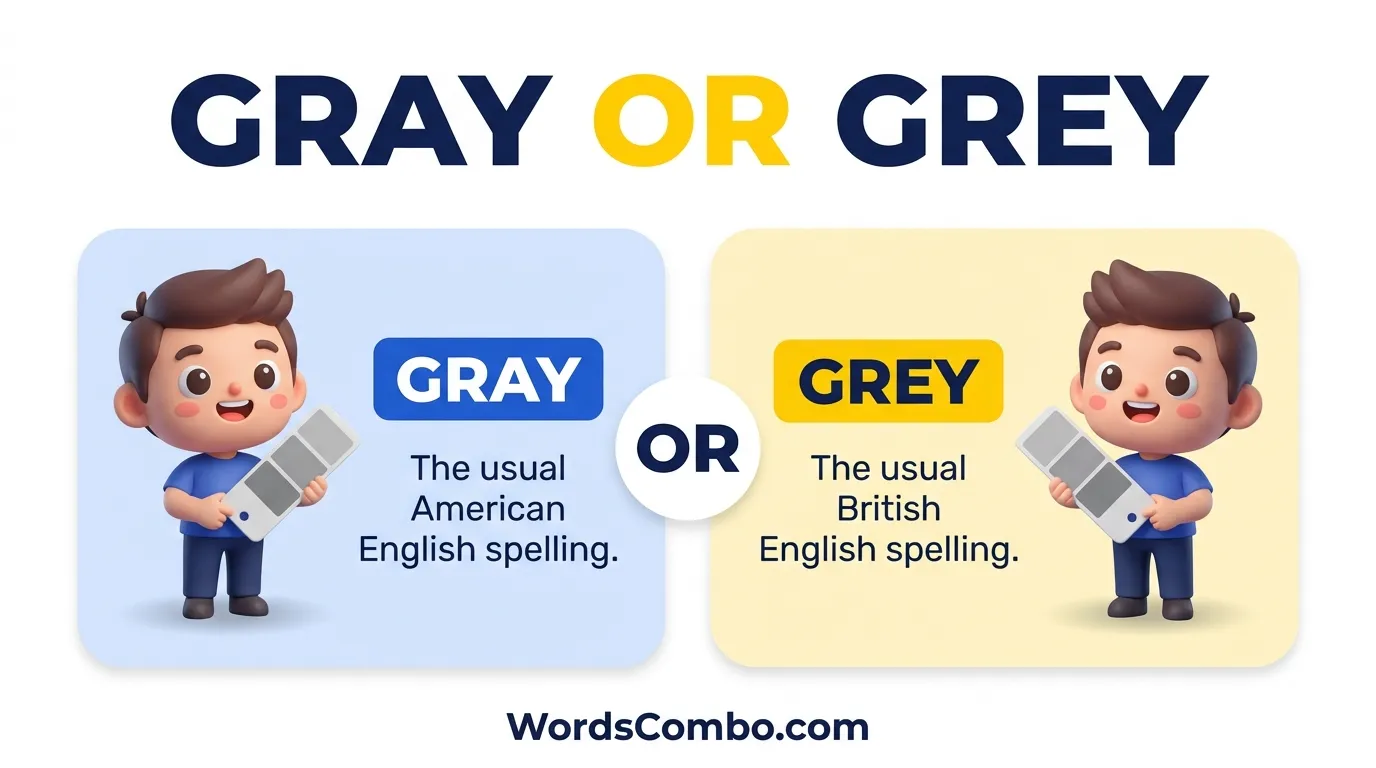
Both gray and grey are correct spellings of the same color. Gray is the standard spelling in American English, while grey is more common in British English.
You are writing an email and type “grey sky,” but your spelling checker suggests “gray sky.” Both words are correct, so which one should you use? The answer depends mainly on your audience and the type of English you are writing.
Although gray or grey can seem like a tricky choice, the difference is simple. American writers usually choose gray, while British writers often choose grey. Let’s look at the rules, examples, and common mistakes so you can choose with confidence.
Gray or Grey: Quick Answer
Both gray and grey describe a color between black and white. They have the same meaning and sound alike, but their spelling differs by region.
- Gray: The usual spelling in American English. Example: The gray cat slept on the sofa.
- Grey: The usual spelling in British English. Example: The grey cat slept on the sofa.
However, neither spelling is wrong. The best choice depends on the English style you follow.
The Origin of Gray and Grey
The words gray and grey have a long history in English. Both developed from older forms of the same color word, which came from Germanic languages.
Over time, different spellings became common in different places. American English settled mainly on gray, while British English kept grey as its more common form.
This difference is part of a wider pattern in English spelling. For example, Americans often write color, while British writers use colour. Similarly, American English favors center, whereas British English usually uses centre.
Even so, the meaning stays the same. The spelling changes with the region, not the color itself.
Gray or Grey Explained: Key Differences
The main difference between gray and grey is the spelling used in each region. Both words can work as a noun, an adjective, or a verb, depending on the sentence.
For example, you can use either spelling to describe a coat, a cloudy sky, or hair that has lost its color. However, American English usually uses gray, while British English usually uses grey.
What Does Gray Mean?
Gray is the standard American spelling for the color between black and white. It can describe objects, clothing, animals, weather, and hair.
For example, an American writer might say, “She bought a gray jacket for winter.” The same spelling also appears in phrases such as gray hair, gray clouds, and gray area.
What Does Grey Mean?
Grey has the same meaning as gray, but it is more common in British English. It appears in everyday writing across the UK and in other places that often follow British spelling.
For instance, a British writer might say, “She bought a grey jacket for winter.” Similarly, grey hair, grey clouds, and grey area are common forms.
Gray vs. Grey Comparison Table
| Term | Meaning | When to Use | Region/Context |
| Gray | Color between black and white | Standard US spelling | American English |
| Grey | The same color | Standard UK spelling | British English |
| Graying | Becoming gray | Standard form in US writing | American English |
| Greying | Becoming grey | Standard form in UK writing | British English |
| Grayish | Slightly gray | US spelling | American English |
| Greyish | Slightly grey | UK spelling | British English |
Although the spelling changes, the pronunciation and basic meaning remain the same. So, you do not need to learn two different definitions.
Which One Should You Use?
Your audience is the best guide when choosing between gray or grey. Both are accepted spellings, but one may fit your writing style better.
- For American readers: Use gray because it is the standard US spelling.
- For British readers: Use grey because it is the usual UK spelling.
- For school assignments: Follow the spelling style your teacher requests.
- For business writing: Match the English style used by your company or client.
- For websites and blogs: Choose one spelling style and use it throughout your content.
If you write for a US audience, gray is the safest choice. However, if your article targets British readers, grey will usually feel more natural.
Remember that consistency matters, too. A mix of both spellings can distract readers, even when every use is understandable.
Common Mistakes with Gray and Grey
Writers often mix up these spellings because both look right. However, a few simple rules can help you avoid common errors.
Mistake 1: Thinking Grey Is Always Wrong
Incorrect idea: “Grey is a misspelled word.”
Correction: Both gray and grey are correct.
The mistake happens when writers learn only the American spelling. However, British English commonly uses grey.
Mistake 2: Mixing Both Spellings in One Article
Inconsistent: “The gray clouds covered the grey sky.”
Better for US English: “The gray clouds covered the gray sky.”
Better for UK English: “The grey clouds covered the grey sky.”
Although the first sentence is easy to understand, choosing one spelling style makes your writing look more polished.
Mistake 3: Using Grey in American Writing Without a Reason
Less typical for US readers: “The walls are painted grey.”
Preferred US form: “The walls are painted gray.”
The first sentence is still understandable, but American readers are more used to gray. Therefore, use the local spelling when you want your writing to feel natural.
Mistake 4: Changing a Proper Name
Incorrect: Changing Earl Grey to Earl Gray when referring to the well-known tea.
Correct: Earl Grey tea.
Proper names keep their established spelling. For this reason, the normal regional rule does not apply to every name containing Gray or Grey.
Mistake 5: Changing Every Word That Contains Grey
Incorrect: Changing greyhound to grayhound in American writing.
Correct: Greyhound.
Some words have fixed spellings that do not follow the regional color rule. So, check the whole word instead of changing its letters automatically.
Gray or Grey in Real-World Examples
The easiest way to learn the difference is to see how each spelling works in everyday writing. These examples show how to use the words in common situations.
Professional Email
American English:
“Hello, the new office chairs will arrive in gray on Friday.”
British English:
“Hello, the new office chairs will arrive in grey on Friday.”
Both sentences are correct, but the spelling matches a different English style.
News Headline
American English:
“Gray Skies Expected Across the City This Weekend”
British English:
“Grey Skies Expected Across the City This Weekend”
News headlines often follow the spelling rules of their intended audience. Therefore, the same headline can use either form.
Social Media Post
American English:
“I love my new gray sweater because it goes with everything.”
British English:
“I love my new grey sweater because it goes with everything.”
The meaning stays the same, so the choice depends on your preferred spelling style.
Formal Document
American English:
“The building has gray walls and white doors.”
British English:
“The building has grey walls and white doors.”
Formal writing follows the same regional rule as everyday writing. However, if a company or school has a style guide, follow that guide first.
Gray or Grey: Data, Trends and Usage
People search for gray or grey because spelling checkers, books, websites, and everyday messages may show both forms. The question is especially common among English learners and writers who work with American and British English.
The search intent is mainly informational. Readers want to know which spelling is correct, whether the words have different meanings, and which form to use in formal writing.
For US-focused websites, gray is usually the better choice because it matches standard American spelling. Meanwhile, grey is useful when writing for a British audience.
One useful point is that regional spelling can affect more than the main word. Related forms often change, too, such as graying and greying. So, keeping one spelling style across your article helps readers follow your writing with ease.
Gray vs Grey: Comparison at a Glance
| Term/Variant | Meaning | Region/Context | Best Used When |
| Gray | A color between black and white | United States | Writing for American readers |
| Grey | The same color | United Kingdom | Writing for British readers |
| Gray area | An unclear situation | American English | Following US spelling |
| Grey area | An unclear situation | British English | Following UK spelling |
| Earl Grey | A type of tea | Fixed proper name | Referring to the named tea |
| Greyhound | A breed of dog | Fixed word | Naming the breed |
The simple rule is to use gray for American English and grey for British English. However, always keep established names and fixed spellings as they are.
Frequently Asked Questions
Is gray or grey the correct spelling?
Both gray and grey are correct spellings of the same color word. However, gray is standard in American English, while grey is more common in British English.
Is gray American or British English?
Gray is the standard American English spelling. In contrast, British English usually uses grey, so choose the spelling that matches your readers.
Is grey wrong in American English?
No, grey is a recognized spelling and is not automatically wrong in American English. Still, gray is the usual choice for US schoolwork, business writing, and websites.
Is it gray hair or grey hair?
Both forms are correct, but the preferred spelling depends on the region. Americans usually write gray hair, while British writers commonly use grey hair.
Why are gray and grey spelled differently?
Both spellings developed from older forms of the same word. Over time, gray became the main American form, while grey remained more common in British English.
Should I use gray or grey in formal writing?
Use gray for formal writing in American English and grey for formal writing in British English. If your workplace, school, or publisher has a style guide, follow its rules for consistency.
Is it grey area or gray area?
Both expressions are correct and describe a situation that is not clear or easy to judge. Use gray area in American English and grey area in British English.
Final Thoughts on Gray or Grey
The choice between gray or grey is easier than it may seem. Both spellings are correct, have the same basic meaning, and sound the same when spoken. The main difference is the type of English you use.
For American readers, choose gray. For British readers, choose grey. Also, keep your spelling consistent throughout emails, essays, articles, and other written work.
If you remember just one rule, remember this: gray has an A for America, while grey has an E for England. This simple trick can help you make the right choice quickly.
Now, check your next piece of writing and make sure your spelling matches your audience. With this small habit, you can write more clearly and confidently.
Curious about other confusing spellings? Explore Esthetician or Aesthetician to learn more.

I studied English literature and have spent years editing content for blogs and digital platforms. I noticed most people struggle with choosing between two similar words. At WordsCombo, I make that choice simple and clear.