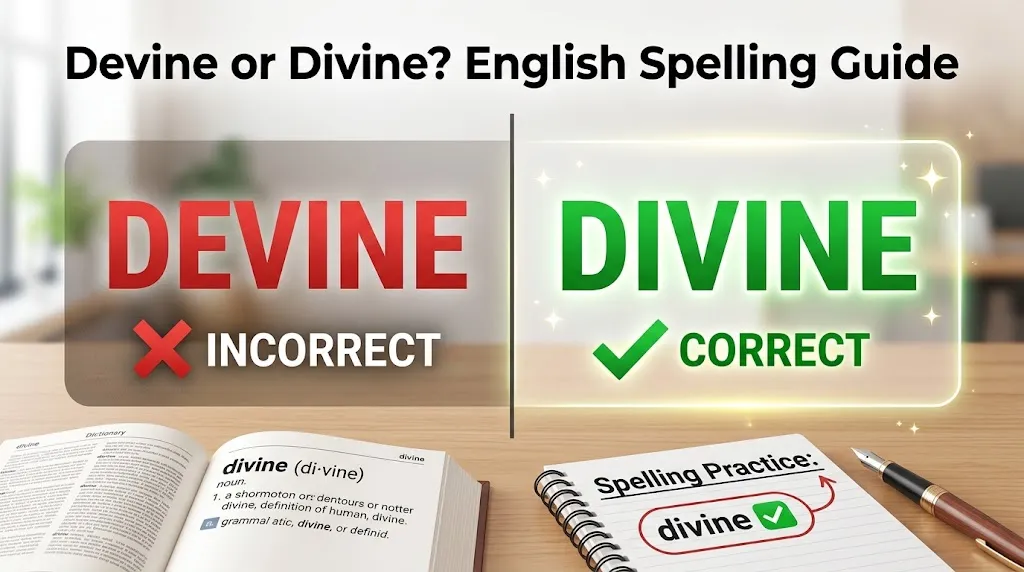
Divine is the correct spelling when you mean “related to God,” “holy,” or “wonderfully beautiful.” Devine is usually a proper name or surname, not the standard spelling of the adjective.
Have you ever typed a word, looked at it twice, and thought, “Wait… is that really how it is spelled?” Devine or divine is one of those small spelling choices that can make even confident writers stop.
I have seen this mistake many times when helping people improve everyday English. The confusion makes sense. Divine is pronounced in a way that can make the spelling feel less obvious. Add the letter e after the v, and devine can look perfectly believable.
But there is a simple rule that clears it up.
If you are describing something holy, godlike, heavenly, or exceptionally wonderful, you want divine. For example, you might say, “She has a divine voice,” or “They believe the message was of divine origin.”
Devine has a different role. It is mainly used as a surname or proper name.
Once you understand that difference, you will rarely mix these two forms again. Let’s make the distinction easy to remember.
Devine or Divine: Quick Answer
Divine is the standard English word.
It can describe something connected with God, a god, heaven, or a sacred power. It can also describe something that is extremely pleasant or beautiful.
Examples:
- “The priest spoke about divine wisdom.”
- “That chocolate cake was divine.”
Devine, with an e, is generally not the spelling you want for this meaning. It most often appears as a surname or proper name, such as the family name Devine.
So, if you are writing a normal English sentence, remember:
Divine = the word
Devine = usually a name
That one distinction solves most cases.
The Origin and Background of Divine
The word divine has a long history.
It comes from Latin divinus, meaning “of a god” or “godlike.” It later entered English through Old French and developed into the word we use today.
At its heart, divine has always been linked to the idea of a god, God, or something sacred.
Over time, its meaning grew wider. Today, you can use it in religious writing, everyday conversation, literature, and even food reviews.
For example:
- Religious: “They prayed for divine guidance.”
- Spiritual: “She felt a divine presence.”
- Literary: “The poet described the divine beauty of nature.”
- Informal: “The dessert was divine.”
The spelling devine can look natural because English has many words where the letters e and i create similar sounds.
There is also a simple visual reason for the mistake. The word define is common in English, and devine can feel like a similar pattern.
But divine is the standard spelling for the word meaning sacred, heavenly, or wonderful.
Divine Explained: Meaning, Uses, and Examples
Divine can work as an adjective, noun, and verb, although its adjective use is the one you will see most often.
1. Divine as an adjective
As an adjective, divine means connected with God or a god.
Example:
“The ancient people believed the king had divine authority.”
It can also mean heavenly, sacred, or godlike.
“They believed the message came from a divine source.”
There is another common meaning that has nothing directly to do with religion.
Divine can describe something that is extremely good, beautiful, or enjoyable.
“The restaurant served a divine chocolate dessert.”
Here, the speaker is not necessarily talking about religion. They are simply saying the dessert was exceptionally good.
2. Divine as a verb
Divine can also be a verb.
To divine something means to discover or guess something through intuition, insight, or careful thought.
Example:
“I tried to divine what she was thinking.”
This use is less common in casual conversation, but it appears in books and formal writing.
3. Divine as a noun
The noun form is less common. The Divine can refer to God or a divine being, especially in religious or philosophical writing.
Example:
“The philosopher wrote about the relationship between humanity and the Divine.”
Comparison at a Glance
| Term | Meaning | When to Use | Region/Context |
|---|---|---|---|
| Divine | Holy, godlike, heavenly, or extremely wonderful | Standard English writing and speech | All major varieties of English |
| Devine | Usually a surname or proper name | When referring to a person or name | Names and proper nouns |
| Divine | To discover or guess through insight | Literary or formal contexts | English generally |
Which Version Should You Use?
For most readers, the answer is very easy:
For students → Use divine
If you are writing an essay, homework, assignment, or exam answer, use divine when you mean sacred, heavenly, or wonderful.
Example:
“The poem describes the beauty of divine creation.”
For professional writers → Use divine
In emails, reports, articles, blogs, and business writing, divine is the correct choice when the meaning fits.
Example:
“The painting creates an almost divine sense of peace.”
For names → Use Devine when it is the actual name
If you are referring to someone whose surname is Devine, keep the spelling exactly as their name is written.
For example:
“Mr. Devine attended the meeting.”
Do not change someone’s surname to Divine simply because divine is the normal English word.
For neutral, everyday English → Choose divine
If you are unsure, ask yourself one question:
Am I describing something sacred, heavenly, or exceptionally good?
If the answer is yes, divine is almost certainly the word you need.
Common Mistakes With Devine and Divine
Small spelling errors often happen because the wrong version looks right. Here are the most common ones.
Mistake 1: Writing “devine” for something holy
❌ “The prophet received a devine message.”
✅ “The prophet received a divine message.”
Why?
The adjective meaning “from God” is divine.
Mistake 2: Using “devine” to describe excellent food
❌ “The cake was devine.”
✅ “The cake was divine.”
Why?
When divine means extremely good or delightful, it still has the same spelling.
Mistake 3: Assuming “Devine” is always wrong
❌ “Devine is never a correct spelling.”
✅ “Devine can be correct when it is a person’s name.”
Why?
A surname does not have to follow the spelling of a similar English word.
Mistake 4: Changing someone’s name
❌ “Ms. Divine spoke at the event.”
when her surname is actually Devine
✅ “Ms. Devine spoke at the event.”
Why?
Proper names should be written accurately.
Mistake 5: Confusing divine with define
❌ “Can you divine this word?”
If you mean “explain the meaning,” use:
✅ “Can you define this word?”
Divine and define are different words with different meanings.
Define means to explain or state the meaning of something.
Divine can mean holy, heavenly, wonderful, or to discover something through intuition.
Devine or Divine in Real-World Examples
Seeing the word in real situations makes the difference easier to remember.
1. Professional Email
“The team described the new design as divine and highly elegant.”
Here, divine is being used figuratively to mean extremely beautiful or impressive.
2. News Article
“The group gathered to discuss the role of divine inspiration in the artist’s work.”
This is a formal use connected with religion or spirituality.
3. Social Media Post
“Just tried the new dessert downtown. Absolutely divine! 🍰”
Here, divine means extremely delicious.
4. Formal Document
“The text refers to divine authority and moral responsibility.”
This is appropriate in academic, religious, or formal writing.
5. Using Devine as a Name
“Dr. Devine presented the research at the conference.”
Here, Devine is a surname. The capital D is important because it is a proper name.
Devine or Divine: Data, Trends & Usage
The search for devine or divine is mainly informational. People usually type the phrase because they are unsure which spelling is correct.
The strongest search intent is simple:
“Which spelling should I use?”
Related searches often center on:
- divine meaning
- devine meaning
- divine definition
- devine vs divine
- is devine a word?
- how do you spell divine?
- divine pronunciation
- divine meaning in English
This topic matters because spelling questions often happen while someone is already writing. They may be working on an essay, email, caption, article, or school assignment and need a fast answer.
There is also an important context difference.
Divine belongs to normal English vocabulary. Devine is much more likely to appear as a proper name.
That means context can solve the problem faster than memorizing a complicated spelling rule.
When you see the word in your own writing, ask:
Am I describing something, or am I naming someone?
If you are describing something sacred or wonderful, choose divine.
If you are writing someone’s surname, use their actual spelling.
Standalone Comparison: Devine vs Divine
| Term/Variant | Meaning | Region/Context | Best Used When |
|---|---|---|---|
| Divine | Holy or related to God | Standard English | Talking about God, heaven, spirituality, or sacred things |
| Divine | Extremely beautiful or enjoyable | Everyday English | Describing food, beauty, experiences, or feelings |
| Divine | Discover or guess through insight | Literary/formal English | Describing intuitive understanding |
| Devine | Usually a surname | Proper names | Referring to a person or family named Devine |
A Simple Memory Trick
If you often forget which spelling is correct, use this trick:
Divine = Divine power
Both ideas connect with divinity.
You can also remember:
God → divine
Person’s surname → Devine, if that is their name
Try not to create a complicated spelling rule. The meaning is more useful than memorizing letters.
When the sentence talks about something holy, heavenly, sacred, or amazing, write divine.
FAQ: Devine or Divine
Q: What does divine mean?
A: Divine can mean related to God, a god, heaven, or something sacred. It can also mean extremely beautiful, enjoyable, or wonderful.
Q: Is devine a correct English word?
A: Devine is not the standard spelling of the common adjective divine. However, Devine can be a valid surname or proper name.
Q: How do you use divine correctly?
A: Use divine when you mean holy, heavenly, godlike, or exceptionally wonderful. For example, “The food was divine” means the food was extremely good.
Q: Is divine acceptable in formal writing?
A: Yes. Divine is fully acceptable in formal writing when its meaning fits the context. It is common in religious, academic, literary, and historical writing.
Q: Which is correct, devine or divine?
A: Divine is correct when you mean sacred, heavenly, or wonderful. Devine is generally used as a surname or proper name.
Q: Where does the word divine come from?
A: Divine comes from Latin divinus, meaning “of a god” or “godlike.” It entered English through French and developed into its modern uses.
Q: Can divine describe food?
A: Yes. In informal English, divine can describe food that tastes exceptionally good. For example, “The chocolate cake was divine.”
Q: Is Devine the same as divine?
A: No. They can look similar, but they normally serve different purposes. Divine is a standard English word, while Devine is commonly found as a surname.
Q: Is divine the same as define?
A: No. Define means to explain the meaning of something. Divine can mean holy or heavenly, or it can mean to discover something through intuition.
Q: How can I remember the spelling of divine?
A: Connect divine with divinity. Both refer to the idea of God or something godlike. If you are talking about a person’s surname, check whether their name is spelled Devine.
Conclusion: Devine or Divine?
The difference between devine or divine is much easier once you focus on meaning.
Divine is the standard English word. Use it when you mean holy, sacred, heavenly, godlike, or exceptionally wonderful. You can also use it as a verb when you mean to discover or guess something through insight.
Devine is different. It is most often seen as a surname or proper name. So it can be correct, but only when the name itself is spelled that way.
The best rule to remember is simple:
Sacred or wonderful = divine.
A person’s surname = Devine, if that is their actual name.
You do not need to second-guess this pair every time you write it. Look at the meaning, check the context, and choose the form that fits.
Now you know exactly when to use divine and when Devine may be a name. Bookmark this guide so you never have to second-guess this spelling again.
Learn more: Artic or Arctic: The Complete Easy Guide

I started writing about English word differences after years of teaching students who kept making the same mistakes. My focus is on making spelling rules feel simple and easy to remember. At WordsCombo, I turn confusing word pairs into clear comparisons.











1 thought on “Devine or Divine: The Easy Way to Get It Right”