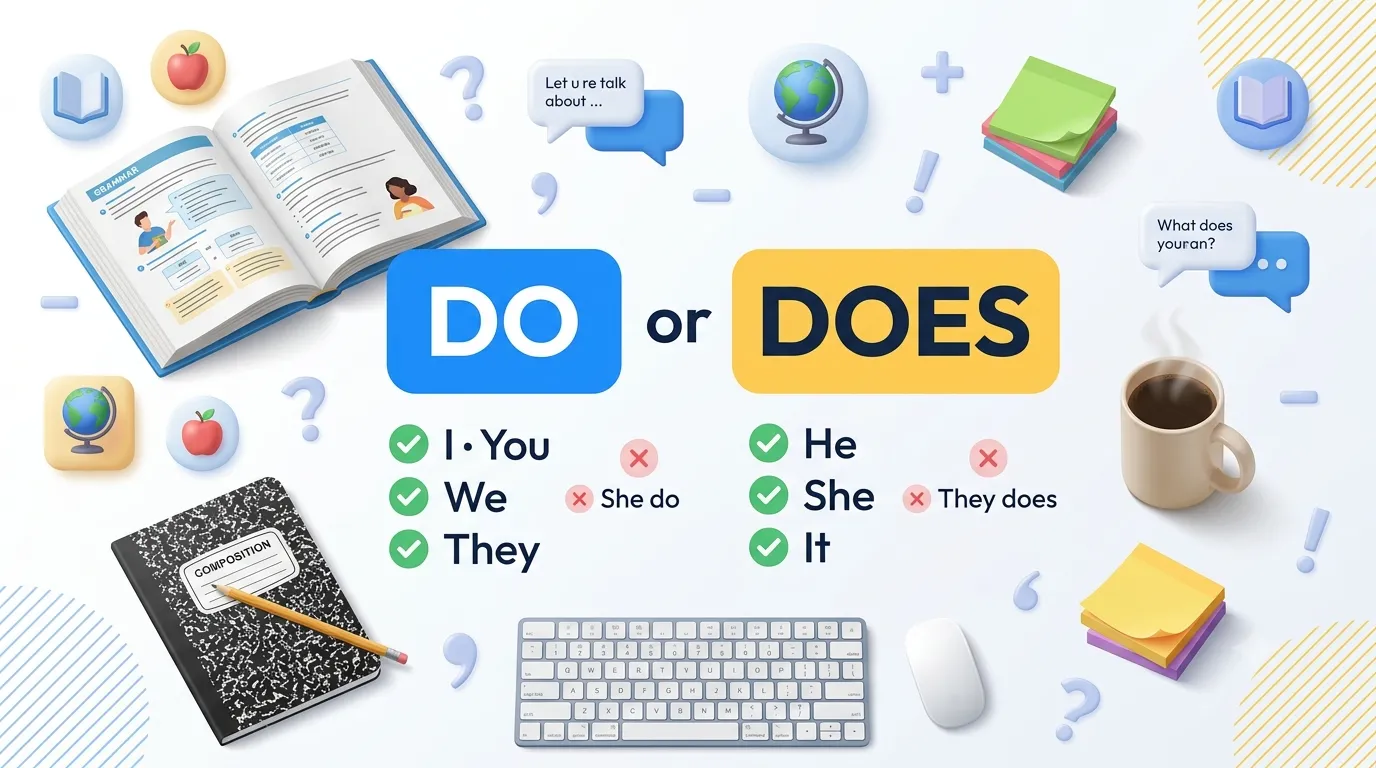
Do and does are forms of the verb “do.” Do is used with I, you, we, and they, while does is used with he, she, and it in the present tense.
I still remember helping a student who kept asking, “Why do we say She does but They do?” It seemed like a tiny grammar rule, yet it caused mistakes in almost every sentence they wrote. After explaining it with simple examples, the confusion disappeared in minutes.
If you have ever paused before writing do or does, you are not alone. Many English learners struggle with these two words because both come from the same verb but follow different grammar rules.
The good news is that the rule is simple once you understand it. You do not need to memorize long grammar charts. You only need to know which subject comes before the verb.
By the end of this guide, you will know when to use do and does, avoid common mistakes, and feel confident in everyday conversations, emails, schoolwork, and professional writing.
The Origin and Background of Do or Does
The verb do comes from the Old English word dōn, which meant to perform, make, or act.
Over time, English changed. Like many common verbs, do developed different forms depending on the subject.
That is why we now have:
- Do
- Does
- Did
- Done
- Doing
Many learners become confused because English changes the verb only for he, she, and it in the simple present tense.
For example:
- They do the work.
- She does the work.
The meaning stays the same. Only the verb changes.
Do or Does Explained: Key Differences
The biggest difference is the subject.
| Term | Meaning | When to Use | Region/Context |
|---|---|---|---|
| Do | Present tense of do | I, You, We, They | Standard English worldwide |
| Does | Present tense for third person singular | He, She, It | Standard English worldwide |
Examples
Do
- I do yoga.
- You do your homework.
- We do our best.
- They do the dishes.
Does
- He does the laundry.
- She does her work.
- It does look nice.
In Questions
- Do you like coffee?
- Do they play football?
- Does she live here?
- Does he speak English?
In Negative Sentences
- I do not understand.
- They do not agree.
- She does not know.
- He does not drive.
Notice something important.
After does, the main verb returns to its base form.
✅ She does play tennis.
❌ She does plays tennis.
Which Version Should You Use?
The correct choice depends on your subject.
For Beginners
Use do with:
- I
- You
- We
- They
For Third Person Singular
Use does with:
- He
- She
- It
For Professional Writing
Follow the same grammar rule. There are no special business exceptions.
For Global English
Both American and British English use these rules.
Quick tip:
If the subject is one person like he or she, choose does.
Otherwise, choose do.
Common Mistakes with Do or Does
Many learners make the same mistakes.
| Mistake | Correct Form | Why? |
|---|---|---|
| She do homework. | She does homework. | Third person singular needs does. |
| He doesn’t plays football. | He doesn’t play football. | Base verb follows doesn’t. |
| They does the work. | They do the work. | Plural subjects use do. |
| Does you know? | Do you know? | “You” always takes do. |
| It do not matter. | It does not matter. | “It” uses does. |
Why These Mistakes Happen
- Learners focus on the main verb.
- They forget the subject rule.
- They add an extra s after does.
Remember:
Only one verb changes.
Do or Does in Real World Examples
Professional Email
Does your team need any additional information before Friday’s meeting?
News Headline
Does climate change affect food prices?
Social Media Post
Who does love weekend coffee?
Formal Report
The company does meet all safety standards.
Everyday Conversation
- What do you think?
- Where does she work?
- Why do they leave early?
These examples show how naturally both words appear in daily English.
Do or Does: Data, Trends & Usage
Grammar questions about do and does are searched millions of times each year.
The topic is especially popular among:
- English learners
- School students
- IELTS candidates
- TOEFL test takers
- ESL teachers
- Parents helping children
Search Intent
Primary intent: Informational
People want a quick answer with clear examples.
Regions with High Interest
- India
- Pakistan
- Philippines
- United States
- United Kingdom
- Canada
Why It Matters Today
English is used in school, work, travel, and online communication. A simple grammar mistake can change how confident your writing sounds.
Learning do and does improves both speaking and writing immediately.
Comparison Table
| Term/Variant | Meaning | Region/Context | Best Used When |
|---|---|---|---|
| Do | Present tense verb | Worldwide | I, You, We, They |
| Does | Third person singular form | Worldwide | He, She, It |
| Did | Past tense | Worldwide | All subjects in the past |
| Doing | Present participle | Worldwide | Continuous tenses |
| Done | Past participle | Worldwide | Perfect tenses |
Frequently Asked Questions
Q: What does do or does mean?
A: Both are present tense forms of the verb do. They are used to talk about actions, ask questions, and make negative sentences.
Q: How do you use do and does correctly?
A: Use do with I, you, we, and they. Use does with he, she, and it.
Q: Do vs does what is the difference?
A: The only difference is the subject. Singular third person subjects use does, while all other present tense subjects use do.
Q: Is does acceptable in formal writing?
A: Yes. Does is standard English and is correct in academic, business, and professional writing.
Q: Which version is correct do or does?
A: Both are correct. Choose the one that matches the subject of your sentence.
Q: Where does do come from?
A: It comes from the Old English word dōn, meaning to perform or to act.
Q: Can do and does be used in questions?
A: Yes. They are commonly used to form questions, such as Do you understand? and Does she work here?
Conclusion
Learning do and does is easier than it first appears. The rule stays the same every time. Use do with I, you, we, and they. Use does with he, she, and it. Remember that after does, the main verb always returns to its base form.
Practice with simple sentences each day. Read English books, listen to conversations, and notice how native speakers use these words. The more examples you see, the more natural the rule becomes.
Small grammar improvements like this make your writing clearer and your speaking more confident. Whether you are preparing for an exam, writing an email, or chatting with friends, choosing the correct form helps you communicate with ease.
Now you know exactly how to use do and does—try using both in your next conversation or piece of writing. Bookmark this guide so you never second guess them again, and share it with someone who still gets confused.

I have a background in academic writing and spent several years as a proofreader for digital publications. Spotting differences between easily confused words became second nature to me. At WordsCombo, I share that knowledge so readers can write with confidence.