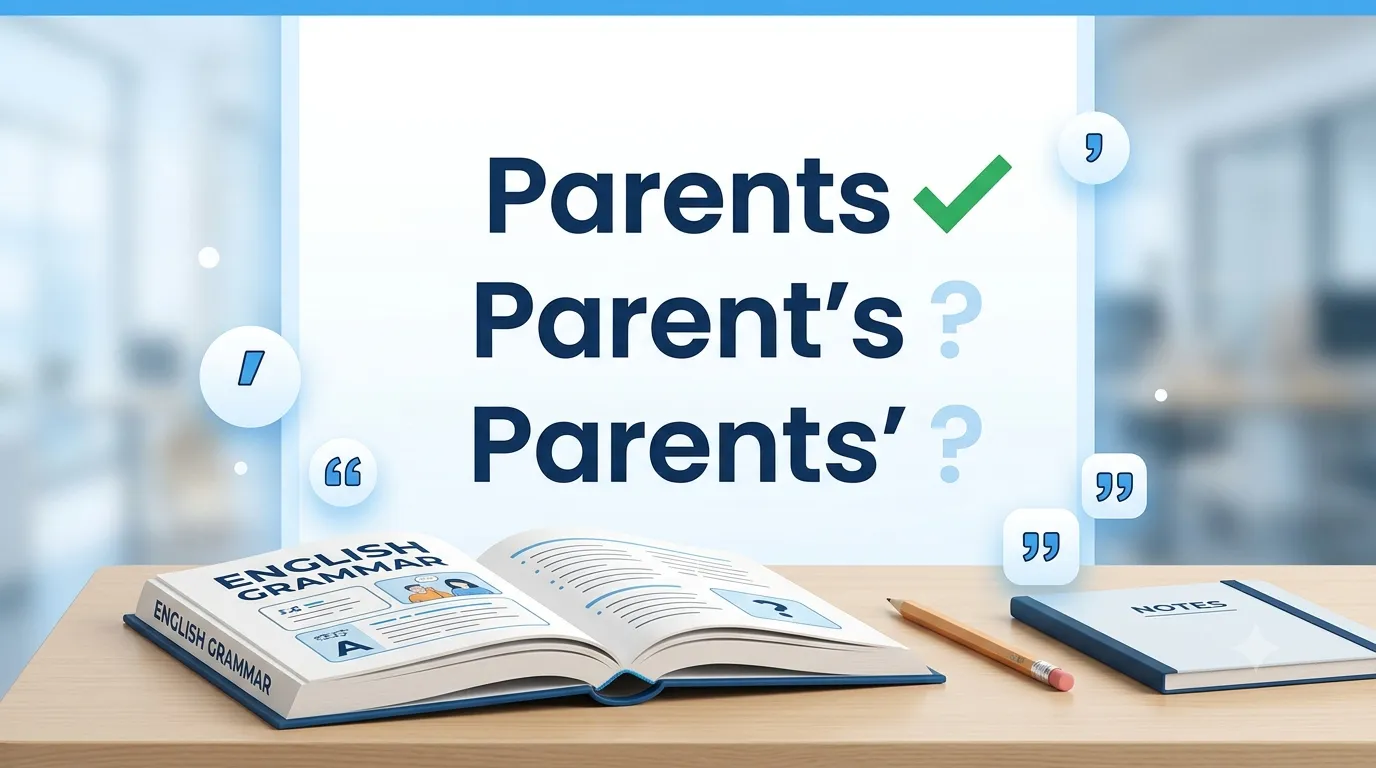
Parents is the plural form of parent. It means two or more parents. Parent’s is the singular possessive form, which shows that one parent owns or has something. Choosing the correct form depends on whether you mean more than one parent or something that belongs to one parent.
A few years ago, I was proofreading a school newsletter when I noticed a headline that read, “Parent’s Meeting Next Friday.” At first glance, it looked fine. Then I realized the meeting was for all parents, not just one. One tiny apostrophe had completely changed the meaning.
That simple mistake is more common than you might think. Students, teachers, business owners, and even experienced writers often pause when deciding between parents and parent’s. Apostrophes can be confusing because they sometimes show possession and sometimes do not belong at all.
If you’ve ever wondered which version is correct, you’re in the right place. By the end of this guide, you’ll know exactly when to use parents, parent’s, and even parents’. You’ll also see real-life examples, learn the grammar behind each word, and avoid the mistakes that trip up many writers.
Let’s clear up the confusion once and for all.
Parents or Parent’s: Quick Answer
The answer depends on what you want to say.
- Parents = more than one parent.
- Parent’s = something belongs to one parent.
- Parents’ = something belongs to two or more parents.
Examples
✅ My parents live in Chicago.
✅ The parent’s signature is required on the form.
✅ The parents’ meeting starts at 6 p.m.
A simple way to remember it is this:
- No apostrophe → Just talking about more than one parent.
- Apostrophe before “s” → One parent owns something.
- Apostrophe after “s” → Several parents own or share something.
The Origin and Background of “Parent”
The word parent comes from the Latin word parens, which means one who gives birth, raises, or cares for another person. Over time, it entered English through Old French and became the word we use today.
The grammar rules around parents and parent’s did not come from the word itself. They come from English punctuation rules.
Here’s why people get confused:
- Many English words add ‘s to show possession.
- Most plural nouns simply add s.
- When a plural noun already ends in s, the apostrophe moves to the end.
Because these rules look so similar, many writers add an apostrophe where it doesn’t belong.
For example:
❌ My parent’s are visiting.
The writer wanted the plural form but accidentally used the possessive.
The correct sentence is:
✅ My parents are visiting.
Understanding this basic rule makes writing much easier.
Parents or Parent’s Explained: Key Differences
Although these words look almost identical, they have different meanings.
| Term | Meaning | When to Use | Region/Context |
|---|---|---|---|
| Parents | More than one parent | Talking about two or more parents | Standard English worldwide |
| Parent’s | Belonging to one parent | Showing possession by one parent | Formal and informal writing |
| Parents’ | Belonging to multiple parents | Showing possession by several parents | Standard English worldwide |
Parents
Use parents when you’re simply referring to a mother and father or any group of parents.
Examples:
- My parents love gardening.
- The parents waited outside the classroom.
- Many parents attended the concert.
Notice that nothing belongs to them in these examples. You’re simply talking about people.
Parent’s
Use parent’s when one parent owns, has, or is responsible for something.
Examples:
- The parent’s phone rang.
- I read the parent’s email.
- The parent’s opinion mattered.
Ask yourself:
Does something belong to one parent?
If yes, use parent’s.
Parents’
Use parents’ when something belongs to more than one parent.
Examples:
- The parents’ lounge is upstairs.
- The parents’ feedback helped improve the program.
- The parents’ meeting begins at noon.
Think of it this way:
One parent = parent’s
Many parents = parents’
A Quick Trick to Remember
Ask one simple question:
“Am I talking about ownership?”
If the answer is no, use parents.
If the answer is yes, ask another question:
- One parent owns it? → parent’s
- Several parents own it? → parents’
This quick check prevents most mistakes.
Which Version Should You Use?
The best choice depends on your audience and what you’re trying to say.
For Students
Use the grammar rule first.
- Talking about more than one parent? Use parents.
- Talking about one parent’s belongings? Use parent’s.
- Talking about several parents’ belongings? Use parents’.
This approach works well in school assignments and exams.
For Teachers
Teachers often write notices, newsletters, and classroom updates.
Examples:
✅ Parents are welcome to attend the event.
✅ Each parent’s signature is required.
✅ The parents’ meeting has been rescheduled.
Using the correct form helps students learn proper grammar through real examples.
For Business Professionals
Businesses regularly communicate with families, schools, and customers.
Correct usage makes your writing look polished and professional.
For example:
- Parents receive free admission.
- The parent’s request was approved.
- The parents’ concerns were addressed during the meeting.
Clear grammar builds trust and reduces confusion.
For Content Writers and Bloggers
If you create online content, choosing the right word also helps with readability.
Use parents when your article speaks to families in general.
Use parent’s only when discussing one parent’s experience or opinion.
Use parents’ when describing something shared by many parents, such as:
- Parents’ guide
- Parents’ handbook
- Parents’ rights
Correct grammar improves both user experience and credibility.
Standalone Comparison Table
| Term/Variant | Meaning | Region/Context | Best Used When |
|---|---|---|---|
| Parents | Two or more parents | Global English | Referring to multiple parents without showing ownership |
| Parent’s | Something belongs to one parent | Global English | Showing possession by a single parent |
| Parents’ | Something belongs to several parents | Global English | Showing shared ownership or responsibility among multiple parents |
Common Mistakes with Parents and Parent’s
Even native English speakers mix these words up. The good news is that the mistakes are easy to fix once you know the rule.
| Mistake | Correct | Why It Happens |
|---|---|---|
| ❌ My parent’s are here. | ✅ My parents are here. | The writer wanted the plural form, not possession. |
| ❌ All parent’s must attend. | ✅ All parents must attend. | An apostrophe is not used to make a noun plural. |
| ❌ The parents meeting starts at 6. | ✅ The parents’ meeting starts at 6. | The meeting belongs to or is for all parents. |
| ❌ Every parents’ opinion matters. | ✅ Every parent’s opinion matters. | “Every” refers to one parent at a time. |
| ❌ The parents’s room is upstairs. | ✅ The parents’ room is upstairs. | Never add another s after a plural possessive. |
How to Avoid These Errors
Before you write, ask yourself these questions:
- Am I talking about more than one parent?
- Yes → parents
- Does something belong to one parent?
- Yes → parent’s
- Does something belong to several parents?
- Yes → parents’
That quick check takes only a few seconds and helps you avoid most grammar mistakes.
Parents or Parent’s in Real World Examples
Seeing these words in everyday writing makes the difference much easier to remember.
Professional Email
Dear Parents,
We are happy to invite you to our annual school event.
Each parent’s signature is required on the permission form before Friday.
Thank you for your support.
News Headline
Parents’ concerns grow as schools announce new safety rules.
Here, the concerns belong to many parents, so parents’ is correct.
Social Media Post
Huge thanks to all the parents who volunteered today. Your help made the event a success!
This sentence simply refers to a group of parents.
Formal Report
The parents’ feedback showed high satisfaction with the new education program.
The feedback came from many parents, so the plural possessive is needed.
Everyday Conversation
- “My parents are visiting this weekend.”
- “The parent’s car is parked outside.”
- “The parents’ meeting starts after lunch.”
These examples show how each form naturally fits a different situation.
Parents or Parent’s: Data, Trends & Usage
Many people search for “Parents or Parent’s” because apostrophes are one of the most confusing parts of English grammar.
Search Intent
- Primary Intent: Informational
- Secondary Intent: Educational
- Audience:
- Students
- Teachers
- Parents
- Bloggers
- Business writers
- English learners
Where Is This Topic Popular?
Questions about apostrophes are searched worldwide, especially in countries where English is widely spoken or taught, including:
- United States
- United Kingdom
- Canada
- Australia
- India
- Pakistan
Why Does This Matter Today?
People write more emails, social media posts, school notices, and business documents than ever before. A misplaced apostrophe can make writing look careless or even change the meaning of a sentence.
Learning this simple grammar rule helps you write with confidence in both personal and professional situations.
Standalone Comparison Table
| Term/Variant | Meaning | Region/Context | Best Used When |
|---|---|---|---|
| Parents | More than one parent | Standard English | Talking about two or more parents |
| Parent’s | Belonging to one parent | Standard English | Showing ownership by one parent |
| Parents’ | Belonging to multiple parents | Standard English | Showing ownership by several parents |
Frequently Asked Questions
Q: What does “parents” mean?
A: Parents is the plural form of parent. It refers to two or more parents and does not show ownership.
Q: How do you use “parent’s” correctly?
A: Use parent’s when something belongs to one parent. For example, The parent’s signature is required.
Q: What’s the difference between “parents” and “parent’s”?
A: Parents simply means more than one parent. Parent’s means something belongs to one parent.
Q: Is “parent’s” acceptable in formal writing?
A: Yes. It is completely correct in formal writing when it shows possession by one parent.
Q: Which is correct: “parents” or “parent’s”?
A: Both are correct. The right choice depends on your meaning. Use parents for the plural noun and parent’s for the singular possessive.
Q: Where does the word “parent” come from?
A: The word comes from the Latin parens, meaning someone who gives birth to or raises a child. English later adopted the word and its modern grammar rules.
Q: Can I use “parents'” in school notices?
A: Yes. In fact, parents’ is often the correct choice because many school events, meetings, and guides are meant for all parents.
Conclusion
A single apostrophe may seem like a tiny detail, but it can completely change the meaning of a sentence. That’s why understanding the difference between parents, parent’s, and parents’ is so valuable.
Here are the key points to remember:
- Parents means two or more parents.
- Parent’s shows that one parent owns or has something.
- Parents’ shows that something belongs to multiple parents.
Whenever you’re unsure, pause and ask yourself one simple question: Am I talking about more than one parent, or am I showing ownership? The answer will guide you to the correct choice every time.
With a little practice, these forms become second nature. You’ll write more clearly, avoid common grammar mistakes, and feel more confident in emails, school assignments, blog posts, and professional documents.
Now you know exactly how to use parents, parent’s, and parents’ correctly. Bookmark this guide so you never second-guess these words again, and share it with someone who could use a quick grammar refresher.

I have a background in academic writing and spent several years as a proofreader for digital publications. Spotting differences between easily confused words became second nature to me. At WordsCombo, I share that knowledge so readers can write with confidence.