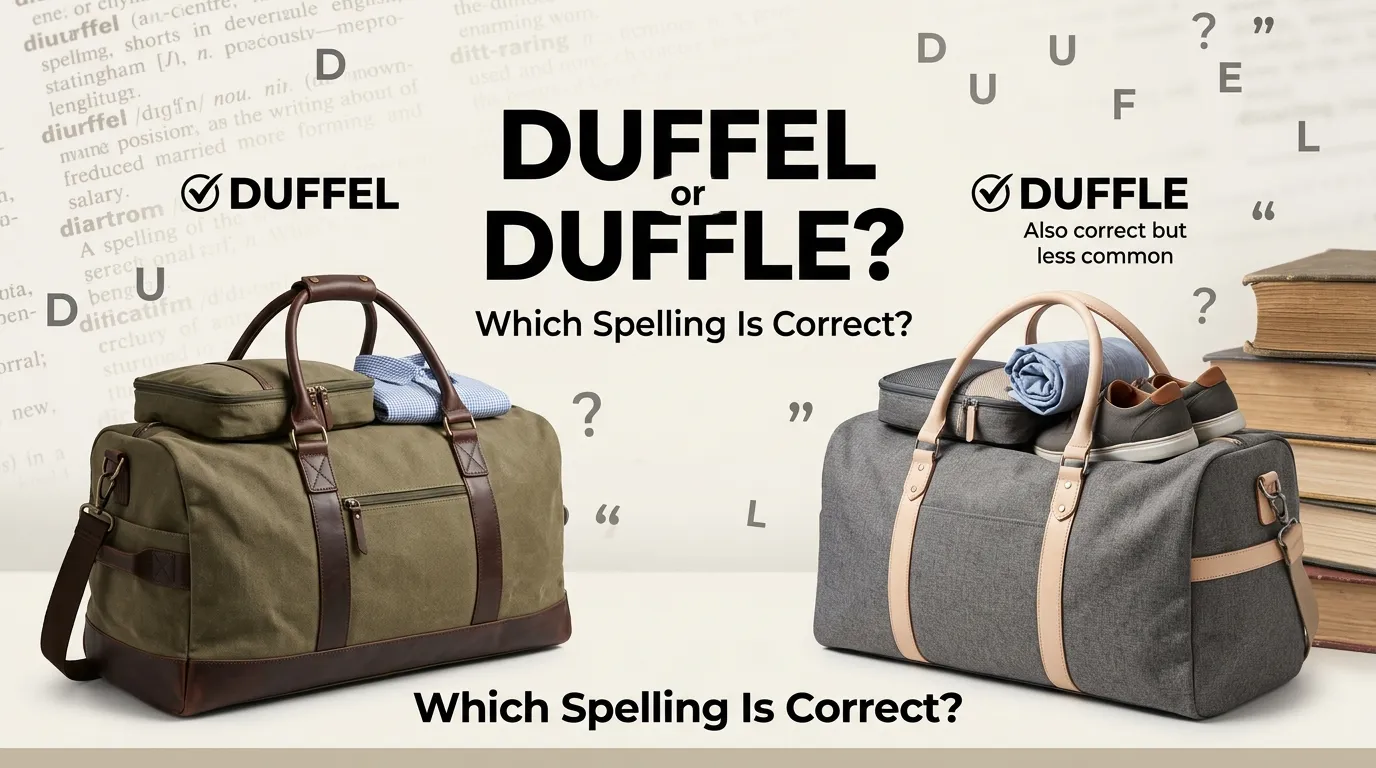
Duffel or duffle can both be correct spellings for the same type of soft travel bag. Duffel is the safer choice for modern, standard English, while duffle is an accepted variant.
Have you ever typed duffel bag, stopped, and wondered if there should be an extra “l” instead?
You are not alone. This is a small spelling question, but it causes a surprising amount of confusion. You may see duffel bag on one website and duffle bag on another. Both look natural. Both are used by real writers. Even major dictionaries list duffle as a variant of duffel.
The confusion becomes even stronger when you move between countries. British English may use holdall for the same general type of travel bag, while North American English commonly uses duffel bag.
So which spelling should you choose?
If you want one simple rule, use duffel. It is clear, widely recognized, and a strong choice for school, work, websites, and general writing.
But there is more to the story. The word has a fascinating link to a town in Belgium, and duffle is not simply a spelling mistake.
Let’s clear up the difference once and for all.
Duffel or Duffle
Duffel and duffle have the same basic meaning when they refer to a bag.
A duffel bag is a large, soft bag used to carry clothes, sports gear, camping supplies, or other personal items. It is often made from canvas or another strong fabric. Oxford lists duffle bag as an alternative form.
For example:
- I packed my clothes in a duffel bag.
- She bought a new duffle bag for the gym.
Both sentences are understandable, and both spellings are accepted.
The key difference is usage preference, not meaning.
If you are unsure which one to write, choose duffel.
The Origin and Background of Duffel
The story behind duffel starts in Belgium.
The word comes from Duffel, a town in Belgium near Antwerp. The town became associated with a thick, coarse woolen cloth. That cloth was known as duffel. Merriam Webster traces the English word to Dutch duffel, from Duffel, Belgium.
Over time, the word moved from describing the fabric to describing things made from it.
It became linked with clothing, equipment, and eventually the familiar duffel bag.
Merriam Webster also records older meanings connected with heavy woolen material and personal equipment.
That history helps explain why the word can mean more than just a bag.
You may see:
- duffel bag
- duffel coat
- duffel cloth
- duffel meaning personal equipment or supplies
The spelling duffle developed as a recognized variant. Major dictionaries such as American Heritage and Collins list duffel or duffle.
So if you write duffle, you are not automatically making a spelling error.
Duffel or Duffle Explained: Key Differences
The most important point is simple: there is usually no difference in the object itself.
A duffel bag and a duffle bag are normally the same kind of bag.
The difference is mainly the spelling and the context in which you see it.
| Term | Meaning | When to Use | Region/Context |
|---|---|---|---|
| duffel | A large soft travel or gear bag | Best general choice | Common in North American English and global writing |
| duffle | Variant spelling of duffel | Fine when matching an existing name or style | Used in British and other English contexts |
| duffel bag | A soft, roomy travel or gear bag | Travel, sports, camping, military use | Very common |
| duffle bag | Same basic type of bag | Retail, casual writing, product names | Accepted variant |
| holdall | A large travel bag | Travel and everyday use | Common in British English |
Oxford specifically lists duffel bag, with duffle bag as an alternative. It also identifies holdall as the British English term for the larger travel bag sense.
Example: Travel
I packed my shoes and clothes into a duffel bag.
Here, duffel is the safest choice.
Example: Product Name
A company might call its product a duffle bag.
If that is the official product name, keep the brand’s spelling. You do not need to “correct” it.
Example: British English
A British writer may choose holdall instead.
That does not mean duffel is wrong. It simply reflects a different regional preference.
Which Version Should You Use?
Here is the practical answer.
For students
Use duffel.
It is a clear and standard choice for essays, assignments, and general English writing.
Example:
I carried my clothes in a large duffel bag.
For bloggers and website writers
Use duffel as your main spelling.
It is widely recognized and works well for readers in different English speaking markets.
If your article targets a specific brand or product that uses duffle, keep that spelling where needed.
For businesses
Follow your brand or product name.
If your product is officially called a “Duffle Bag,” changing it to “Duffel Bag” may create inconsistency.
Use the customer’s search language naturally, but keep official names unchanged.
For formal writing
Choose duffel unless there is a good reason to use the variant.
It is easy to understand and supported by major dictionaries. Merriam Webster and American Heritage both recognize duffel, with duffle as a variant.
For global English
Duffel is the best default.
It gives readers the clearest and most widely recognized form.
Common Mistakes with Duffel or Duffle
1. Thinking “duffle” is always wrong
Mistake:
Duffle is an incorrect spelling.
Correction:
Duffle is an accepted variant of duffel.
Both dictionaries and real world usage support the variant.
2. Mixing spellings without a reason
Mistake:
We sell duffel bags and duffle bags. Our duffel bags are made from canvas.
This may look inconsistent if you are talking about the same product type.
Better:
We sell duffel bags. Our bags are made from strong canvas.
Pick one form and stay consistent.
3. Assuming the spelling changes the meaning
Mistake:
A duffle bag must be different from a duffel bag.
Correction:
In normal use, they mean the same type of bag.
The spelling does not normally tell you anything about the bag’s size, material, or design.
4. Confusing “duffel” with “holdall”
These terms can overlap, but regional use differs.
Duffel bag is common in North American English.
Holdall is common in British English for a large travel bag.
5. Treating SEO spelling as a grammar rule
Search engines and readers may see both forms.
That does not mean you should force both into every paragraph.
Write naturally. Use duffel as your main form and mention duffle where it helps answer the reader’s question.
Duffel or Duffle in Real World Examples
The best way to understand a spelling choice is to see it in action.
Professional Email
Subject: Weekend Equipment
Please bring your duffel bag with your clothes and personal items.
For professional writing, duffel is a clean and safe choice.
News Headline
Traveler Finds Missing Passport Inside Old Duffel Bag
News writing often favors familiar, direct wording.
Social Media Post
New duffel bag packed and ready for the weekend. ✈️
Social posts are more relaxed, so either spelling may appear.
Formal Report
Each participant was asked to carry essential equipment in a duffel bag.
Here, duffel sounds natural and professional.
Product Description
This lightweight duffle bag has a padded shoulder strap and several storage pockets.
If the product or brand uses duffle, keeping that spelling is perfectly reasonable.
Duffel or Duffle: Data, Trends & Usage
The search intent behind duffel or duffle is mainly informational.
People are usually not asking which bag to buy. They want to know:
- Which spelling is correct?
- Is duffle a mistake?
- Is there a difference between duffel and duffle?
- Which form should I use in writing?
- Where did the word come from?
That makes this a classic spelling and language intent query.
There is one useful point about search data: Google Trends treats spelling variations as separate search terms. Its own guidance says spelling variants and misspellings are not automatically combined in a normal term comparison.
So claims such as “duffel gets exactly X% more searches than duffle” should be treated carefully unless the underlying Trends settings and time period are shown.
What is clear from dictionary usage is that duffel is a strong standard form, while duffle is an accepted variant. Oxford, Merriam Webster, American Heritage, and Collins all support this broader picture.
This matters for writers because you do not need to fear the alternative spelling. You simply need to choose one form and use it consistently.
Duffel vs Duffle: Standalone Comparison
| Term/Variant | Meaning | Region/Context | Best Used When |
|---|---|---|---|
| Duffel | Soft travel or gear bag; also related to cloth/equipment | Broad English use | You want the safest general spelling |
| Duffle | Variant of duffel | British and other English contexts | A brand, source, or local style uses it |
| Duffel bag | Large soft sided bag | Travel, sports, camping, military | General writing |
| Duffle bag | Same basic bag | Casual and retail usage | Matching a product or existing wording |
| Holdall | Large travel bag | Mainly British English | Writing for a British audience |
| Duffle coat | Heavy hooded coat | British and fashion contexts | Referring specifically to the coat |
FAQ: Duffel or Duffle
Q: What does duffel mean?
A: Duffel can refer to a heavy woolen cloth, personal equipment, or a duffel bag. Today, many people mainly know it as the name of a large soft travel or gear bag.
Q: How do you use duffel correctly?
A: Use duffel when talking about the bag or related equipment. For example: “I packed my clothes in a duffel bag.”
Q: Duffel vs duffle: what is the difference?
A: In most cases, there is no difference in meaning. Duffle is an accepted variant spelling of duffel.
Q: Is duffel acceptable in formal writing?
A: Yes. Duffel is fully acceptable in formal writing when the word fits the context. It is also listed by major dictionaries.
Q: Which version is correct: duffel or duffle?
A: Both are correct, but duffel is the better default choice if you are unsure. Use duffle when matching a brand name, source, or preferred style.
Q: Where does the word duffel come from?
A: It comes from Duffel, a town in Belgium. The town was associated with a thick woolen cloth, and the name became an English word for the material and later related equipment.
Q: Can duffel be used for a gym bag?
A: Yes. A duffel bag can be used for gym clothes, sports equipment, travel items, or camping gear. The word describes the bag style, not one specific activity.
Q: Is duffle bag a spelling mistake?
A: No. Duffle bag is an accepted variant of duffel bag. Still, duffel bag is a strong choice when you want a standard form for general writing.
Conclusion
The good news is that you do not need to second guess this word anymore.
Duffel and duffle are both used for the same basic type of bag. Duffle is not simply a typo. Major dictionaries recognize it as a variant.
Still, if you need one spelling, choose duffel.
It is a strong option for:
- School assignments
- Professional writing
- Blog posts
- General websites
- Travel content
- Global English
The word itself has an interesting history. It comes from Duffel in Belgium, a place linked to the heavy cloth that gave the word its name.
And when you see duffle, do not assume someone made a mistake. It is simply another accepted form.
So the easy rule is this: use duffel when you want the safest general choice, and use duffle when context or a brand calls for it.
Now you know exactly how to use duffel or duffle. Bookmark this guide so you never have to second guess the spelling again.
Read more: Till or Til: The Complete Guide to Correct Usage

I started writing about English word differences after years of teaching students who kept making the same mistakes. My focus is on making spelling rules feel simple and easy to remember. At WordsCombo, I turn confusing word pairs into clear comparisons.