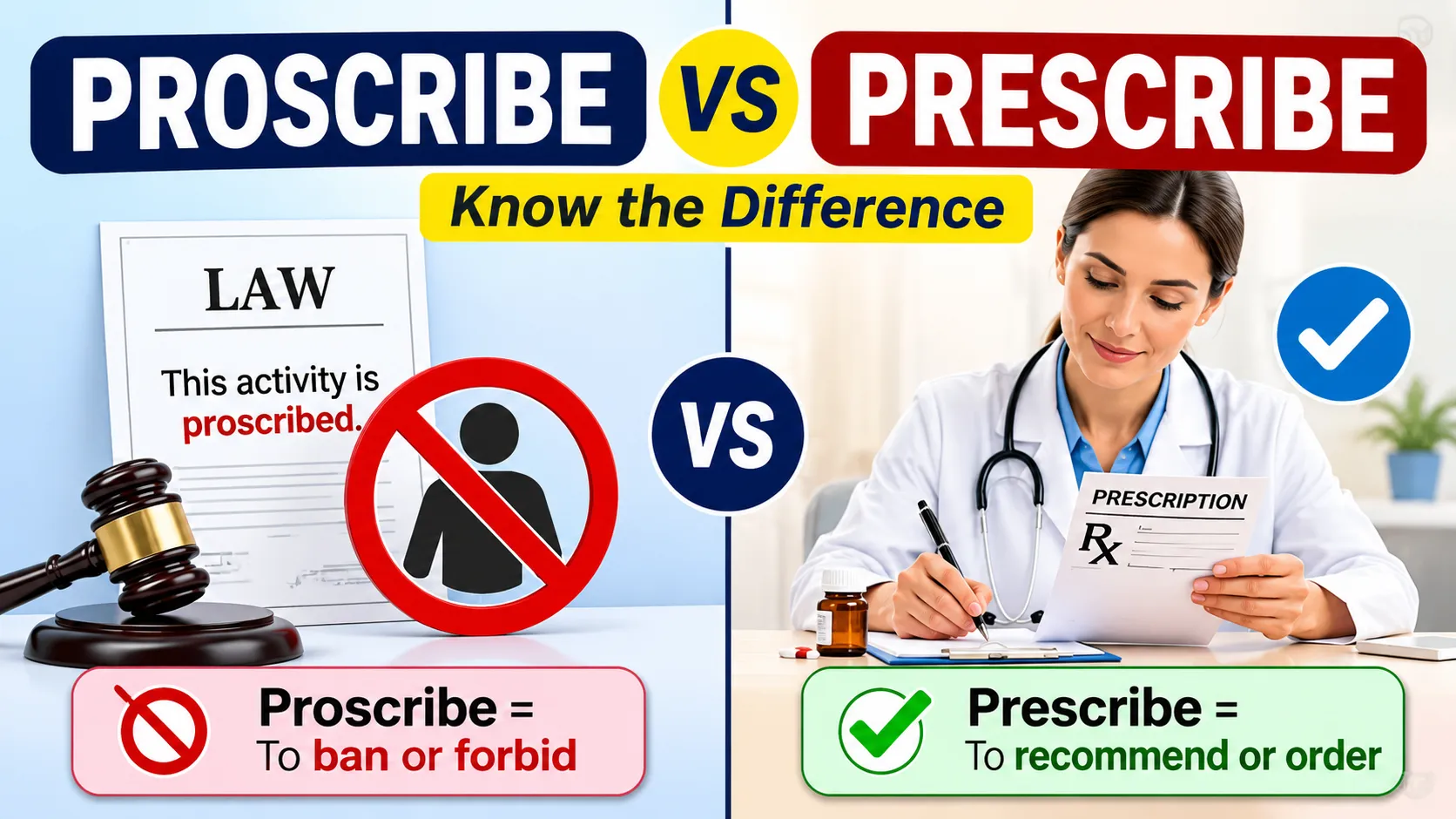
Proscribe or prescribe depends on the meaning you need. Prescribe means to officially recommend, order, or set a rule, while proscribe means to officially ban or forbid something.
Have you ever written a sentence, stopped, and wondered, “Is it proscribe or prescribe?”
You are not alone. These two verbs look almost the same. They also sound similar. Yet their meanings point in opposite directions.
A doctor prescribes medicine. A law may proscribe an activity. A school may prescribe a set of rules. A government may proscribe an organization.
One small letter can change the meaning of the whole sentence.
This is a common problem for English learners, students, writers, and even native speakers. The words share a Latin root and have a long history in formal English. That makes them easy to mix up.
The good news is that you only need one simple idea to remember the difference:
Prescribe = tell someone what to do. Proscribe = say what must not be done.
Once you see that pattern, the choice becomes much easier. Let’s break it down with clear examples, useful memory tricks, common mistakes, and real world sentences.
Proscribe or Prescribe
The difference is simple:
- Prescribe means to recommend, order, or set something as a rule.
- Proscribe means to ban, forbid, or officially reject something.
Examples
Prescribe:
The doctor prescribed antibiotics for the infection.
The doctor told the patient what medicine to take.
Proscribe:
The law proscribes the use of certain substances.
The law says that their use is not allowed.
A quick memory trick can help:
Prescribe = positive instruction.
Proscribe = prohibition.
The meanings are not exact opposites in every situation, but this shortcut works well for everyday writing.
Oxford defines proscribe as formally saying that something is banned. It defines prescribe as telling someone what to do, including giving medical treatment or setting an official rule.
The Origin and Background of Proscribe or Prescribe
The confusion between these words is not surprising. Both come from Latin verbs built around scribere, meaning “to write.”
Proscribe comes from Latin proscribere. It originally had the sense of making something public in writing, and later developed the meaning of outlawing or banning something.
Prescribe comes from Latin praescribere. Its history is linked to the idea of writing or setting something down in advance. Over time, it gained meanings connected with giving instructions, setting rules, and ordering medical treatment.
That shared history helps explain why the words look so similar.
But modern English gives them very different jobs.
Think of them this way:
- Prescribe: “Here is what you should do.”
- Proscribe: “Here is what you must not do.”
This distinction appears in medicine, law, government, education, business, and formal writing.
Proscribe or Prescribe Explained: Key Differences
Here is the easiest way to compare them:
| Term | Meaning | When to Use | Region/Context |
|---|---|---|---|
| Prescribe | Recommend, order, or set a rule | Medicine, rules, procedures | Standard English |
| Proscribe | Officially ban or forbid | Law, policy, government | Formal English |
| Prescription | A doctor’s written order or a recommended plan | Medicine or formal discussion | Standard English |
| Proscription | An official ban | Law, policy, formal writing | Formal English |
1. Prescribe means “tell what should happen”
Doctors often prescribe medicine.
The doctor prescribed a new treatment.
But medicine is only one use.
Rules and authorities can also prescribe actions.
The company policy prescribes a clear process for handling complaints.
Here, the policy tells people what they should do.
Oxford also gives examples where regulations prescribe how something should be done.
2. Proscribe means “say that something is forbidden”
Proscribe is much closer to ban, forbid, or outlaw.
The government proscribed the organization.
This means the organization was officially banned.
Another example:
The rules proscribe the use of personal devices during the exam.
The rules do not recommend an action. They forbid one.
Oxford lists proscribe as a formal verb meaning to officially say that something is banned.
The fastest memory trick
Ask yourself:
Does the sentence tell someone what to do?
Use prescribe.
Does it say something is not allowed?
Use proscribe.
Which Version Should You Use?
Your choice depends on the message you want to express.
For students and beginners → Use “prescribe” for instructions
If you are talking about a doctor, treatment, rules, or instructions, prescribe is usually the word you need.
Examples:
- The doctor prescribed medication.
- The teacher prescribed a reading list.
- The rules prescribe a specific procedure.
For law and formal policy → Use “proscribe” for bans
Use proscribe when something is officially forbidden.
Examples:
- The law proscribes discrimination.
- The organization proscribes violent behavior.
- The policy proscribes unauthorized access.
For neutral global English → Choose the clearer word
Both words are standard English. However, prescribe is much more common in everyday situations.
Proscribe is formal. Many readers may understand ban or forbid faster.
So, if your goal is simple communication, you can often write:
The law bans the practice.
Instead of:
The law proscribes the practice.
But do not replace prescribe with proscribe. They are not interchangeable.
Common Mistakes with Proscribe or Prescribe
Mistake 1: Using “proscribe” for medicine
Wrong:
The doctor proscribed painkillers.
Correct:
The doctor prescribed painkillers.
Why? The doctor is ordering or recommending treatment.
Mistake 2: Using “prescribe” when you mean “ban”
Wrong:
The law prescribed smoking in the building.
Correct:
The law proscribed smoking in the building.
Or, in simpler English:
The law banned smoking in the building.
The problem is the direction of the meaning. Prescribe gives an instruction. Proscribe creates a prohibition.
Mistake 3: Thinking “pro” means something positive
The prefix pro can make learners think that proscribe should have a positive meaning.
That is not how this word works.
Proscribe = officially ban
Do not rely on the prefix alone. Learn the whole word.
Mistake 4: Confusing “prescribe” with “describe”
These words are also easy to mix up.
- Describe = say what something is like.
- Prescribe = tell someone what should be done.
- Proscribe = say something is forbidden.
For example:
The report describes the problem.
The doctor prescribes a treatment.
The law proscribes the activity.
Mistake 5: Using “proscribe” in casual writing
Proscribe is correct, but it sounds formal.
For a simple email, ban or forbid may be clearer.
For a legal document or academic discussion, proscribe can be a strong and precise choice.
Proscribe or Prescribe in Real World Examples
Seeing these words in context makes the difference much easier to remember.
Professional email
Please note that company policy prescribes a two step review process for all new contracts.
Here, prescribes means the policy sets the required process.
News headline
New Law Proscribes Unauthorized Use of Public Data
Here, proscribes means the law officially bans the action.
Social media post
My doctor prescribed a new treatment today, so I’m hoping to feel better soon.
Here, prescribed has its medical meaning.
Formal report
The regulations prescribe minimum safety standards for all facilities.
The regulations set standards that must be followed.
Another example:
The policy proscribes the sharing of confidential information.
The policy forbids that action.
A useful writing test
Before choosing the word, replace it mentally with “tell to do” or “ban.”
If “tell to do” works, choose prescribe.
If “ban” works, choose proscribe.
That simple test can save you from many errors.
Proscribe or Prescribe: Data, Trends & Usage
This is mainly an informational search query. People usually search for these words because they want to know which spelling and meaning is correct.
The topic is especially useful for:
- English learners
- Students
- Teachers
- Professional writers
- Editors
- Legal writers
- Healthcare writers
- People preparing for exams
The two words also appear in very different contexts.
Prescribe has broad use. It appears in healthcare, rules, procedures, education, policy, and formal recommendations. Oxford lists both its medical meaning and its broader meaning of setting out what should be done.
Proscribe has a narrower and more formal use. It is strongly linked with bans, laws, regulations, and official restrictions.
That difference matters for searchers. Someone looking up “proscribe or prescribe” is often not asking for a long grammar lesson. They want a fast answer they can trust.
The best practical rule is simple:
Prescribe = recommend or require.
Proscribe = ban or forbid.
Proscribe vs Prescribe: Standalone Comparison Table
| Term/Variant | Meaning | Region/Context | Best Used When |
|---|---|---|---|
| Prescribe | Recommend or officially require | General and formal English | Giving treatment, rules, or instructions |
| Proscribe | Officially ban or forbid | Formal English | Talking about laws, bans, or restrictions |
| Prescription | A medical order or formal recommendation | Healthcare and formal writing | Referring to treatment or a recommended plan |
| Proscription | An official ban | Legal and formal contexts | Referring to a prohibition |
| Prescribed | Required, ordered, or recommended | Rules and healthcare | Describing something already set |
| Proscribed | Officially banned | Law and policy | Describing something forbidden |
One line comparison
Prescribe tells you what to do. Proscribe tells you what not to do.
Frequently Asked Questions
Q: What does “proscribe or prescribe” mean?
A: The phrase asks which of two similar words is correct. Prescribe means to recommend, order, or set a rule, while proscribe means to officially ban or forbid something.
Q: How do you use “prescribe” correctly?
A: Use prescribe when someone with authority gives an instruction or recommendation. For example, “The doctor prescribed antibiotics” or “The rules prescribe a safety check.”
Q: What is the difference between proscribe and prescribe?
A: Prescribe means to say what should be done. Proscribe means to say what must not be done. Think prescribe = direct and proscribe = ban.
Q: Is “proscribe” acceptable in formal writing?
A: Yes. Proscribe is a standard formal English word. It is especially useful in legal, academic, government, and policy writing when you mean “officially ban.”
Q: Which is correct: “proscribe” or “prescribe”?
A: Both are correct words. The correct choice depends on the meaning. Use prescribe for an instruction or recommendation and proscribe for an official ban.
Q: Where does “proscribe” come from?
A: Proscribe comes from the Latin proscribere, connected with writing or making something public. Its meaning later developed toward officially outlawing or banning something.
Q: Can “prescribe” be used outside medicine?
A: Yes. This is a common point of confusion. Authorities, rules, policies, and regulations can prescribe what should be done. For example, “The regulations prescribe minimum safety standards.”
Q: Is “proscribe” the same as “prohibit”?
A: They can be close in meaning. Both can refer to something being forbidden. However, proscribe often has a formal sense of officially declaring something banned, while prohibit is a more common general word for stopping or forbidding an action.
Q: What is an easy way to remember the difference?
A: Remember this sentence: “A doctor prescribes; a law can proscribe.” A doctor tells you what treatment to take. A law can say that an activity is forbidden.
Conclusion
The difference between proscribe or prescribe looks small, but the meanings are very different.
Prescribe means to recommend, order, or set out what should be done. Doctors prescribe medicine. Rules prescribe procedures. Regulations prescribe standards.
Proscribe means to officially ban or forbid something. Laws, governments, and organizations may proscribe certain actions or activities.
The easiest memory trick is:
Prescribe = tell what to do.
Proscribe = tell what not to do.
If you are writing for beginners, remember that prescribe is the more common word in everyday and professional contexts. Proscribe is more formal and is often used when discussing official bans.
You do not need to memorize a long grammar rule. Just ask one question: Am I giving an instruction, or am I describing a ban?
If it is an instruction, choose prescribe. If it is a ban, choose proscribe.
Bookmark this guide so you never second guess “proscribe or prescribe” again.
Read more: Draft or Draught: Real Guide to Choosing Right

I have been working with English language content for over six years. I specialize in word comparisons and spelling differences that most people overlook. At WordsCombo, I help readers choose the right word every time.