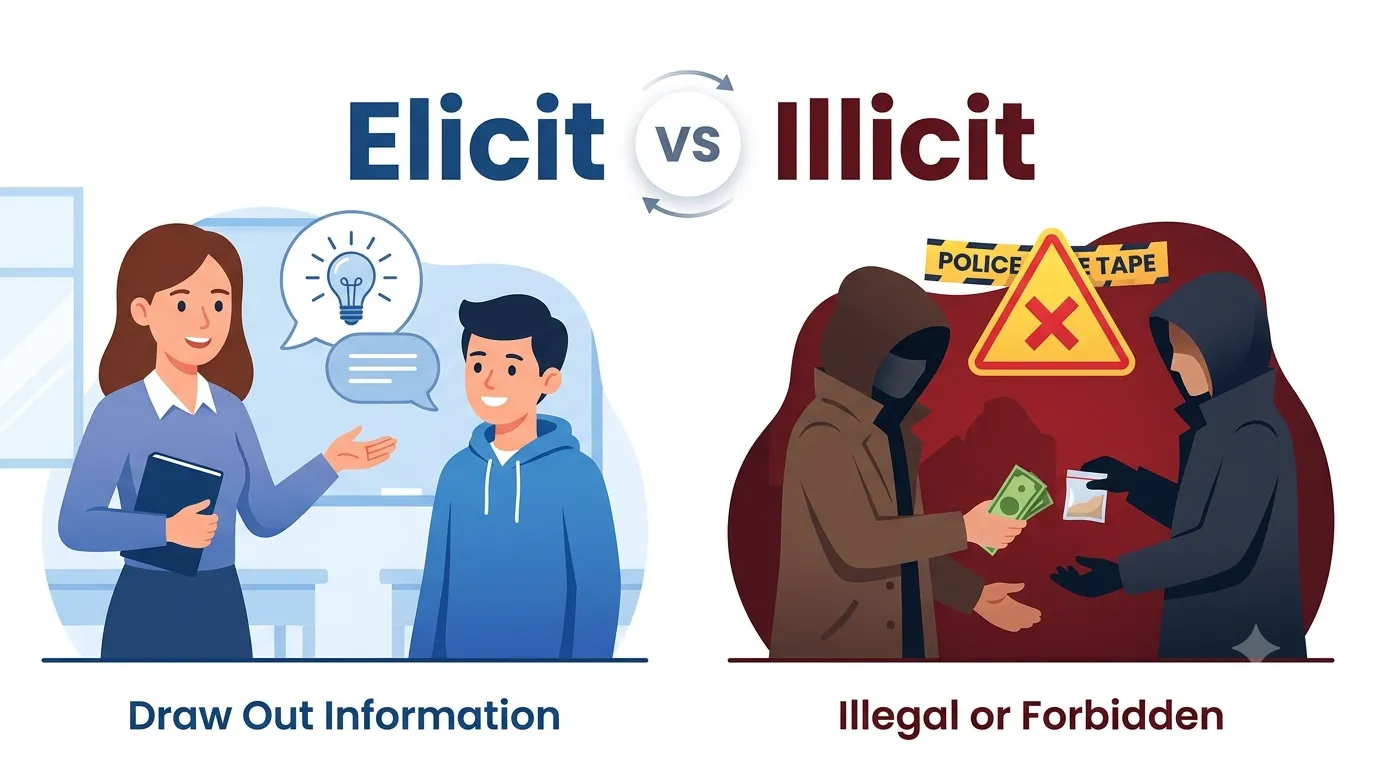
Elicit means to draw out or bring forth a response, feeling, or information. Illicit means illegal or not allowed by law or rules. They sound alike, but they have very different meanings.
A few years ago, while reviewing articles written by new writers, I noticed one mistake that kept appearing. Someone would write, “The interview illicited helpful answers.” Every time, I had to explain that they meant elicited, not illicit. It is one of the most common word mix-ups in English because the two words sound almost the same.
If you’ve ever paused before typing elicit or illicit, you’re not alone. Students, professionals, bloggers, and even experienced writers confuse them. Spell check may not catch the mistake because both words are correct—they just mean completely different things.
The good news is that this confusion is easy to fix. Once you understand what each word means and see a few real examples, you’ll remember the difference for good.
By the end of this guide, you’ll know when to use elicit, when to use illicit, how to avoid common mistakes, and how to use both words with confidence.
Elicit or Illicit: Quick Answer
Although they sound alike, elicit and illicit have different meanings.
- Elicit = to bring out, draw out, or get a response.
- Illicit = illegal, forbidden, or not officially allowed.
Real-world examples
✅ The teacher elicited thoughtful answers from the students.
✅ Police investigated an illicit drug operation.
A simple memory trick:
- Elicit = Extract information.
- Illicit = Illegal.
The Origin Background of Elicit and Illicit
These words have different roots.
Elicit
The word elicit comes from the Latin word elicere, meaning to draw out or bring forth.
That meaning has stayed almost the same for hundreds of years.
Examples:
- elicit a smile
- elicit feedback
- elicit information
Illicit
The word illicit comes from the Latin word illicitus, meaning not allowed or unlawful.
Today, it often appears in legal, business, and news writing.
Examples:
- illicit trade
- illicit drugs
- illicit activity
Why do people confuse them?
The confusion happens because:
- They sound nearly identical.
- Both begin with “ili/eli.”
- They are often used in formal writing.
- Spell check cannot always detect the wrong choice.
Elicit or Illicit Explained: Key Differences
| Term | Meaning | When to Use | Region/Context |
|---|---|---|---|
| Elicit | Draw out information or emotion | Interviews, conversations, research, education | Worldwide English |
| Illicit | Illegal or forbidden | Crime, law, government, news | Worldwide English |
Example of elicit
- The survey elicited honest opinions.
- Her speech elicited applause.
- The doctor tried to elicit more details.
Example of illicit
- Customs officers found illicit goods.
- The company reported illicit payments.
- Police stopped an illicit business.
Which Version Should You Use?
Choosing the correct word is easier than you think.
For students
Use elicit when talking about answers, ideas, or reactions.
Example:
“The teacher elicited several good responses.”
For journalists
Use illicit when reporting crimes or illegal actions.
Example:
“Authorities uncovered an illicit gambling network.”
For business writers
Use elicit when discussing customer feedback.
Example:
“The survey helped elicit customer opinions.”
For legal professionals
Use illicit when referring to unlawful behavior.
Example:
“The report investigated illicit financial transactions.”
For everyday writing
Ask yourself one simple question:
Is something being drawn out?
→ Use elicit.
Is something illegal?
→ Use illicit.
Common Mistakes with Elicit or Illicit
Here are mistakes many people make.
| Mistake | Correct Version | Why? |
|---|---|---|
| The survey illicited responses. | The survey elicited responses. | Responses are drawn out. |
| Police found elicit drugs. | Police found illicit drugs. | Drugs are illegal. |
| His speech was illicit applause. | His speech elicited applause. | Applause is a reaction. |
| She tried to illicit feedback. | She tried to elicit feedback. | Feedback is obtained. |
| They sold elicit goods. | They sold illicit goods. | Goods were illegal. |
Elicit or Illicit in Real-World Examples
Professional email
“Our customer survey elicited valuable feedback that will improve our service.”
News headline
“Police seize illicit drugs during border inspection.”
Social media post
“The movie elicited so many emotions. I wasn’t ready for that ending!”
Formal report
“The investigation found evidence of illicit financial transactions.”
Elicit or Illicit: Data, Trends & Usage
Many people search for elicit or illicit because the words sound alike.
Most common search intent
Informational
People want to know:
- Which spelling is correct.
- What each word means.
- How to remember the difference.
- Which word fits a sentence.
Who searches most?
- Students
- English learners
- Content writers
- Bloggers
- Journalists
- Job seekers
- Teachers
Why this matters today
Good writing builds trust. A single word mistake can change the meaning of your sentence. Knowing the difference helps you write more clearly and professionally.
Standalone Comparison Table
| Term/Variant | Meaning | Region/Context | Best Used When |
|---|---|---|---|
| Elicit | Draw out information, feelings, or responses | Global English | Interviews, surveys, conversations, teaching |
| Illicit | Illegal or forbidden | Global English | Law, crime, government, business compliance |
Frequently Asked Questions
Q: What does elicit mean?
A: Elicit means to bring out or obtain a response, answer, feeling, or information from someone. It usually involves asking, encouraging, or causing a reaction.
Q: What does illicit mean?
A: Illicit means illegal, forbidden, or not officially allowed. It often describes activities, trade, money, or substances that break laws or rules.
Q: How do you use elicit correctly?
A: Use elicit when someone causes another person to respond or share something. For example, “The interview elicited honest answers.”
Q: Elicit vs illicit what’s the difference?
A: Elicit is a verb that means to draw something out. Illicit is an adjective that describes something illegal or prohibited.
Q: Is illicit acceptable in formal writing?
A: Yes. Illicit is widely used in legal documents, business reports, academic writing, and news articles when describing unlawful actions.
Q: Where does elicit come from?
A: It comes from the Latin word elicere, meaning “to draw out” or “bring forth.” Its meaning has stayed almost unchanged over time.
Q: Can illicit be used in everyday conversation?
A: Yes, but it is more common in news, legal, and professional settings. In casual conversation, people often say illegal instead.
Conclusion
The difference between elicit and illicit is simple once you know what each word does.
Remember these key points:
- Elicit means to draw out information, ideas, or emotions.
- Illicit means illegal or not allowed.
- Elicit is always about getting a response.
- Illicit describes something against the law or rules.
A quick memory trick can help. Think of E in elicit as extract. Think of illicit as containing the idea of illegal. That tiny reminder can save you from making a common writing mistake.
The more you read and write, the easier this distinction becomes. Soon, choosing the right word will feel natural.
Now you know exactly how to use elicit and illicit—try using both correctly in your next email, article, or conversation. Bookmark this guide so you never second-guess these words again, and share it with anyone who has ever mixed them up.

I have been writing about English spelling and word usage for the past five years. My goal is to give readers a clear answer without overwhelming them with complicated rules. At WordsCombo, I focus on making everyday English easier for everyone.