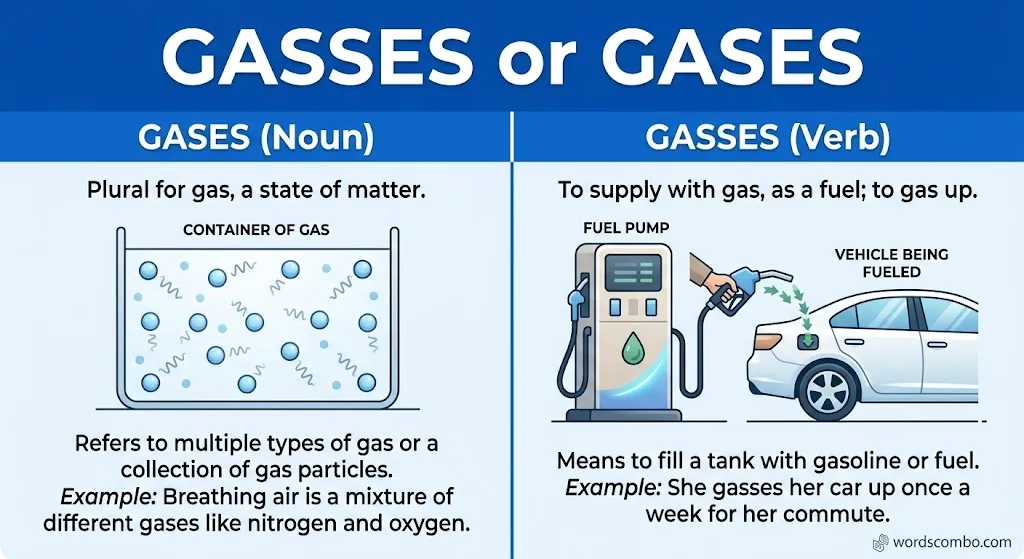
Gases is the standard plural of gas. Gasses is also a valid word, mainly as the third-person singular form of the verb gas, though it can appear as a less common noun plural.
You’re writing an email, report, or school assignment and stop at gasses or gases. The two forms look almost identical, but your choice depends on how the word works in the sentence. If you mean more than one gas, gases is normally the form you want. If you are describing an action, gasses may be correct.
Why the Confusion Happens
The confusion comes from the fact that gas can function as both a noun and a verb. English then gives these uses different forms.
As a noun, gas refers to a substance. Its ordinary plural is gases:
- one gas
- two gases
- several gases
As a verb, gas can describe an action involving gas. Its third-person singular form is gasses. For example, “The machine gasses the chamber” uses gasses as a verb.
The spelling can therefore change according to the grammatical job the word is doing.
This is not mainly a British-versus-American spelling difference. You should decide between the two forms based on meaning and grammar, not simply on which variety of English you use.
Meanings
Gases
Gases is the normal plural noun for gas. Use it when you are talking about two or more gases or several types of gas.
You will commonly see it in writing about science, chemistry, air quality, fuel, laboratories, and the atmosphere.
Examples include:
- Different gases have different properties.
- The atmosphere contains several gases.
- The experiment measures the pressure of various gases.
When your sentence means “more than one gas,” choose gases.
Gasses
Gasses is commonly used as the third-person singular form of the verb gas. In this role, it tells you what a person, machine, substance, or process does.
For example:
- The machine gasses the chamber.
- The process gasses the material.
- The chemical treatment gasses the enclosed space.
The word can also appear as a plural noun in some specialized contexts. However, gases is the clearer choice for general writing when you simply mean multiple gases.
Correct Usage Examples
Gases
- The atmosphere contains several different gases.
- Some gases can be dangerous when inhaled.
- Scientists studied how the gases reacted under pressure.
- The factory monitors the gases released during production.
Gasses
- The machine gasses the chamber before testing.
- The treatment gasses the enclosed area.
- The equipment gasses the material during processing.
- The system gasses the container under controlled conditions.
A useful test is to look at the word before and after the blank. If you are counting or identifying substances, you probably need gases. If you are describing what something does, gasses may fit.
Memory Trick
Use this simple reminder:
Gases = substances
Gasses = action
If you can say “more than one gas,” write gases.
If you can replace the word with an action such as “treats with gas” or “fills with gas,” check whether gasses is the appropriate verb form.
For example:
Several gases were detected.
Here, you are identifying substances.
The machine gasses the chamber.
Here, you are describing an action.
Common Mistakes
1. Using “gasses” as the ordinary plural
Mistake: The atmosphere contains several gasses.
Correction: The atmosphere contains several gases.
The mistake usually comes from treating gasses and gases as interchangeable plural spellings. In ordinary general English, gases is the standard choice.
2. Using “gases” for the verb
Mistake: The machine gases the chamber.
Correction: The machine gasses the chamber.
Here, the word describes what the machine does, so the verb form is needed.
3. Choosing by appearance alone
Mistake: I chose gasses because gas ends in s.
Correction: Check the word’s grammatical role first.
The spelling alone does not tell you which form belongs in every sentence. Look at whether you are naming a substance or describing an action.
4. Assuming one is British and the other American
Mistake: Gasses must be the British spelling of gases.
Correction: The main distinction is grammatical use, not a simple regional spelling difference.
Both forms can appear in English, but they do not automatically mean the same thing in every sentence.
Gasses or Gases in Real-World Examples
Professional Email
Suppose you are reporting laboratory results:
The analysis identified three different gases in the sample.
Here, gases works as a plural noun.
If you are explaining a process, you might write:
The equipment gasses the chamber before testing begins.
The sentence describes an action, so gasses is appropriate.
Report or Headline
A report about air quality might use:
Gases Detected in Industrial Air Samples
A report about equipment could instead say:
New System Gasses Materials During Treatment
The surrounding words make the grammatical difference easy to spot.
Text Message
Even in casual writing, the same rule applies:
The test found several gases in the container.
But:
The machine gasses the area before anyone enters.
You do not need to memorize a long grammar rule. Check what you are trying to say.
Gases vs Gasses at a Glance
| Word | Status/Context | Why | Example |
| gases | Standard plural noun | Refers to more than one gas | Several gases were detected. |
| gasses | Verb form | Describes an action involving gas | The machine gasses the chamber. |
| gasses | Less common noun plural | Can occur in specialized usage | Different gasses may be discussed in technical writing. |
For normal everyday writing, gases will be the form you need when you are talking about multiple gases.
Similar Word Pairs to Watch For
Gas or Gases
You will often see the singular and plural forms together. Gas can refer to one gas or to the substance generally, while gases refers to multiple gases.
Glass or Glasses
This pair has a similar visual pattern. Glass can refer to the material or a single drinking container, while glasses can refer to multiple containers or eyewear.
Class or Classes
If you are learning how plural forms work, class provides another familiar example. Its plural is classes, showing how an extra syllable can affect the spelling.
Pass or Passes
You may also notice a similar pattern with verbs. Pass becomes passes in the third-person singular form, which helps explain why adding -es is common with certain words ending in s.
Bus or Buses
Bus becomes buses in its standard plural form. The less common busses exists with a different use, making this another pair where context matters.
Origin/Background
The word gas became established in English as a term for a substance that expands to fill its available space. Over time, its ordinary plural developed as gases.
The form gasses emerged in related verb usage, following a familiar English pattern in which a verb ending in s takes -es in the third-person singular. This gives us forms such as pass/passes and gas/gasses.
That history helps explain why the two spellings look so similar. Their modern difference is easier to understand through grammar than through regional English.
Mini FAQ
Is “gasses” a correct spelling?
Yes. Gasses is a valid English word, particularly as a verb. It is also found as a less common plural noun in some contexts.
Is “gases” the plural of gas?
Yes. Gases is the standard plural when you mean two or more gases. It is the form you should normally use in general writing.
Which is correct, “gasses or gases”?
Both can be correct, but they serve different purposes. Use gases for the ordinary plural noun and gasses when the sentence calls for the verb form.
Is “gasses” an American spelling?
No simple American-versus-British rule separates the two. The important distinction is how the word is being used in the sentence.
Why is “gases” spelled differently from “gas”?
Gases is the established plural form of gas. The spelling also reflects its pronunciation, with an additional syllable in the plural.
Can “gasses” be used as a noun?
Yes, although this use is less common. If you simply mean multiple gases in ordinary writing, gases is usually the clearest option.
Which form should I use in formal writing?
Use gases when referring to multiple gases. Use gasses when you need the verb form and the sentence describes an action involving gas.
Conclusion
When you mean more than one gas, gases is the standard choice. Gasses is also valid, mainly when it functions as a verb.
If you want to avoid this common spelling confusion, check the grammatical role of the word before choosing a form. For more practical word comparisons, visit the Word Usage-Grammar category on Wordscombo, and explore related guides such as Spelt or Spelled and Helped or Helpped.

I have been writing about English spelling and word usage for the past five years. My goal is to give readers a clear answer without overwhelming them with complicated rules. At WordsCombo, I focus on making everyday English easier for everyone.










1 thought on “Gasses or Gases: When to Use Each”