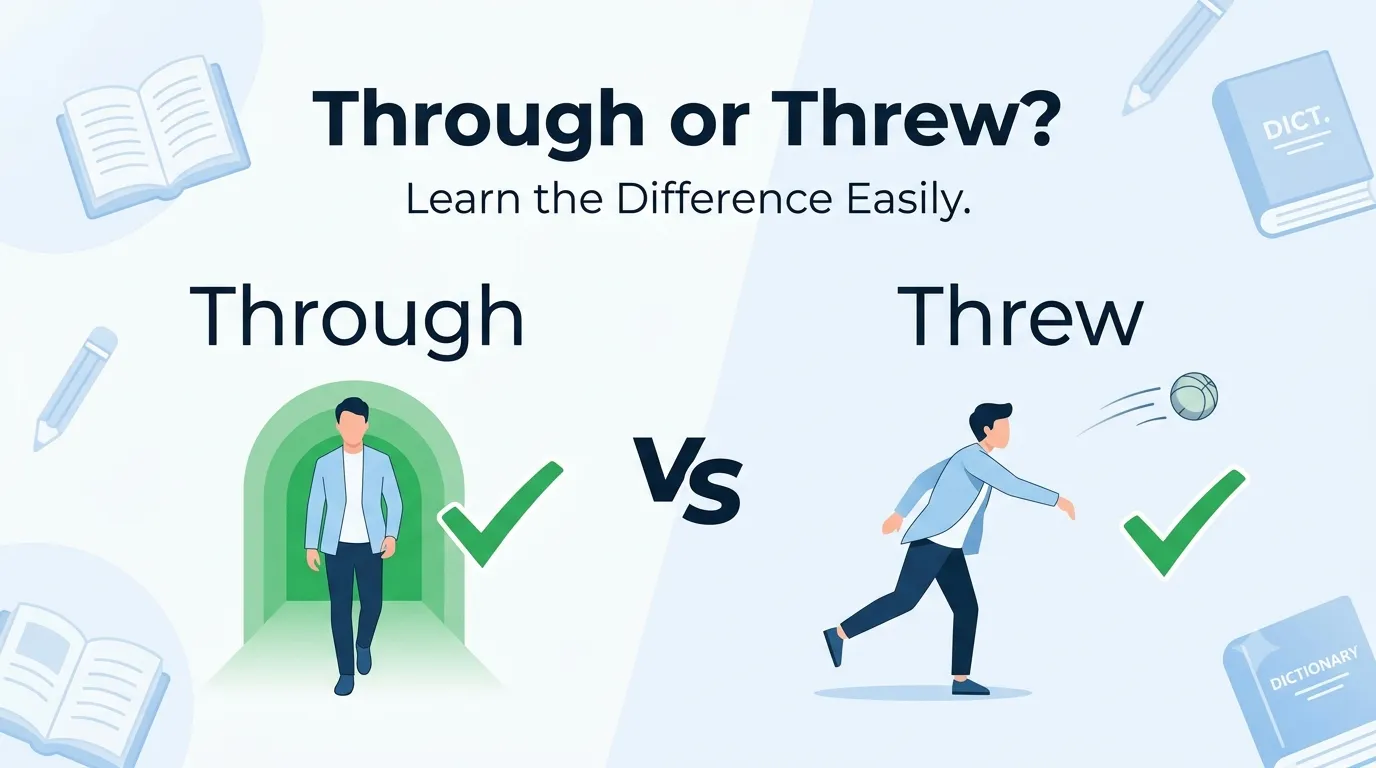
Through means moving from one side to another or continuing until the end. Threw is the past tense of throw, which means to toss or send something through the air.
I still remember reading a student’s email that said, “I threw the tunnel safely.” I smiled because I knew exactly what had happened. The writer meant through, not threw. It was a tiny spelling mistake, but it changed the whole meaning of the sentence.
If you’ve ever stopped while writing and wondered which word to use, you’re not alone. Even native English speakers mix up through and threw because they sound almost the same. These words are called homophones. They have similar pronunciation but very different meanings and uses.
The good news is that the difference is simple once you understand it. A few easy examples can help you remember the correct word every time.
In this guide, you’ll learn what through and threw mean, where they came from, how to use them correctly, and the common mistakes to avoid. By the end, you’ll feel confident using both words in everyday writing and conversation.
Through or Threw: Quick Answer
Although through and threw sound alike, they have different meanings.
- Through shows movement, completion, or passing from one side to another.
- Threw is the past tense of throw. It means someone tossed or launched something.
Simple examples
✅ She walked through the park.
✅ He threw the football to his friend.
Notice how one word describes movement or completion, while the other describes an action of throwing.
A quick memory trick:
- Threw = Throw
- Through = Go through, pass through, get through
The Origin and Background of Through or Threw
Understanding where these words came from makes them much easier to remember.
The history of through
The word through comes from Old English thurh. It has been part of English for hundreds of years. Over time, its spelling changed, but its meaning stayed almost the same.
It usually means:
- passing from one side to another
- continuing until the end
- using something as a way to reach another place
Examples:
- We drove through the mountains.
- She worked through the weekend.
- I heard the news through a friend.
The history of threw
Threw comes from the verb throw.
It is simply the past tense form.
Present tense:
I throw the ball.
Past tense:
Yesterday, I threw the ball.
Unlike through, this word always relates to tossing, launching, or sending something.
Examples:
- He threw his keys onto the table.
- The child threw a snowball.
- She threw the paper into the bin.
Why do people confuse them?
The answer is simple.
They sound almost identical.
English has many homophones, such as:
- their / there
- hear / here
- to / too
- through / threw
When speaking, listeners understand the meaning from the sentence. But when writing, choosing the correct spelling matters.
Through or Threw Explained: Key Differences
The easiest way to remember these words is to focus on what the sentence is talking about.
If the sentence is about movement, direction, completion, or passing, use through.
If someone throws something, use threw.
| Term | Meaning | When to Use | Context |
|---|---|---|---|
| Through | Passing from one side to another or continuing until the end | Movement, completion, direction | Everyday English |
| Threw | Past tense of throw | Tossing or launching something | Past actions |
Meaning of Through
Through can work as several parts of speech.
It can be:
- a preposition
- an adverb
- an adjective
Most learners simply need to remember its common meanings.
Examples:
Movement
- We walked through the forest.
Completion
- I’m finally through with my homework.
Using a method
- She booked the tickets through the company website.
Meaning of Threw
Threw is only a verb.
It tells us what someone did in the past.
Examples:
- He threw the ball.
- She threw the letter away.
- The player threw the winning pass.
Notice that every sentence includes the action of throwing.
Side by side examples
| Sentence | Correct Word | Why? |
|---|---|---|
| We drove through the city. | Through | Passing across the city |
| He threw the ball. | Threw | Action of throwing |
| She worked through lunch. | Through | Continued until lunch ended |
| The child threw his toy. | Threw | Tossed the toy |
Easy memory trick
Ask yourself one question:
Can I replace the word with “throw”?
If yes, choose threw.
If not, choose through.
Example:
“He _____ the stone.”
You can say:
“He threw the stone.”
Correct.
Now try another.
“We walked _____ the tunnel.”
“We walked throw the tunnel.”
That makes no sense.
So the answer is through.
Which Version Should You Use?
The right choice depends entirely on what you want to say.
For students
Use through when talking about:
- moving across a place
- finishing something
- passing from one point to another
Use threw only when writing about throwing something.
For business professionals
In emails and reports, through appears much more often.
Examples:
- We completed the project through teamwork.
- Please send requests through the support team.
Use threw only when describing a physical action.
Example:
- Someone threw a package over the fence.
For writers and bloggers
Before publishing, read the sentence aloud and ask:
Is this about movement or completion?
Choose through.
Or ask:
Is someone throwing something?
Choose threw.
This simple check prevents one of the most common English spelling mistakes.
Standalone Comparison Table
| Term/Variant | Meaning | Region/Context | Best Used When |
|---|---|---|---|
| Through | Passing across, inside, or until completion | Worldwide English | Talking about movement, direction, process, or finishing something |
| Threw | Past tense of throw | Worldwide English | Describing the past action of tossing or launching something |
| Throw | Present tense verb | Worldwide English | Describing the current action of tossing something |
| Throughout | During the whole period or every part of something | Worldwide English | Talking about an entire time or place |
Key Takeaways So Far
Before moving on, remember these simple rules:
- Through = movement, direction, process, or completion.
- Threw = past tense of throw.
- They sound alike but have completely different meanings.
- Ask yourself, “Is someone throwing something?” If yes, use threw. Otherwise, through is probably the right choice.
Part 2 will cover:
- Common mistakes with through and threw
- Real world examples (email, news, social media, formal report)
- Data, search trends, and usage insights
- 7 SEO friendly FAQs
- Conclusion with CTA
- Exactly 20 word SEO meta description
Common Mistakes with Through and Threw
Even confident English writers mix up these words. The mistake usually happens because they sound the same. Here are the most common errors and the correct way to write them.
| Mistake | Correct | Why It Is Wrong |
|---|---|---|
| I threw the tunnel. | I went through the tunnel. | Threw means tossed something. |
| She walked threw the park. | She walked through the park. | The sentence describes movement. |
| He through the ball. | He threw the ball. | The action is throwing. |
| We are threw with dinner. | We are through with dinner. | Through means finished. |
| They got the job threw hard work. | They got the job through hard work. | It means “by means of.” |
Why do these mistakes happen?
- Through and threw sound almost the same.
- Spell check tools may not catch the mistake because both words are real.
- Writers often choose the word that “looks right” instead of checking the meaning.
A simple tip
Before you finish writing, ask yourself:
- Is this sentence about throwing something? → Use threw.
- Is it about passing, finishing, or moving? → Use through.
This quick check takes only a few seconds and helps you avoid a common writing error.
Through or Threw in Real World Examples
Seeing these words in everyday situations makes the difference much easier to remember.
Professional Email
Hello Sarah,
We completed the project through close teamwork and clear communication.
Thank you,
Alex
Here, through means by means of.
News Headline
Firefighters rescued a family through a second floor window.
The word shows movement from one place to another.
Social Media Post
My dog threw my shoe into the pool again! 😂
The dog tossed the shoe, so threw is correct.
Formal Report
The company reduced costs through better planning and improved training.
The sentence explains how the result happened.
Everyday Conversation
- We walked through the museum.
- She threw the keys on the table.
- I read through the report before the meeting.
- He threw the basketball from half court.
- We drove through heavy rain all afternoon.
The more examples you read, the faster the correct word becomes natural.
Through or Threw: Data, Trends & Usage
People search for through or threw because they want a quick answer to a common spelling question.
Search Intent
Primary intent: Informational
Most readers want to know:
- Which spelling is correct?
- What is the difference?
- How can I remember it?
- Which word should I use in a sentence?
Who searches for this topic?
The audience includes:
- Students
- English learners
- Teachers
- Bloggers
- Business professionals
- Job seekers
- Content writers
Where is it searched most?
The topic is popular in countries where English is widely spoken or studied, including:
- United States
- United Kingdom
- Canada
- Australia
- India
- Pakistan
- Philippines
Why does it matter now?
People write more emails, messages, blog posts, and social media updates than ever before. Clear writing builds trust. Using through and threw correctly helps your message sound polished and professional.
Frequently Asked Questions (FAQs)
Q: What does “through” mean?
A: Through means moving from one side to another, continuing until the end, or doing something by means of another thing. It does not mean throwing an object.
Q: What does “threw” mean?
A: Threw is the past tense of throw. It means someone tossed, launched, or sent something through the air.
Q: How do I use through correctly?
A: Use through when talking about movement, completion, direction, or a method. For example, “We walked through the park.”
Q: How do I use threw correctly?
A: Use threw only when describing the past action of throwing something. For example, “She threw the ball.”
Q: Through vs. threw: what’s the difference?
A: Through relates to passing, finishing, or moving across something. Threw is the past tense of throw. They sound alike but have different meanings and grammar.
Q: Is “through” acceptable in formal writing?
A: Yes. Through is completely correct in formal writing, business emails, academic papers, and professional reports.
Q: Which version is correct: through or threw?
A: Both are correct, but they are used in different situations. Choose through for movement or completion. Choose threw when someone tossed something.
Q: Where do these words come from?
A: Through comes from Old English and has meant passing from one place to another for centuries. Threw comes from the verb throw and is simply its past tense.
Q: Can I use through in business writing?
A: Absolutely. It is common in business communication, such as “The issue was solved through teamwork.”
Conclusion
Now you know that through and threw may sound alike, but they serve very different purposes. Through is used for movement, direction, completion, or showing how something happens. Threw is the past tense of throw and always describes the action of tossing or launching something.
The easiest way to remember the difference is to focus on the meaning of your sentence. If someone is throwing an object, use threw. If the sentence is about passing through a place, finishing a task, or doing something by means of another thing, use through.
A small spelling choice can change the meaning of an entire sentence. Taking a moment to check your word helps your writing look clear, accurate, and professional.
Now you know exactly how to use through and threw. Try using them in your next email, assignment, or conversation with confidence. If you found this guide helpful, bookmark it and share it with someone who has ever mixed up these two words.
Read more: Bolder or Boulder: Easy Guide to Correct Usage

I have been writing about English spelling and word usage for the past five years. My goal is to give readers a clear answer without overwhelming them with complicated rules. At WordsCombo, I focus on making everyday English easier for everyone.