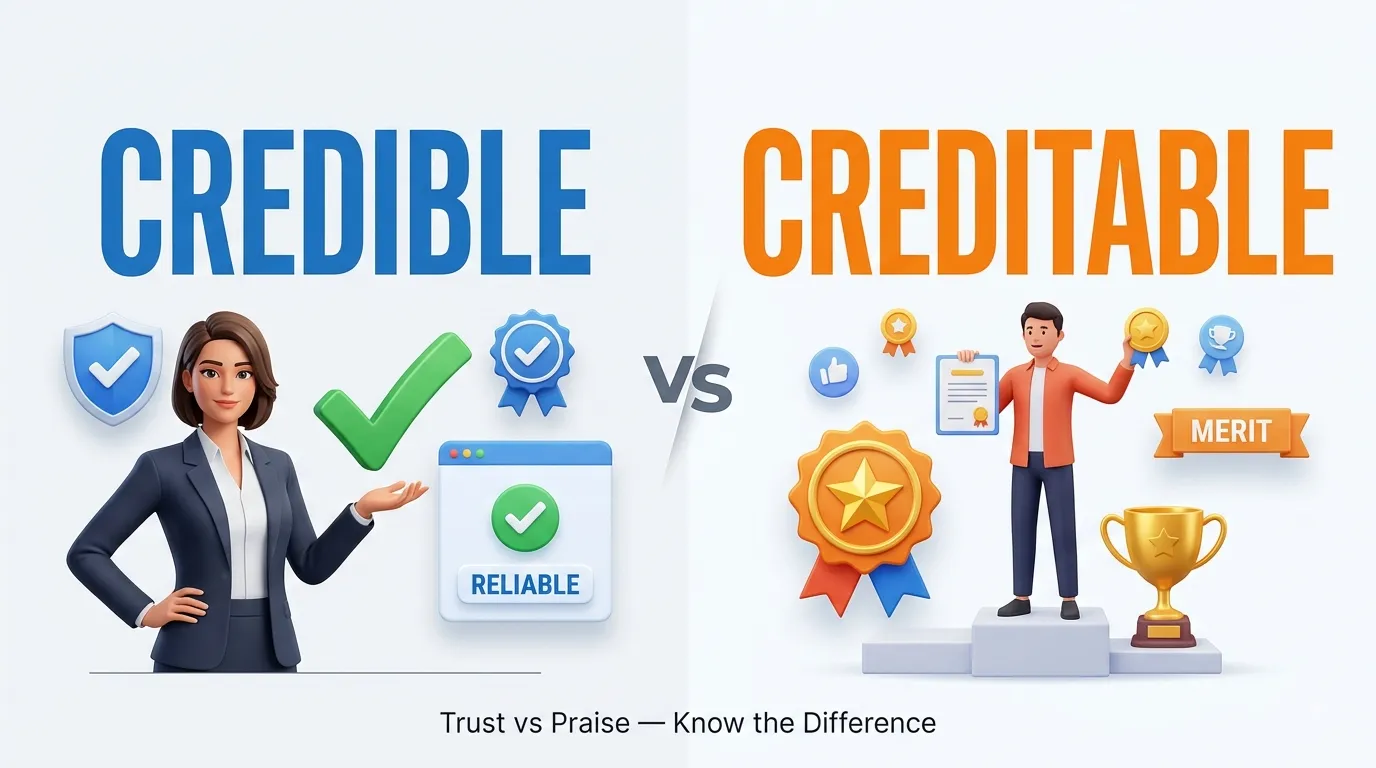
Credible means believable or trustworthy, while creditable means deserving praise, respect, or approval. Use credible for trust and creditable for merit.
Have you ever written a sentence, stopped, and wondered, “Is this credible or creditable?”
You are not alone. These two words look almost identical. They also share the word credit, which makes the choice even harder. Yet their meanings are quite different.
I often see this mix up when helping learners improve everyday English. A student may write, “She gave a creditable report,” when the real meaning is that the report can be trusted. Another may say, “His work was credible,” when they really mean his work deserves praise.
The good news is that you do not need a complex grammar rule.
You only need to ask one simple question: Are you talking about trust, or are you talking about merit?
This guide makes that difference easy to remember. You will learn the meaning, origin, correct use, common mistakes, examples, and a simple memory trick. By the end, choosing between credible or creditable should feel much easier.
Credible or Creditable
Credible means believable, convincing, or worthy of trust.
Use it when you are talking about a person, claim, source, story, explanation, or piece of information.
- The witness gave a credible account.
- The website is a credible source of information.
- Her explanation sounds credible.
Creditable means deserving praise, respect, or approval.
Use it when someone has done something reasonably good or worthy of recognition.
- He gave a creditable performance.
- The team made a creditable effort.
- Her exam result was creditable.
The easy memory trick
Think:
Credible = Can I believe it?
Creditable = Does it deserve credit?
That one question can solve most cases.
The Origin Background of Credible or Creditable
Both words come from the Latin root credere, which means “to believe” or “to trust.”
That root also gave English words such as credit, credibility, and credential.
Over time, English developed different words from the same family.
Credible became linked to the idea of belief. If something is credible, people can reasonably accept it as true or reliable.
Creditable, on the other hand, became linked to the idea of receiving credit. If something is creditable, it deserves praise or respect.
This shared history explains why the words look so similar.
It also explains why learners often confuse them.
The ending helps, but meaning is the real key. Credible is about trust. Creditable is about merit.
Credible or Creditable Explained: Key Differences
The clearest way to understand the difference is to compare their jobs in a sentence.
| Term | Meaning | When to Use | Region/Context |
|---|---|---|---|
| Credible | Believable or trustworthy | Claims, people, sources, stories, evidence | Standard English |
| Creditable | Worthy of praise or respect | Efforts, results, performances, achievements | Standard English, often formal |
| Credibility | The quality of being believable or trusted | Reputation, sources, information | Common in professional English |
| Credit | Praise, recognition, or acknowledgment | Achievements, work, responsibility | Very common |
Example 1: A news source
The newspaper is a credible source.
This means the newspaper is trustworthy.
You would not normally say:
The newspaper is a creditable source.
That changes the focus to praise rather than trust.
Example 2: A performance
She gave a creditable performance.
This means her performance was good enough to deserve praise.
You could say:
She gave a credible performance.
But the meaning is different. It suggests that her performance was believable or convincing, especially if she was acting or presenting a role.
Example 3: A claim
The scientist made a credible claim.
The claim seems believable.
A creditable claim would suggest that the claim itself deserves credit or recognition. That use is possible, but it is less common.
Which Version Should You Use?
The best choice depends on what you want to say.
For students and beginners
Use credible when you mean believable or trustworthy.
Use creditable when you mean good enough to deserve praise.
If you are unsure, ask:
Can I believe it?
If yes, choose credible.
Then ask:
Does it deserve credit?
If yes, choose creditable.
For professional writing
Credible is much more common in business, education, journalism, research, and online writing.
For example:
We need a credible source before publishing the report.
Creditable is more formal and less common. It often describes an effort, performance, result, or achievement.
The company made a creditable effort to reduce waste.
For global or neutral English
Choose credible when you mean trustworthy.
It is widely understood in international English.
Use creditable when the sentence clearly means worthy of praise.
Common Mistakes with Credible or Creditable
These mistakes are easy to make because the words look so alike.
| Mistake | Correction | Why |
|---|---|---|
| The website is creditable. | The website is credible. | You mean trustworthy. |
| He gave a credible effort. | He gave a creditable effort. | You mean worthy of praise. |
| Her story is creditable. | Her story is credible. | You mean believable. |
| The player had a creditable performance. | Correct: creditable performance. | The performance deserves praise. |
| The evidence is creditable. | The evidence is credible. | The evidence seems trustworthy. |
Mistake 1: Using creditable for “trustworthy”
This is the most common problem.
Wrong:
This is a creditable website.
Better:
This is a credible website.
The website can be trusted. That is why credible works.
Mistake 2: Using credible for “praiseworthy”
Wrong:
The team made a credible effort.
If you mean the team worked hard and deserves praise, use:
The team made a creditable effort.
Mistake 3: Thinking “creditable” means “full of credit”
It does not.
Creditable means something is worthy of credit. It does not simply mean that something contains or has credit.
Mistake 4: Assuming the words are interchangeable
They are not.
Replacing one with the other can change the meaning of the sentence.
Always focus on the idea behind the sentence.
Credible or Creditable in Real World Examples
Seeing the words in context makes the difference much clearer.
1. Professional email
Credible:
Before we approve the proposal, we need a credible source for these figures.
Here, the figures need to come from a source that can be trusted.
Creditable:
Your team made a creditable effort to finish the project early.
Here, the team deserves praise for its effort.
2. News headline or article
Credible:
Police Seek Credible Evidence in Investigation
The word refers to evidence that can be trusted or accepted as believable.
A news article might also say:
The researcher is considered a credible expert.
Again, the focus is trust.
3. Social media post
“Always check whether a source is credible before sharing a shocking claim.”
This is a natural use of credible because social media users need to judge whether information is trustworthy.
4. Formal report
“The department made a creditable improvement in customer service.”
The department has achieved something worthy of praise.
A report could also say:
“The study used data from several credible sources.”
Here, the sources are trustworthy.
Credible or Creditable: Data, Trends & Usage
The two words do not have equal everyday use.
Credible is far more common in modern English. You will see it often in news, education, research, business, politics, online content, and everyday conversation.
It is especially useful when people need to judge whether information can be trusted.
This matters even more in the age of online misinformation. Readers constantly ask whether a source, claim, review, expert, or statistic is credible.
Creditable has a narrower role. It appears more often in formal or descriptive writing. It commonly describes an effort, performance, result, achievement, or record that deserves praise.
The search intent behind credible or creditable is mainly informational. People usually want to know which word is correct and how the meanings differ.
The key insight is simple: credible is about belief; creditable is about credit.
Standalone Comparison Table: Credible vs. Creditable
| Term/Variant | Meaning | Region/Context | Best Used When |
|---|---|---|---|
| Credible | Believable or trustworthy | All standard English | You mean something can be trusted |
| Creditable | Deserving praise or credit | Standard English, often formal | You mean an effort or result deserves praise |
| Credibility | The quality of being trusted | Professional and academic English | You discuss trust or reputation |
| Credit | Praise, recognition, or acknowledgment | Everyday and formal English | Someone deserves recognition |
A fast rule to remember
Credible → believe
Creditable → credit
If you can connect the sentence to belief, choose credible.
If you can connect it to praise, choose creditable.
FAQs About Credible or Creditable
Q: What does credible mean?
A: Credible means believable, convincing, or trustworthy. It can describe a person, source, claim, explanation, or piece of evidence.
Q: What does creditable mean?
A: Creditable means deserving praise, respect, or credit. It often describes an effort, performance, result, or achievement.
Q: How do you use credible correctly?
A: Use credible when you mean that something can be believed or trusted. For example, “She is a credible expert” means people can trust her knowledge.
Q: Credible vs. creditable: what is the difference?
A: Credible is about trust or belief. Creditable is about praise or merit. Think credible = believe and creditable = credit.
Q: Is credible acceptable in formal writing?
A: Yes. Credible is common and fully acceptable in formal writing. It is widely used in academic papers, reports, journalism, and business documents.
Q: Is creditable a correct English word?
A: Yes. Creditable is a correct English word. It is simply less common than credible and has a different meaning.
Q: Which version is correct: credible or creditable?
A: Both are correct, but they are used in different situations. Choose credible for something believable or trustworthy and creditable for something deserving praise.
Q: Where do credible and creditable come from?
A: Both words trace back to the Latin root credere, meaning “to believe” or “to trust.” Their meanings developed in different directions over time.
Q: Can credible be used for a person?
A: Yes. You can say someone is a credible expert, credible witness, or credible source. It means the person is believable or trustworthy.
Q: Can creditable be used for a person?
A: Yes, but the meaning is different. Calling someone creditable suggests that the person is worthy of praise or respect. This use is less common in everyday speech.
Conclusion
The difference between credible or creditable is small in spelling but clear in meaning.
Credible means believable or trustworthy. Use it for people, sources, claims, evidence, stories, and information.
Creditable means worthy of praise or credit. Use it for efforts, performances, results, achievements, and similar things.
There is one simple trick worth remembering:
Credible = believe.
Creditable = credit.
When you are writing, stop for one second and ask what you mean. Are you saying, “I can trust this”? Choose credible. Are you saying, “This deserves praise”? Choose creditable.
That small check can prevent a common English mistake and make your writing sound more precise.
Bookmark this guide so you never have to second guess “credible or creditable” again.
Read more: Ingenious or Ingenuous: Complete Guide to Meaning, Uses & Differences

I have been working with English language content for over six years. I specialize in word comparisons and spelling differences that most people overlook. At WordsCombo, I help readers choose the right word every time.