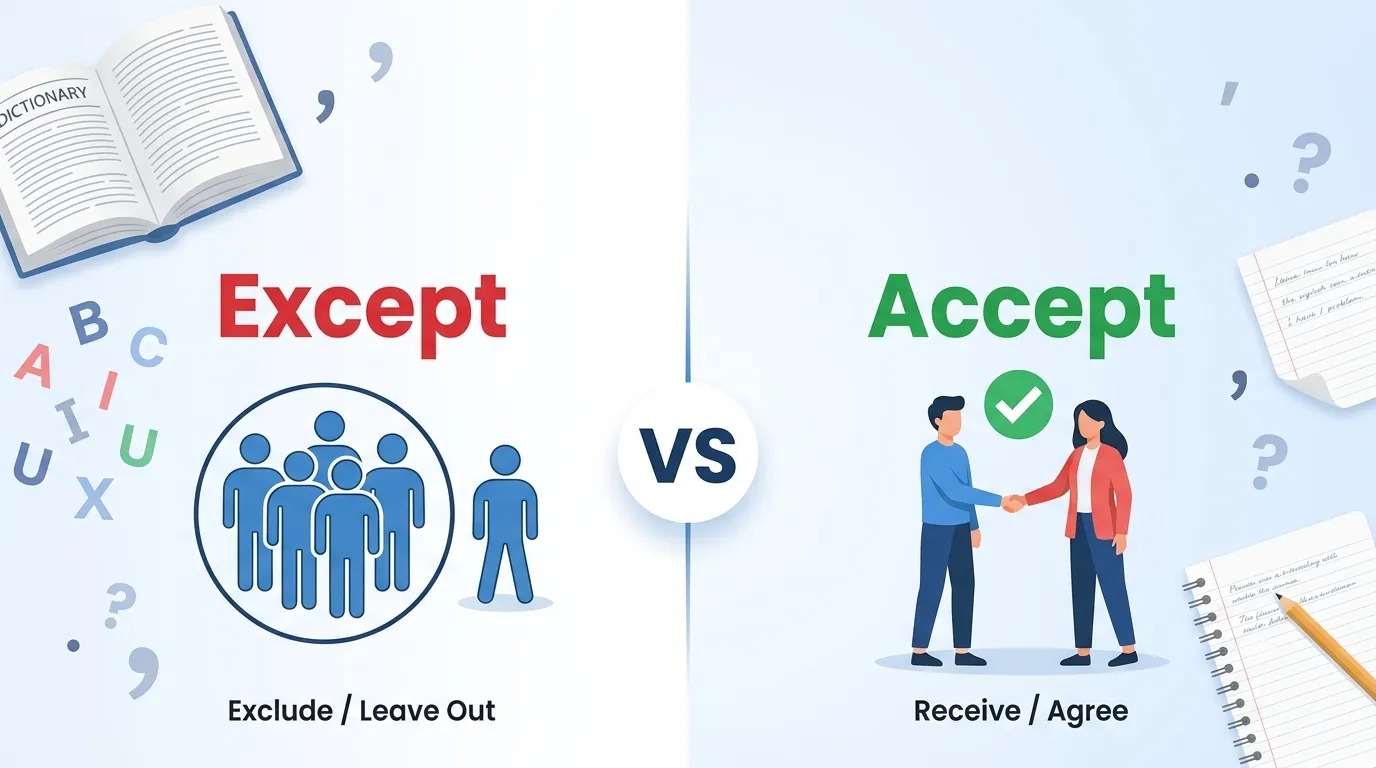
Except means to leave out or exclude, while accept means to receive, agree to, or say yes to something. They sound similar, but they have completely different meanings.
A few years ago, I was proofreading a student’s college application. Everything looked great until I found this sentence: “I except your offer with gratitude.” One tiny word changed the whole meaning.
That mistake is more common than you might think.
Many English learners, students, and even native speakers confuse except and accept because they sound almost the same. They are classic homophones. Your spell checker may not catch the mistake because both words are spelled correctly. The problem is that only one fits the sentence.
The good news is that the difference is easy to remember once you know the trick. After teaching English for more than a decade, I’ve found that simple examples work much better than long grammar rules.
In this guide, you’ll learn the meaning of except and accept, when to use each one, common mistakes to avoid, real-life examples, and an easy memory tip you’ll never forget.
Except or Accept: Quick Answer
The difference is simple.
- Accept = Receive, agree, or say yes.
- Except = Leave out or exclude.
Examples
✅ I accept your invitation.
✅ Everyone came except Sarah.
Think of it this way:
- Accept brings something in.
- Except leaves something out.
The Origin and Background of Except or Accept
The confusion began centuries ago because the two words have similar sounds but different Latin roots.
Accept
The word accept comes from the Latin word acceptare, meaning to receive willingly or to take.
Its meaning has stayed almost the same for hundreds of years.
Except
The word except comes from the Latin word exceptus, meaning taken out or excluded.
That is why except always has the idea of leaving something out.
Even though their pronunciation is close, their histories show they were never meant to mean the same thing.
Except or Accept Explained
Although they sound alike, they do different jobs in a sentence.
| Term | Meaning | When to Use | Context |
|---|---|---|---|
| Accept | Receive or agree | Accept gifts, jobs, invitations, ideas | Everyday English |
| Except | Leave out or exclude | Show someone or something is not included | Everyday English |
When to Use Accept
Use accept when someone receives something or agrees to something.
Examples:
- I accept your apology.
- She accepted the job offer.
- We accept credit cards.
- He accepted the award proudly.
When to Use Except
Use except when someone or something is excluded.
Examples:
- Everyone passed except Tom.
- The store opens every day except Sunday.
- I like every fruit except bananas.
- Nobody knew the answer except the teacher.
Which Version Should You Use?
Here is an easy guide.
For Students
Use accept when talking about agreeing, receiving, or joining something.
Example:
“I accepted my university offer.”
Use except when showing something is missing.
Example:
“Everyone finished the assignment except me.”
For Business Writing
Choose accept when discussing:
- Offers
- Contracts
- Payments
- Applications
- Invitations
Example:
“We are pleased to accept your proposal.”
For Everyday Conversation
Use except whenever you mean “not including.”
Example:
“I invited everyone except Jake.”
Best Choice for Everyone
Ask yourself one question.
Am I receiving something?
- Yes → Accept
- No, I am leaving someone or something out → Except
Easy Memory Trick
This trick works every time.
Accept has the letter A
Think:
A = Agree
or
A = Acquire
If you agree or receive something, use accept.
Except has the letters EX
Think:
EX = Exit
Something exits the group.
That means it is excluded.
Example:
Everyone came except Alex.
Alex exited the group.
Common Mistakes with Except or Accept
Here are mistakes people often make.
| Mistake | Correct Version | Why |
|---|---|---|
| I except your offer. | I accept your offer. | You receive the offer. |
| Everyone accept Tom came. | Everyone except Tom came. | Tom is excluded. |
| She excepted the gift. | She accepted the gift. | She received it. |
| We accept everyone John. | We accept everyone except John. | John is left out. |
| I cannot except this payment. | I cannot accept this payment. | Payment is received. |
Why These Errors Happen
People confuse the words because:
- They sound almost identical.
- Spell check often misses the mistake.
- They type quickly.
- They remember the sound but forget the meaning.
Except or Accept in Real-World Examples
Professional Email
“We are happy to accept your proposal and begin work next Monday.”
News Headline
“All Flights Resume Except Routes Affected by Storm”
Social Media Post
“I’ll be at the party! I accept every dance challenge.”
Formal Report
“All departments met the target except the marketing division.”
School Example
“Our teacher accepted our science project.”
Daily Conversation
“I’ll eat anything except spicy food.”
Except or Accept: Data, Trends & Usage
The keyword except or accept is searched thousands of times every month.
Search Intent
Primary intent:
Informational
People want to know:
- Which word is correct.
- The difference between them.
- Easy ways to remember.
- Real examples.
Popular Audiences
This topic is especially popular among:
- English learners
- Students
- Teachers
- Bloggers
- Writers
- Job seekers
- Professionals
Regions Where It’s Common
Search interest is strong in:
- United States
- United Kingdom
- Canada
- Australia
- India
- Pakistan
Why It Matters Today
Emails, social media, and online applications make writing more important than ever.
Using the wrong word can make your message look careless, even when your grammar is otherwise perfect.
Standalone Comparison Table
| Term/Variant | Meaning | Region/Context | Best Used When |
|---|---|---|---|
| Accept | Receive or agree | Worldwide English | Receiving gifts, offers, ideas, invitations |
| Except | Exclude or leave out | Worldwide English | Showing something is not included |
Quick Practice Quiz
Choose the correct word.
1.
I happily ______ your invitation.
✅ Accept
2.
Everyone finished the race ______ Ben.
✅ Except
3.
The company will ______ online payments.
✅ Accept
4.
I eat every vegetable ______ spinach.
✅ Except
5.
She decided to ______ the scholarship.
✅ Accept
Frequently Asked Questions
Q: What does except mean?
A: Except means to leave someone or something out. It shows that a person or thing is not included in a group.
Q: What does accept mean?
A: Accept means to receive something willingly or agree to it. You can accept gifts, invitations, apologies, payments, and offers.
Q: How do you use except correctly?
A: Use except whenever you mean “not including.” For example: “Everyone passed the exam except Liam.”
Q: How do you use accept correctly?
A: Use accept when someone receives or agrees to something. For example: “She accepted the award.”
Q: Except vs accept: what’s the difference?
A: Accept means to receive or agree. Except means to exclude or leave out. The words sound alike but have opposite ideas.
Q: Is accept correct in formal writing?
A: Yes. Accept is perfectly correct in formal writing. It appears in business emails, contracts, reports, and academic writing.
Q: Can except be used in business writing?
A: Yes. It is often used to describe exclusions, conditions, or exceptions in reports, contracts, and official documents.
Final Thoughts
The difference between except and accept becomes easy once you focus on their meanings instead of their sounds.
Remember these three simple rules:
- Accept means receive or agree.
- Except means leave out or exclude.
- Ask yourself whether something is coming in or staying out.
That single question will help you choose the right word almost every time.
Small word choices make a big difference in your writing. Whether you’re sending an email, writing an essay, or posting online, using the correct word shows confidence and attention to detail.
Now you know exactly how to use except and accept. Bookmark this guide so you never second-guess these words again, and share it with anyone who still mixes them up.

I started writing about English word differences after years of teaching students who kept making the same mistakes. My focus is on making spelling rules feel simple and easy to remember. At WordsCombo, I turn confusing word pairs into clear comparisons.



1 thought on “Except or Accept: The Complete Guide to Using Them Correctly”