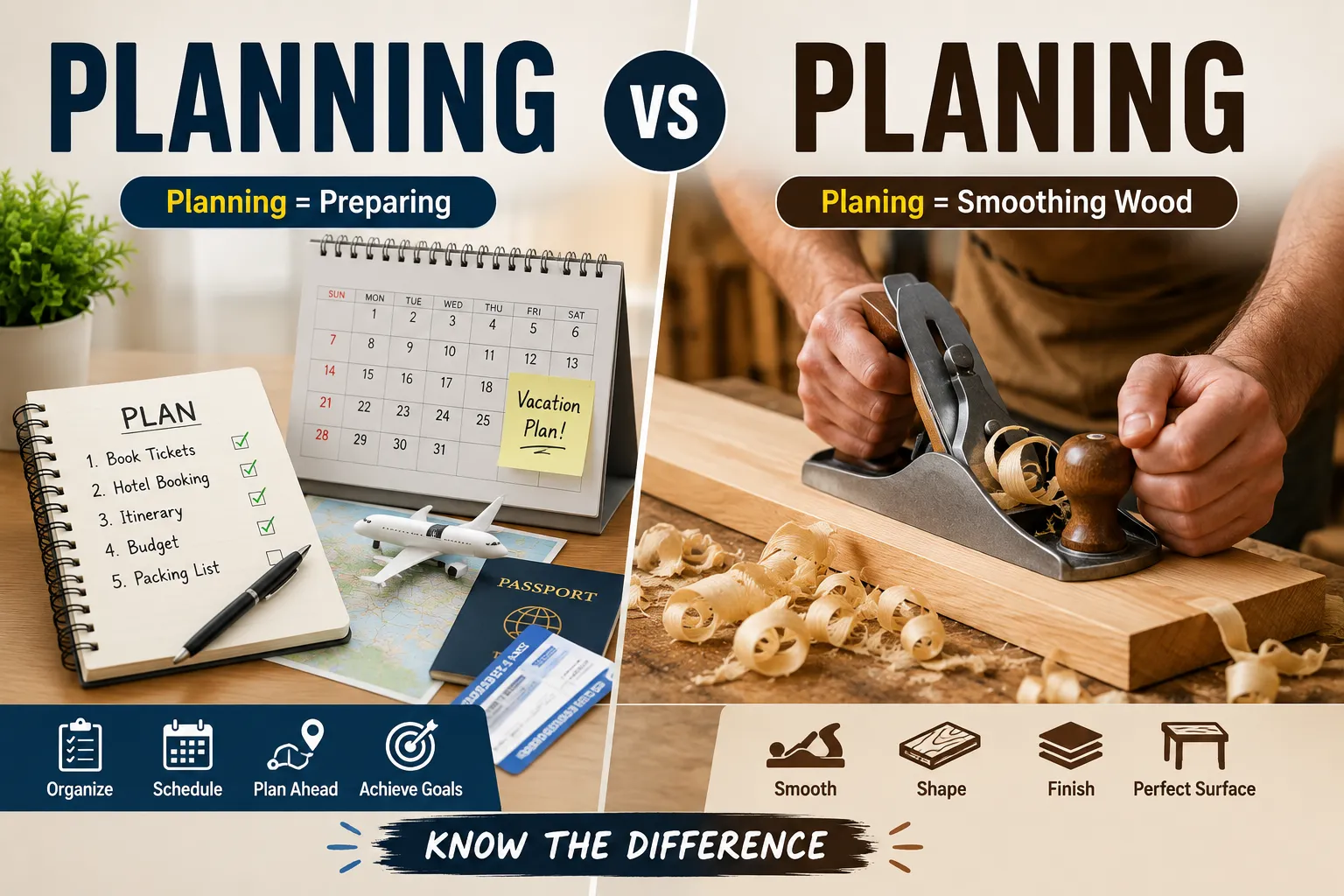
Planning or planing depends on meaning: planning means preparing or organizing something, while planing means smoothing wood with a plane.
Have you ever typed a sentence, stopped, and wondered, “Is it planning or planing?”
You are not alone. I have seen this mistake many times while helping students improve their English writing. The two words look almost the same. Yet, they have very different meanings.
Here is a simple example:
I am planning a trip.
This means you are preparing for a trip.
Now look at this:
The carpenter is planing the wood.
This means the carpenter is smoothing wood with a tool called a plane.
One extra n changes the word. It also changes the meaning.
The good news is that you do not need to memorize a long grammar rule. Once you understand where each word comes from, the difference becomes easy.
In this guide, you will learn the meaning, spelling, word history, common mistakes, real world examples, and a simple trick to remember planning vs planing. By the end, you should never need to guess again.
Planning or Planing
Planning is the correct word when you mean preparing, organizing, or deciding what to do.
Planing is a different word. It means smoothing or shaping a surface, usually wood, with a plane.
Simple examples
- We are planning our holiday.
- She is planning a birthday party.
- He is planing a wooden board.
- The carpenter spent the morning planing the door.
So, remember:
Planning = preparing
Planing = smoothing wood
For most everyday writing, you probably need planning
The Origin and Background of Planning and Planing
The confusion starts with the words plan and plane.
The verb plan means to think about something before you do it. It can mean to organize an event, prepare for a task, or decide what you want to do.
When we add ing, we get:
plan + ing = planning
The final n is doubled.
The word planing comes from plane. A plane is a tool used by woodworkers. It removes thin layers from wood and makes the surface smooth.
When plane becomes an ing form, the final e is removed:
plane + ing = planing
That gives us two different words:
- plan → planning
- plane → planing
This small spelling difference is why the words are easy to confuse.
Planning vs Planing: Key Difference Explained
The easiest way to understand the difference is to focus on the base word.
| Term | Meaning | When to Use | Region/Context |
|---|---|---|---|
| Planning | Preparing or organizing something | Events, work, travel, study, life | General English |
| Planing | Smoothing a surface with a plane | Woodworking and construction | Technical/trade contexts |
| Plan | To prepare or organize | Before an action | General English |
| Plane | To smooth a surface with a plane | Working with wood or similar materials | Technical/trade contexts |
Example 1: Planning
I am planning my exam schedule.
You are organizing your study time. Therefore, planning is correct.
Example 2: Planing
The carpenter is planing the wooden table.
The carpenter is using a plane to smooth the wood. Therefore, planing is correct.
The easy test
Ask yourself:
Am I preparing something?
Use planning.
Am I smoothing a surface with a plane?
Use planing.
That one question solves most cases.
Which Version Should You Use?
For most students and everyday writers, the answer is simple: use planning when you mean preparing or organizing.
For students
Use planning when talking about:
- Study plans
- Homework
- Exams
- School events
- Future goals
- Projects
Example:
I am planning my study schedule for next week.
For professionals
Use planning for:
- Business plans
- Meetings
- Projects
- Marketing
- Work schedules
- Company goals
Example:
The team is planning the next project.
For carpenters and woodworkers
Use planing when talking about smoothing wood with a plane.
Example:
The carpenter is planing the rough board.
For global and neutral English
Planning is the word you are most likely to need in normal conversation and writing.
Planing is correct too, but it has a much narrower meaning.
Common Mistakes With Planning and Planing
These mistakes happen because the words look almost identical.
| Mistake | Correction | Why? |
|---|---|---|
| I am planing a trip. | I am planning a trip. | A trip needs preparation. |
| She is planing a wedding. | She is planning a wedding. | A wedding is organized in advance. |
| The worker is planning the wood. | The worker is planing the wood. | A plane is used on wood. |
| We are planing our future. | We are planning our future. | You organize future actions. |
| He is planning the board. | He is planing the board. | He is smoothing the board. |
Mistake 1: Forgetting the double N
Incorrect:
I am planing my vacation.
Correct:
I am planning my vacation.
The base word is plan, so the spelling becomes planning.
Mistake 2: Adding an extra N to planing
Incorrect:
The carpenter is planning the wood.
Correct:
The carpenter is planing the wood.
Here, the base word is plane, not plan.
Mistake 3: Choosing by sound
The two words can sound very similar. That makes spelling by sound unreliable.
Instead, look at the meaning and the base word.
Planning or Planing in Real World Examples
Seeing the words in real situations makes the difference much easier to remember.
1. Professional email
Subject: Project Planning Update
Hi Sarah,
I am planning the next stage of the project and will share the schedule tomorrow.
Best,
James
Here, planning means organizing future work.
2. News headline
City Planning New Transport Project
The city is preparing and organizing a future project. Therefore, planning is correct.
3. Social media post
Planning my next trip and already making a list of places to visit!
This is about preparing for a trip.
4. Formal report
The company is planning several changes to its training program.
Again, the word means preparing or organizing.
5. Woodworking context
The carpenter is planing the board before applying the finish.
Here, planing is correct because the carpenter is smoothing the wood.
A Simple Grammar Rule for Planning
There is a useful spelling rule behind planning.
When a short word ends in one vowel followed by one consonant, the final consonant is often doubled before adding ing.
For example:
- run → running
- sit → sitting
- stop → stopping
- plan → planning
So:
plan + ing → planning
But plane follows a different pattern because the final e is removed:
plane + ing → planing
Compare them:
plan → planning
plane → planing
The extra letter is not random. It comes from the spelling rules used when adding ing.
Standalone Comparison: Planning vs Planing
| Term/Variant | Meaning | Region/Context | Best Used When |
|---|---|---|---|
| Planning | Preparing or organizing | General English | Talking about future actions |
| Planing | Smoothing a surface | Woodworking | Talking about using a plane |
| Plan | Prepare or organize | General English | Describing an action |
| Plane | Smooth with a plane | Woodworking | Describing a woodworking action |
A useful memory trick is:
Planning has two Ns because you plan things. Planing has one N because you use a plane.
Think about the base word. That makes the spelling easier to remember.
Planning or Planing: Data, Trends & Usage
The question “planning or planing?” has a clear informational search intent. People usually search it when they are writing an email, school assignment, article, report, or social media post.
The word planning appears far more often in everyday English because planning is a common part of daily life.
People talk about:
- Planning a trip
- Planning a wedding
- Planning a meeting
- Planning a career
- Planning a project
- Planning a budget
- Planning a lesson
By contrast, planing is mainly used in specialist contexts such as carpentry, woodworking, furniture making, and construction.
This matters because the correct spelling depends on the meaning, not simply on how the word looks.
If you are writing for a general audience, planning will usually be the word you need.
If your topic involves woodworking, check whether you mean planing.
Why Is “Planning” So Common?
Planning is part of almost every area of life.
Students plan their study time. Businesses plan projects. Families plan holidays. Teachers plan lessons. Governments plan public projects.
That is why planning is a common word in emails, reports, websites, news stories, and everyday conversation.
Planing, however, describes a specific physical action. You are much less likely to use it unless your subject involves woodworking or a similar technical process.
This difference in frequency is useful when proofreading. If you write:
We are planing our next meeting.
The meaning tells you something is wrong. Meetings are organized. They are not normally smoothed with a woodworking tool.
Frequently Asked Questions
Q: What does planning mean?
A: Planning means preparing, organizing, or deciding what you will do. For example, “I am planning my vacation” means you are preparing for the vacation.
Q: How do you use planning correctly?
A: Use planning when the base word is plan and you mean preparing or organizing something. Examples include “planning a trip,” “planning a meeting,” and “planning a project.”
Q: Planning vs planing — what is the difference?
A: Planning means preparing or organizing. Planing means smoothing a surface with a plane, usually in woodworking.
Q: Is planning acceptable in formal writing?
A: Yes. Planning is completely normal in formal English. It is widely used in reports, business writing, academic work, emails, and professional documents.
Q: Which version is correct — planning or planing?
A: Both are correct, but they have different meanings. Use planning for preparing or organizing and planing for smoothing a surface with a plane.
Q: Where does planning come from?
A: Planning comes from the verb plan. When ing is added, the final consonant is doubled: plan → planning.
Q: Can planning be used in a school assignment?
A: Yes. You can write about planning a project, planning a study schedule, or planning an experiment. It is a standard English word and is suitable for academic writing.
How to Remember Planning or Planing
If you often forget the spelling, use this quick trick.
Remember the base word
Plan → Planning
You are preparing something.
Plane → Planing
You are smoothing something.
Now connect each word with an image in your mind:
Planning: a student making a study plan.
Planing: a carpenter smoothing a wooden board.
The meaning gives you the spelling.
You can also use this sentence:
I am planning my project, but the carpenter is planing the wood.
Both words appear together. That makes the difference easier to remember.
Conclusion
The difference between planning and planing is small in spelling but large in meaning.
Planning comes from plan. It means preparing, organizing, or deciding what to do. You will use it for trips, meetings, projects, exams, goals, and many other everyday situations.
Planing comes from plane. It means smoothing a surface, especially wood, with a plane. It is mainly used in woodworking and other technical contexts.
The best way to remember the difference is to check the base word:
- plan → planning
- plane → planing
If you are talking about preparation, choose planning. If you are talking about smoothing wood with a tool, choose planing.
That simple meaning based test will help you avoid this spelling mistake in school, work, and everyday writing.
Now you know exactly when to use planning or planing, try the rule in your next piece of writing. Bookmark this guide so you never have to guess again.
Read more: Analysis vs Analyses: Complete Guide to Meaning, Usage & Differences

I started writing about English word differences after years of teaching students who kept making the same mistakes. My focus is on making spelling rules feel simple and easy to remember. At WordsCombo, I turn confusing word pairs into clear comparisons.