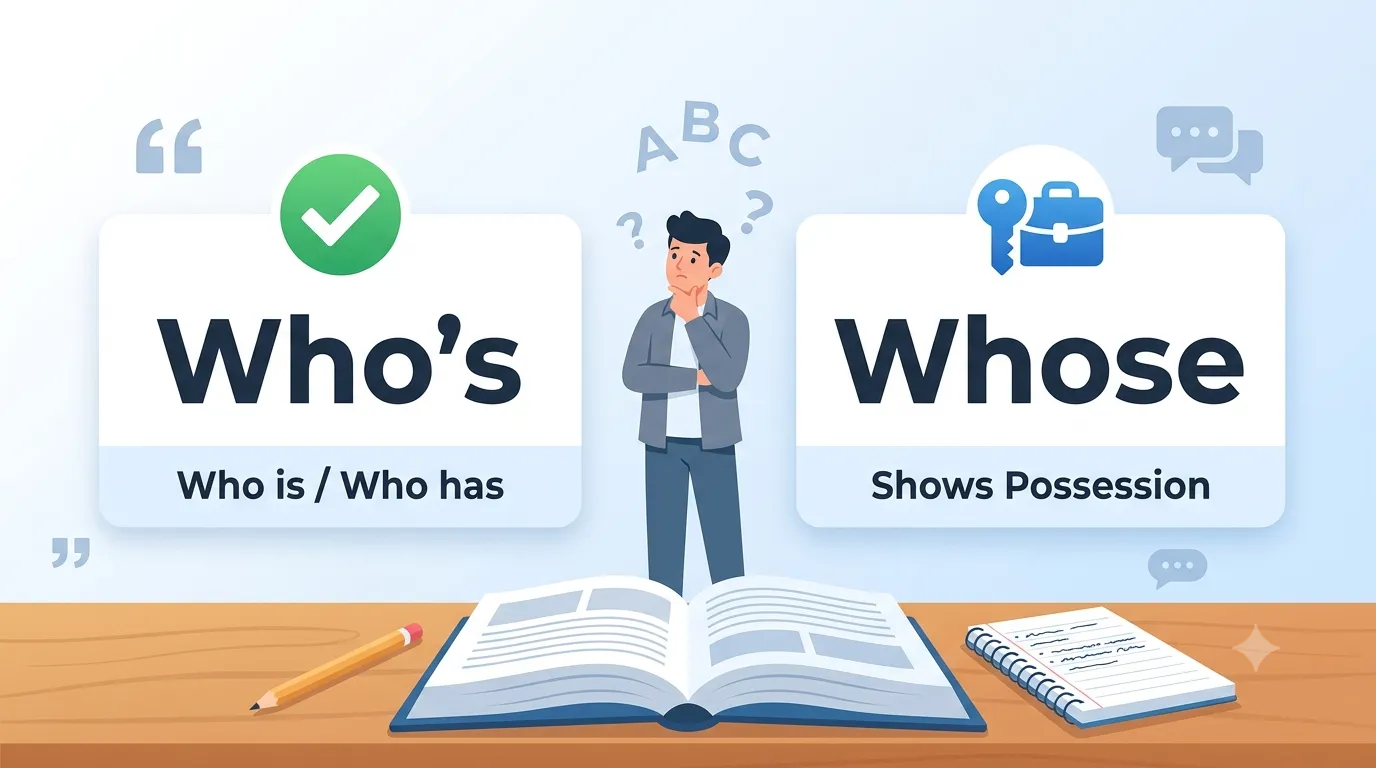
Whose is the correct word when you want to show ownership or ask who something belongs to. Who’s is a contraction of who is or who has. If you can replace it with who is, use who’s. Otherwise, use whose.
I still remember reading a student’s essay that began with, “Who’s backpack is on the table?” The writing was excellent, but that one small mistake changed the meaning of the sentence. It reminded me how often even smart writers mix up who’s and whose.
You’re not alone if you’ve searched for who’s or whose. These two words sound exactly the same. They look similar too. That makes them one of the most common grammar mistakes in English. Even experienced writers pause for a second before typing them.
The good news is that the rule is simple once you understand it. After teaching English for more than ten years, I’ve found that one easy trick helps almost everyone remember the difference.
By the end of this guide, you’ll know exactly when to use who’s and whose, avoid common mistakes, and write with confidence in emails, school assignments, business reports, and social media posts.
Who’s or Whose: Quick Answer
The difference is easy.
- Who’s = Who is or Who has
- Whose = Shows ownership or asks who owns something
Examples
✅ Who’s coming to dinner tonight?
(Who is coming?)
✅ Whose phone is ringing?
(Who owns the phone?)
A quick test works almost every time.
Replace who’s with who is.
If the sentence still makes sense, use who’s.
If not, use whose.
The Origin Background of Who’s or Whose
English has many words that sound alike but have different meanings. These are called homophones.
The word who comes from Old English. Over time, English added:
- Who’s as a short form of who is or who has
- Whose as the possessive form of who
Many people become confused because most possessive nouns use ‘s.
Examples:
- Sarah’s book
- John’s car
But pronouns follow different rules.
Compare these:
- his
- her
- their
- your
- whose
None of them use an apostrophe.
That is why whose has no apostrophe, even though it shows possession.
Who’s or Whose Explained: Key Differences
| Term | Meaning | When to Use | Region/Context |
|---|---|---|---|
| Who’s | Who is or who has | Contractions | British English, American English, Australian English, and worldwide |
| Whose | Belonging to whom | Possession or ownership | Used everywhere English is spoken |
Example with Who’s
- Who’s ready for lunch?
- Who’s finished the project?
Example with Whose
- Whose shoes are these?
- Whose idea was this?
Easy Memory Trick
Think about these examples:
- Who’s = Who is
- Whose = Ownership
If ownership is involved, choose whose.
Which Version Should You Use?
Different situations need different words.
For Students
Use who’s only when you mean who is or who has.
Example:
- Who’s absent today?
For Business Professionals
Check every email before sending it.
Correct:
- Whose approval do we need?
Incorrect:
- Who’s approval do we need?
For Bloggers and Content Writers
Grammar mistakes reduce trust.
Always test:
Can I replace it with who is?
If yes, use who’s.
If no, use whose.
For Everyone
Remember one simple rule:
Ownership = Whose
Who is = Who’s
Common Mistakes with Who’s or Whose
Here are mistakes people make every day.
| Mistake | Correct Version | Why It Happens |
|---|---|---|
| Who’s bag is this? | Whose bag is this? | Ownership needs whose |
| Whose coming today? | Who’s coming today? | Means who is |
| Who’s idea was that? | Whose idea was that? | Showing ownership |
| Whose going first? | Who’s going first? | Means who is |
| Who’s responsibility is this? | Whose responsibility is this? | Ownership again |
Why These Mistakes Happen
- The words sound identical.
- Spell check may not catch them.
- People think possession always uses an apostrophe.
Who’s or Whose in Real World Examples
Professional Email
Whose approval do we need before sending the proposal?
News Headline
Police are asking whose vehicle was left outside the station.
Social Media Post
Who’s excited for the weekend?
Formal Report
The committee reviewed whose recommendations should be included in the final report.
These examples show how naturally both words appear in everyday writing.
Who’s or Whose: Data, Trends & Usage
Many learners search for who’s or whose because it is one of the most confusing grammar topics in English.
Most Interested Audiences
- Students
- English learners
- Bloggers
- Business professionals
- Teachers
- Job seekers
Search Intent
Informational
People want a clear explanation, simple examples, and an easy rule to remember.
Regions Where It’s Common
- United States
- United Kingdom
- Canada
- Australia
- India
- Countries where English is taught as a second language
Why It Matters Today
People write more emails, social media posts, and online content than ever before. Small grammar mistakes can affect first impressions, professional credibility, and search engine content quality.
Standalone Comparison Table
| Term/Variant | Meaning | Region/Context | Best Used When |
|---|---|---|---|
| Who’s | Who is / Who has | Global English | Asking about a person performing an action |
| Whose | Belonging to whom | Global English | Asking about ownership or possession |
Frequently Asked Questions
Q: What does who’s mean?
A: Who’s is short for who is or who has. It is a contraction and always includes an apostrophe.
Q: What does whose mean?
A: Whose is a possessive pronoun. It asks who owns something or shows ownership.
Q: How do you use who’s correctly?
A: Use who’s when you can replace it with who is or who has. If the sentence still makes sense, you’ve chosen the right word.
Q: Who’s vs whose:what’s the difference?
A: Who’s means who is or who has. Whose shows possession. The words sound the same but have different meanings.
Q: Is whose acceptable in formal writing?
A: Yes. Whose is perfectly correct in formal writing, academic papers, business reports, and professional emails.
Q: Which version is correct: who’s or whose?
A: It depends on the sentence. If you mean who is, use who’s. If you’re talking about ownership, use whose.
Q: Where does whose come from?
A: Whose developed from the possessive form of who in Old English. It has been part of English for hundreds of years.
Q: Can whose be used for objects?
A: Yes. Although it often refers to people, whose can also refer to animals, organizations, or even objects in many modern writing styles.
Conclusion
The difference between who’s and whose is much easier than it first appears. Remember these three key points:
- Who’s means who is or who has.
- Whose shows ownership.
- If you can replace the word with who is, use who’s. If not, use whose.
This simple test will help you avoid one of the most common grammar mistakes in English. Whether you’re writing a school essay, a work email, a blog post, or a social media update, using the correct word makes your writing clearer and more professional.
Grammar doesn’t have to be difficult. Small improvements like this build confidence every time you write.
Now you know exactly how to use who’s and whose. Bookmark this guide so you never second guess them again, and share it with someone who always mixes them up!

I started writing about English word differences after years of teaching students who kept making the same mistakes. My focus is on making spelling rules feel simple and easy to remember. At WordsCombo, I turn confusing word pairs into clear comparisons.