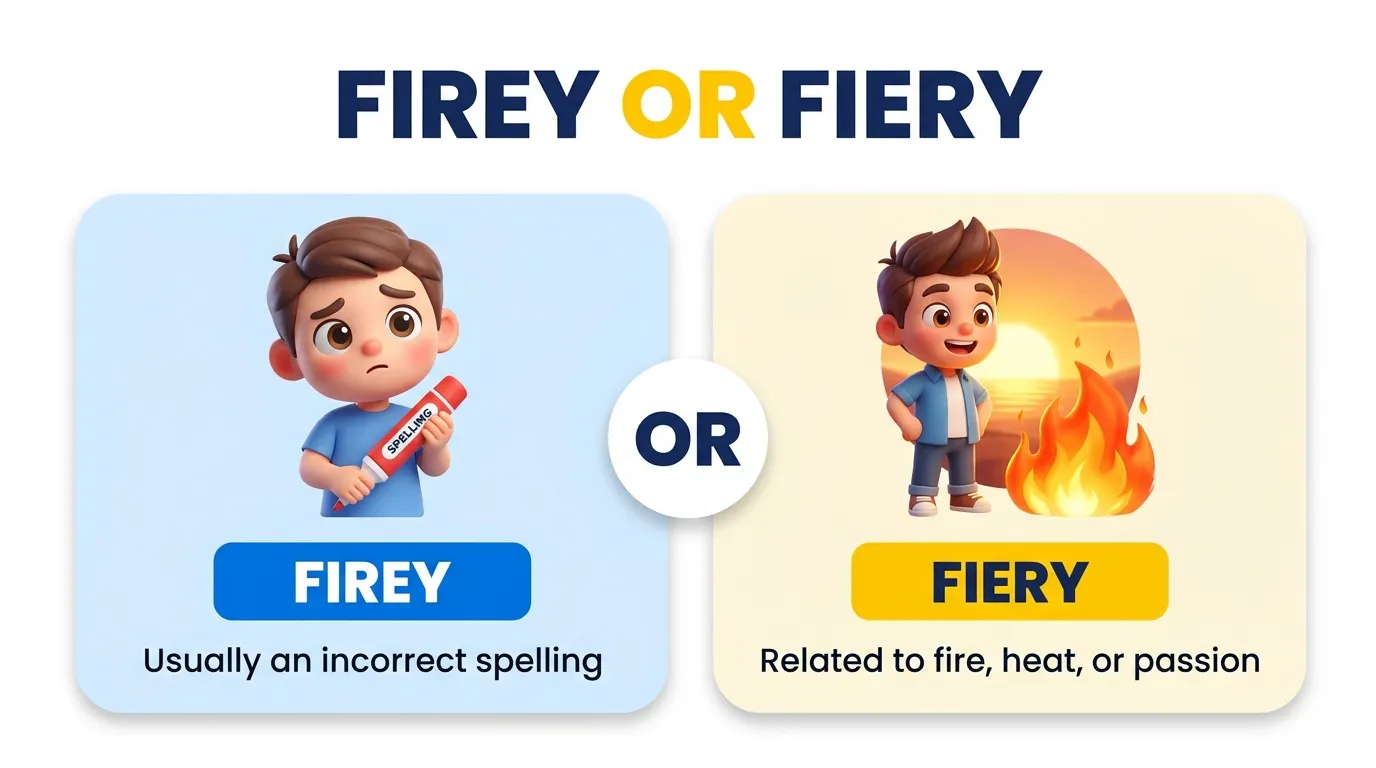
Firey or fiery means a spelling choice between two similar forms, and fiery is the correct standard spelling.
A red squiggly line appears as you finish an email: “The team had a firey debate.” You pause because firey or fiery looks like a tiny spelling choice, yet it can make polished writing look careless. The correct form is fiery, not firey, when you mean hot, bright, passionate, or related to fire. So, you can fix the sentence with one simple change.
Firey or Fiery: Quick Answer
The correct spelling is fiery. The form firey is usually a spelling mistake when you mean something like fire, hot, bright, spicy, or full of strong feeling.
For example, write “a fiery sunset” and “a fiery speech.” Do not write “a firey sunset” in standard English.
The Origin of Firey or Fiery
The word fiery comes from the old English word for fire and has long been linked with the idea of burning heat or flame. Over time, its spelling settled into the form we use today.
However, the wrong form feels natural because firey looks like fire plus y. English does not always build words by simply adding a letter to the modern base word. So, the safest way to remember it is fire → fiery.
The spelling can also confuse learners because the word still clearly points to fire. Yet the letters in the middle change order, giving us f-i-e-r-y. Once you learn that pattern, the mistake becomes much easier to avoid.
Firey or Fiery Explained: Key Differences
The main difference is simple: fiery is the standard adjective, while firey is normally a misspelling.
Fiery can describe real flames, strong heat, a bright red or orange look, spicy food, or strong emotions. For example, “The sky had a fiery glow” describes color, while “She gave a fiery speech” describes strong feeling.
Firey usually appears when someone writes the word the way it seems to be built. Still, readers can often understand it from context. Standard writing calls for fiery.
| Term | Meaning | When to Use | Region/Context |
| fiery | Like fire, hot, bright, spicy, or passionate | Standard writing | American and British English |
| firey | Usually a misspelling of fiery | Avoid for the ordinary adjective | Informal errors or deliberate names |
Firey or Fiery: Comparison at a Glance
| Term/Variant | Meaning | Region/Context | Best Used When |
| fiery | Related to fire or showing heat, color, passion, or intensity | Standard English | Emails, school work, articles, posts, and formal writing |
| firey | Usually intended to mean fiery | Nonstandard spelling | Avoid it unless it is a specific name or label |
Which One Should You Use?
For school writing, use fiery because it is the standard spelling. Your teacher or reader will recognize it as the normal adjective.
For work emails, choose fiery because clean spelling helps your message look polished. A sentence like “The meeting became a fiery debate” uses the word correctly.
For stories and social posts, use fiery when you mean hot, bright, passionate, or intense. If Firey is part of a real character, brand, username, or title, keep that special spelling.
For neutral everyday English, fiery is the clear choice. There is no normal American or British spelling split here.
Common Mistakes with Firey or Fiery
Mistake: Writing firey because fire + y looks logical.
Correction: Write fiery. This mistake happens because the base word is fire, so the wrong form feels easy to build.
Mistake: Using firey in a formal email.
Correction: Replace it with fiery. Formal writing benefits from standard spelling, even when the meaning is easy to guess.
Mistake: Thinking fiery only means “on fire.”
Correction: Use fiery for strong color, spicy taste, passion, anger, or energy too. For example, a fiery red dress has a strong red or orange color.
Mistake: Changing the spelling for American or British English.
Correction: Use fiery in both. Unlike some spelling pairs, this word does not normally change by region.
Mistake: Treating firey as a second standard adjective.
Correction: Use fiery for the ordinary word. A capitalized Firey can be correct when it is part of a specific name.
Firey or Fiery in Real-World Examples
Professional email: “The team had a fiery debate about the new plan.”
News headline: “Fiery Debate Follows the City Council Vote.”
Social post: “This sauce has a fiery kick, so start with a small amount.”
Formal document: “The speaker gave a fiery statement about the proposed change.”
Creative writing: “A fiery sunset filled the sky.”
Everyday message: “That was a fiery argument.”
Firey or Fiery: Data, Trends & Usage
Searches for firey or fiery are mostly spelling and grammar searches. People often type the two forms together because they want a fast answer before sending or publishing something.
Students, teachers, writers, editors, and English learners are likely to care about this word. Meanwhile, everyday users may search it after a spell checker flags firey.
The search intent is mainly informational, but it also has a strong quick-answer need. In fact, most readers want three things: the correct spelling, the meaning, and a few examples.
This matters now because short spelling searches often happen at the exact moment someone is writing. A clear answer can help a reader fix the word in seconds and remember it later.
FAQs About Firey or Fiery
Is it firey or fiery?
Fiery is the correct standard spelling. So, use fiery when you mean something related to fire, hot, bright, spicy, passionate, or intense.
What does fiery mean?
Fiery can describe something like fire or something that feels hot, bright, spicy, passionate, or intense. For example, “a fiery sunset” and “a fiery temper” use the word in different ways.
Is firey a word?
In ordinary English writing, firey is not the standard spelling of the adjective. However, Firey can appear as a special name, title, username, or character name when that spelling is chosen on purpose.
Is fiery accepted in formal writing?
Yes, fiery is suitable for formal writing. For example, you can use it in a report, business email, school paper, or formal statement when the meaning fits.
Is fiery the same in American and British English?
Yes, fiery is the normal spelling in both American and British English. Therefore, you do not need to change it based on the country of your reader.
Why do people spell fiery as firey?
People often write firey because it looks like fire plus y. However, the standard spelling is fiery, so remembering the letters f-i-e-r-y can help.
Can Firey ever be correct?
Yes, Firey can be correct when it is an exact name or label. Still, when you mean the ordinary adjective, choose fiery.
Final Thoughts on Firey or Fiery
The answer is simple: fiery is the standard spelling, while firey is usually a spelling mistake. Remember the middle letters: fier-y, not fire-y.
Also, fiery can describe flames, heat, color, spicy food, strong emotion, or an intense personality. Because the word has several uses, learning it once can help you write many kinds of sentences.
For school, work, and everyday writing, choose fiery with confidence. If you see firey, check whether it is a special name or simply a spelling error. Keep this easy rule in mind, and you will not need to pause over firey or fiery again.
Curious about similar words? Explore Zeros or Zeroes.

I started writing about English word differences after years of teaching students who kept making the same mistakes. My focus is on making spelling rules feel simple and easy to remember. At WordsCombo, I turn confusing word pairs into clear comparisons.









1 thought on “Firey or Fiery: Get the Spelling Right”