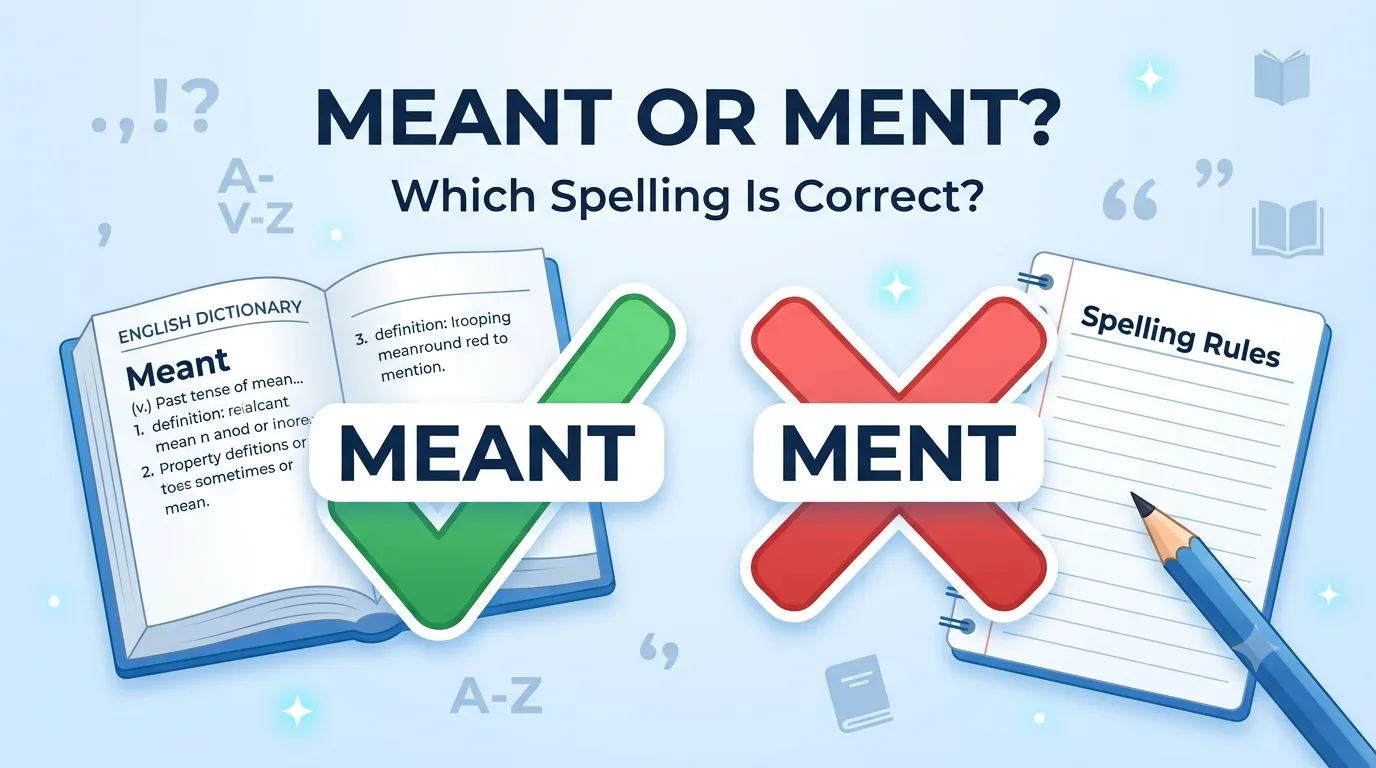
“Meant” is the correct past tense and past participle of the verb “mean.” “Ment” is a common misspelling and is not accepted in standard English writing.
A few years ago, while reviewing essays from my English students, I noticed the same mistake again and again. Many wrote “ment” instead of “meant.” It wasn’t because they didn’t know English. They simply wrote the word the way it sounds. I have also caught myself typing “ment” quickly and relying on spell check to fix it.
If you’ve ever paused and wondered whether it’s “meant” or “ment,” you’re not alone. English is full of words that don’t sound the way they are spelled. That makes even common words confusing.
The good news is that this mistake is easy to fix once you understand the reason behind it. In this guide, you’ll learn the correct spelling, why people get confused, where the word comes from, and how to use it with confidence. By the end, you’ll never have to second guess “meant” again.
Meant or Ment?
The correct spelling is meant.
It is the past tense and past participle of the verb mean.
The spelling ment is incorrect in standard English. It appears because the word meant is pronounced almost like “ment.”
Simple examples
✅ I meant to call you yesterday.
✅ She meant every word she said.
❌ I ment to call you yesterday.
❌ They ment no harm.
A simple trick to remember it is this:
If the base word is mean, the past form must keep the letters ea. That gives you meant.
The Origin and Background of “Meant”
English has borrowed words from many languages over hundreds of years. The verb mean comes from Old English mǣnan, which meant to intend, signify, or have in mind.
As the language changed over time, its spelling stayed almost the same, but its pronunciation changed. That is why meant sounds more like “ment” even though it is spelled with ea.
This is not unusual in English.
Many words keep older spellings even after their pronunciation changes.
For example:
- Bread
- Head
- Dead
- Meant
Each uses ea, but none sounds exactly like the word mean.
Why do people write “ment”?
There are several reasons.
- People spell the word the way they hear it.
- Fast typing leads to mistakes.
- Mobile keyboards encourage phonetic spelling.
- New English learners often follow pronunciation instead of spelling.
That is why ment has become a common search term online, even though it is not a real English word.
Meant or Ment Explained: Key Differences
At first glance, meant and ment look like two different words. In reality, only one is correct.
| Term | Meaning | When to Use | Region/Context |
|---|---|---|---|
| Meant | Past tense and past participle of mean | Always when talking about intention or meaning in the past | Standard English worldwide |
| Ment | Misspelling of meant | Never in formal or correct writing | Informal typing error only |
Example 1
Correct:
I meant to finish my homework before dinner.
Incorrect:
I ment to finish my homework before dinner.
Example 2
Correct:
What did you mean by that?
Past tense:
What meant the most to you?
Example 3
Correct:
She meant no harm.
Incorrect:
She ment no harm.
Why “Meant” Is Correct
The verb changes like this:
| Base Form | Past Tense | Past Participle |
|---|---|---|
| Mean | Meant | Meant |
Just like:
- Keep → Kept
- Sleep → Slept
- Feel → Felt
- Mean → Meant
These are irregular verbs, so they do not simply add ed.
Once you remember this pattern, the correct spelling becomes much easier.
A Quick Memory Trick
Think of this sentence:
“I mean it today, and I meant it yesterday.”
Notice that mean becomes meant, not ment.
Keeping the ea helps you remember the correct spelling every time.
Which Version Should You Use?
The answer is simple.
Use “meant” every time.
There is no situation where “ment” is the correct spelling in standard English.
Still, different readers have different needs. Here’s the best advice based on who you are.
For students
Always write meant in homework, exams, and assignments.
Teachers and examiners treat ment as a spelling mistake.
Example:
✅ I meant to answer the last question.
For professionals
Use meant in emails, reports, proposals, and presentations.
Correct spelling builds trust and shows attention to detail.
Example:
I meant to attach the updated report. Please find it attached now.
For content writers and bloggers
Always use meant in articles and web content.
Search engines reward quality content, and readers expect correct grammar.
Example:
The author meant to explain the idea in simple terms.
For English learners
Don’t spell the word based on its sound.
Instead, remember the base verb:
Mean → Meant
This simple pattern will help you avoid the mistake every time.
Best Recommendation
No matter where you live or what type of English you use—British, American, Canadian, Australian, or Indian English—the correct spelling is always:
✅ Meant
Never write:
❌ Ment
Common Mistakes with “Meant”
Many people know the meaning of the word but still make small spelling or grammar mistakes.
Here are the most common ones.
| Mistake | Correct Version | Why It Happens |
|---|---|---|
| I ment to call you. | I meant to call you. | People spell it the way it sounds. |
| She meaned well. | She meant well. | They forget that mean is irregular. |
| He meanted no harm. | He meant no harm. | Adding ed to an irregular verb. |
| I have mean it. | I have meant it. | Wrong past participle. |
| They ment everything they said. | They meant everything they said. | Phonetic spelling mistake. |
Why These Mistakes Happen
English spelling isn’t always logical.
Words like meant, bread, and friend don’t sound the way they’re written.
Many learners trust pronunciation more than spelling.
Autocorrect may also fail if ment is part of another word, such as government or development, making the error easier to miss.
How to Avoid the Mistake
Remember these quick tips:
- Start with the base verb: mean
- Past tense: meant
- Never remove the letters “ea.”
- Read your writing before sending it.
- Use a spell checker, but don’t depend on it completely.
Memory Trick
Think about this sentence:
I mean it today. I meant it yesterday.
The pattern is easy to remember once you’ve seen it a few times.
“Meant” in Real World Examples
Knowing the rule is helpful.
Seeing the word in real situations makes it even easier to remember.
Professional Email
Dear Sarah,
I meant to send the updated proposal yesterday, but I needed to verify a few details first.
Thank you for your patience.
Notice how meant explains an intention in the past.
News Headline
Coach Says His Earlier Comments Were Meant to Encourage the Team
Here, meant shows the speaker’s intended message.
Social Media Post
I meant to start my workout at 6 a.m., but my alarm had other plans. 😅
This is a natural, everyday use.
Formal Report
The revised policy was meant to improve communication between departments.
In business writing, meant often explains the purpose or intention behind a decision.
Everyday Conversation
Friend A:
Did you ignore my message?
Friend B:
No! I meant to reply, but I got busy.
Classroom Example
Teacher:
What did you mean by your answer?
Student:
I meant that both ideas are connected.
Customer Support Reply
We meant to notify customers before the update, and we apologise for the delay.
“Meant”: Data, Trends & Usage
The confusion between meant and ment is surprisingly common.
Thousands of people search online every month because they are unsure which spelling is correct.
Who Searches This Topic Most?
The topic is especially popular among:
- English language learners
- School and university students
- Content writers
- Bloggers
- Job seekers
- Professionals writing emails
- People preparing for English exams
Where Is It Most Common?
Searches come from many English speaking and English learning countries, including:
- United States
- United Kingdom
- Canada
- Australia
- India
- Pakistan
- Philippines
- Nigeria
The mistake appears worldwide because pronunciation is almost the same everywhere.
Search Intent
Primary Search Intent: Informational
People usually want to know:
- Which spelling is correct?
- Is ment a real word?
- How do I use meant correctly?
- Why is English spelling different from pronunciation?
Some users also look for grammar help while writing emails, essays, or social media posts.
Why This Topic Matters Now
Digital communication has made writing faster than ever.
People send emails, messages, and posts in seconds.
That speed increases typing mistakes, especially with words that sound different from how they are spelled.
At the same time, good writing matters more than ever. Whether you’re applying for a job, submitting an assignment, publishing a blog, or posting on social media, correct spelling leaves a better impression.
Learning the difference between meant and ment takes only a minute, but it helps you write with confidence for years.
Standalone Comparison Table
| Term/Variant | Meaning | Region/Context | Best Used When |
|---|---|---|---|
| Meant | Past tense and past participle of mean | Standard English worldwide | Always when referring to a past intention, purpose, or meaning |
| Ment | Misspelling of meant | Informal typing error only | Never in correct English writing |
| Mean | Base form of the verb | Standard English | Present tense or infinitive (e.g., I mean what I say.) |
| Meaning | Definition or significance of something | Standard English | Talking about the sense or definition of a word or idea |
Frequently Asked Questions (FAQs)
Q: What does “meant” mean?
A: Meant is the past tense and past participle of the verb mean. It shows that someone had an intention, purpose, or message in the past.
Example: I meant to call you yesterday.
Q: How do you use “meant” correctly?
A: Use meant whenever you talk about something you intended, wanted, or referred to in the past. It works with people, actions, ideas, and statements.
Example: She meant every word she said.
Q: “Meant” vs “Ment”: what’s the difference?
A: Meant is the correct English word. Ment is simply a misspelling. Although they sound almost the same, only meant should appear in correct writing.
Q: Is “ment” ever a correct word?
A: No. Ment is not a standard English word. If you see it by itself, it is almost always a spelling mistake for meant.
Keep in mind that ment is a suffix found in words like development, government, and agreement, but that is different from the standalone word ment.
Q: Is “meant” acceptable in formal writing?
A: Yes. Meant is perfectly correct in formal and informal English. You can confidently use it in academic papers, business emails, reports, legal documents, and professional communication.
Q: Where does the word “meant” come from?
A: Meant comes from the Old English verb mǣnan, which meant to intend or to signify. Over time, the pronunciation changed more than the spelling, which is why meant sounds like “ment.”
Q: Can “meant” be used in professional emails and reports?
A: Absolutely. It is commonly used to explain intention or purpose in workplace communication.
Example:
The revised policy was meant to improve customer service.
This sounds natural, clear, and professional.
Conclusion
If you’ve ever stopped to wonder whether the correct spelling is “meant” or “ment,” you now have a clear answer. The only correct spelling in standard English is meant. It is the past tense and past participle of mean, and it is used whenever you describe an intention, purpose, or meaning in the past.
Here are the key points to remember:
- Meant is always the correct spelling.
- Ment is a common spelling mistake caused by pronunciation.
- Remember the simple pattern: Mean → Meant.
- Using the correct spelling makes your writing clearer and more professional.
English can be tricky because words do not always sound the way they are spelled. Fortunately, this is one mistake you can avoid with a simple memory trick and a little practice.
The next time you write an email, complete an assignment, or publish a blog post, you’ll know exactly which word to choose.
Now you know exactly how to use “meant” correctly,put it into practice in your next piece of writing. If you found this guide helpful, bookmark it so you never second guess “meant” again, and share it with someone who has made the same mistake.
Read more: Transfering or Transferring: The Complete Spelling Guide

I started writing about English word differences after years of teaching students who kept making the same mistakes. My focus is on making spelling rules feel simple and easy to remember. At WordsCombo, I turn confusing word pairs into clear comparisons.