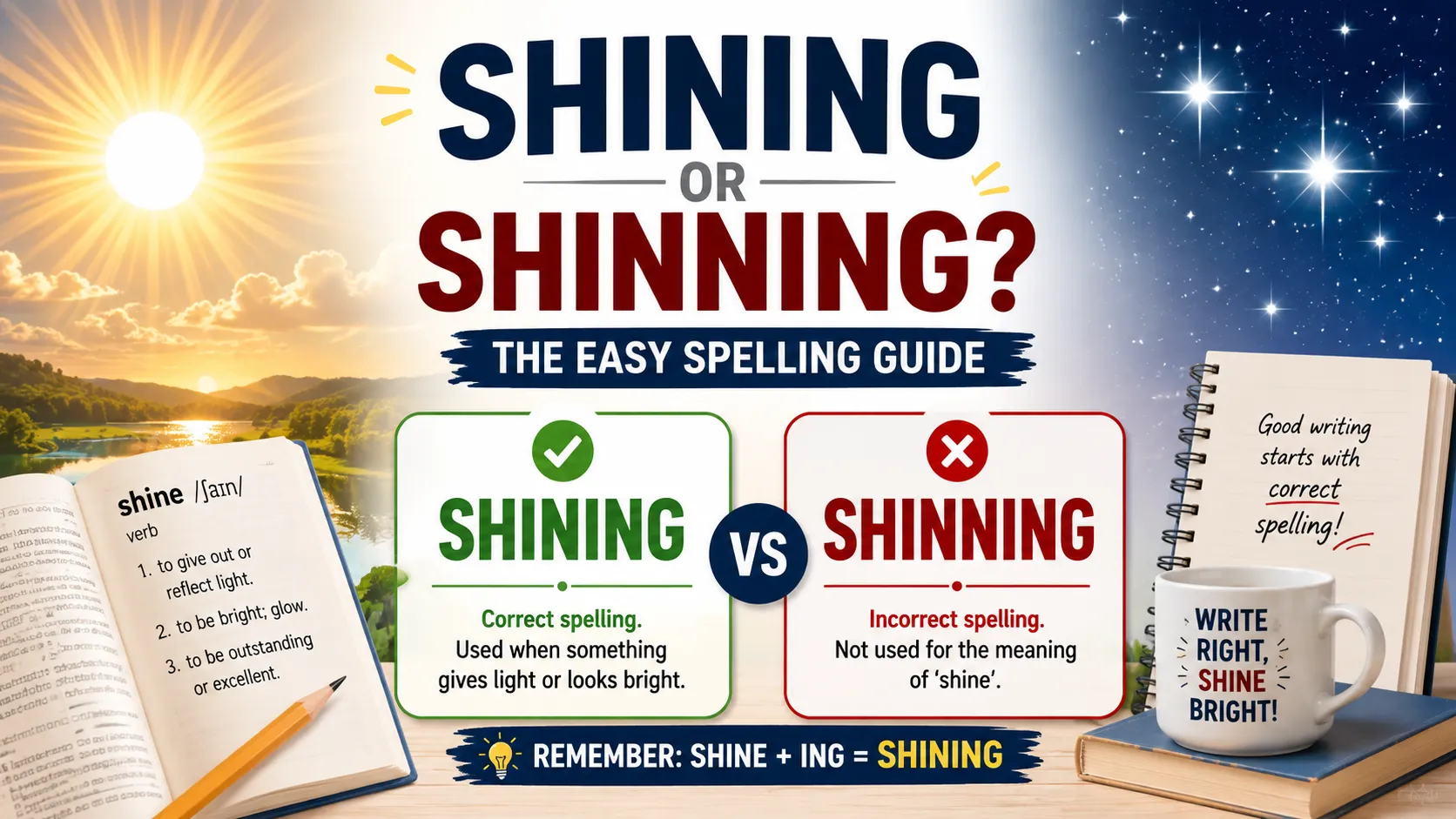
Shining is the correct spelling in standard English. Shinning is usually incorrect when you mean “giving off light” or “looking bright,” but it can be correct in a different context.
Have you ever typed “shining” and stopped to ask, “Wait, should this have two n’s?”
It is an easy mistake to make. English has many words that double their final consonant when we add ing. For example, run becomes running, and sit becomes sitting. So it feels natural to wonder if shine should become shinning.
The answer is simple: shine becomes shining, not shinning.
I often see this confusion when learners write sentences such as “The stars are shinning tonight” or “She has a shinning smile.” The extra n looks harmless, but it changes the spelling from the standard form to a different word pattern.
The good news is that you only need one simple rule to remember the correct form. In this guide, you will learn why shining is correct, when shinning can actually appear, and how to avoid this mistake in school, work, and everyday writing.
Let’s make the difference clear.
Shining or Shinning
Shining is the correct form of the verb shine when you add ing.
- The sun is shining. ✅
- Her eyes were shining with joy. ✅
- The stars are shinning. ❌
The word shine ends in a silent e. When we add ing, we normally remove that silent e.
shine → shining
We do not double the n.
A simple example
Think about this sentence:
The moon is shining brightly tonight.
Here, shining means giving off or reflecting light.
You can also use it in a figurative way:
She has a shining personality.
Here, shining means impressive, positive, or outstanding.
So, if you mean bright, glowing, excellent, or giving off light, use shining.
The Origin and Background of Shining
The word shining comes from the verb shine.
The verb shine has a long history in English. It is related to old Germanic words connected with light and brightness. Over time, it developed into the modern English word we use today.
The spelling rule is more useful than the history, though.
When a verb ends in a silent e, the e is often dropped before adding ing.
For example:
| Base Verb | + ing | Correct Form |
|---|---|---|
| shine | shine + ing | shining |
| make | make + ing | making |
| write | write + ing | writing |
| take | take + ing | taking |
| smile | smile + ing | smiling |
Notice the pattern.
The final e disappears.
So:
shine → shining
Not:
shine → shinning
This is one reason learners sometimes add the extra n. They may remember other English verbs that double a final consonant before ing.
For example:
- run → running
- swim → swimming
- sit → sitting
But shine does not follow that pattern.
Shining Explained: Key Differences and Variations
The biggest point to remember is that shining and shinning are not simply two spellings of the same word.
Shining
Shining is the normal spelling of the present participle of shine.
It can describe:
- giving off light
- reflecting light
- looking bright
- being very good or impressive
- showing a positive quality
Examples:
The stars are shining in the sky.
The floor was shining after it was cleaned.
She is a shining example of hard work.
His shining smile made everyone feel welcome.
Shinning
Shinning is a real word, but it is uncommon.
It can come from the verb shin, which refers to the front part of the lower leg. In some contexts, shin can also mean climbing by gripping or using your legs against something.
For example:
He was shinning up the pole.
This use is rare in everyday English. Most learners do not need it.
The important point is this:
Shinning is not the correct spelling of the ing form of shine.
Comparison Table
| Term | Meaning | When to Use | Region/Context |
|---|---|---|---|
| Shining | Giving off light or being bright | When describing light, success, beauty, or excellence | Standard English |
| Shinning | Climbing or moving using the shins; rare verb form | Only when related to the verb shin | Rare or specialized use |
| Shine | To give off or reflect light | Base form of the verb | Standard English |
| Shone | Past form of shine in many uses | Talking about past light or brightness | Common, especially British English |
| Shined | Past form in some uses | Certain meanings, especially polishing or performing | Common in American English in some contexts |
Which Version Should You Use?
For almost every normal writing situation, choose shining.
For students
Use shining when writing essays, homework, answers, or stories.
The sun was shining through the window.
This is the safe and standard choice.
For professional writing
Use shining in emails, reports, presentations, and business content.
Your team has done a shining job this quarter.
A more natural business phrase may be “excellent job”, but shining is grammatically correct.
For social media
Shining is also the correct choice in captions and posts.
Keep shining! ✨
The stars are shining tonight.
For global or neutral English
Choose shining.
It is widely understood and follows standard English spelling rules.
Quick rule: If your sentence comes from shine, write shining.
Common Mistakes With Shining
Here are some mistakes worth watching for.
1. Mistake: Shinning
❌ The sun is shinning.
✅ The sun is shining.
Why does this happen?
People often expect the final consonant to double before ing. But shine loses its silent e instead.
2. Mistake: Shinning star
❌ She is a shinning star.
✅ She is a shining star.
The phrase shining star is common. It can describe someone who is talented, successful, or impressive.
3. Mistake: Shinning example
❌ He is a shinning example of courage.
✅ He is a shining example of courage.
The phrase shining example means someone or something that is a very good example of a quality.
4. Mistake: Adding the silent e
❌ The moon is shineing.
✅ The moon is shining.
Do not keep the e when adding ing.
shine + ing → shining
5. Mistake: Assuming every short verb doubles its last letter
English spelling does not work that way.
Compare:
- shine → shining
- run → running
- write → writing
- sit → sitting
The spelling pattern depends on the structure of the base verb.
Shining in Real World Examples
Seeing the word in different settings makes the rule easier to remember.
1. Professional Email
Subject: A Shining Result From the Team
The team’s hard work is shining through in the latest project results. Thank you for your effort and care.
Here, shining is used in a figurative sense. It suggests that the team’s quality is clearly visible.
2. News Article
“Shining Stars Lead Their Team to Victory”
A headline may use shining to describe people who perform very well.
3. Social Media Post
The city lights are shining tonight. What a beautiful view! ✨
This use is direct and literal.
4. Formal Report
The student showed shining leadership during the community project.
Here, shining means excellent or outstanding.
5. Everyday Conversation
“Why is the floor shining?”
“I just cleaned it.”
This is a simple literal use.
Shining or Shinning: Data, Trends and Usage
The search intent behind “shining or shinning” is mainly informational.
People who search this phrase usually want to know one of three things:
- Which spelling is correct?
- Why is shining spelled without two n’s?
- Is shinning ever a real word?
This confusion is especially common among English learners, students, writers, and people checking their spelling before publishing text.
It also reflects a wider issue in English: spelling rules often overlap.
Learners see words such as running, swimming, and winning. They may then apply the same pattern to shine. That creates shinning.
But the structure is different.
The correct process is:
shine → remove e → add ing → shining
Understanding that pattern is more useful than simply memorizing the spelling.
It also helps with similar verbs such as:
- write → writing
- drive → driving
- smile → smiling
- hope → hoping
- dance → dancing
The lesson is simple: do not double the final consonant just because a verb ends in a single consonant sound.
Shining or Shinning: Standalone Comparison
| Term/Variant | Meaning | Region/Context | Best Used When |
|---|---|---|---|
| Shining | Giving light or showing excellence | Standard English | Almost all normal uses of shine + ing |
| Shinning | Form of shin meaning climbing or moving in a certain way | Rare/specialized | Only when using the verb shin |
| Shine | Give off or reflect light | Standard English | Base verb |
| Shone | Past form of shine | Common in British English and also widely understood elsewhere | Past events involving light |
| Shined | Alternative past form in some meanings | More common in American English for certain uses | Polishing or specific meanings |
If you are simply asking, “Is the sun shinning?”, the answer is no.
Write:
The sun is shining.
A Quick Memory Trick
Here is an easy way to remember the spelling.
Think:
The silent E shines away.
Start with:
SHINE
Add ING.
The final E disappears:
SHIN + ING
That gives:
SHINING
The spelling has only one n after the i.
You can also remember this sentence:
The sun is shining, not shinning.
Say it a few times. It makes the correct spelling stick.
FAQs About Shining or Shinning
Q: What does shining mean?
A: Shining is the ing form of shine. It can mean giving off or reflecting light, or it can describe someone or something that is excellent or impressive.
Q: How do you use shining correctly?
A: Use shining when the base verb is shine. For example, “The sun is shining” and “She has a shining smile” are correct.
Q: Shining vs. shinning: what is the difference?
A: Shining comes from shine. Shinning can come from shin, but that word is rare. If you mean bright, glowing, or excellent, use shining.
Q: Is shining acceptable in formal writing?
A: Yes. Shining is a standard English word and is fully acceptable in formal writing. The exact meaning depends on the sentence.
Q: Which version is correct: shining or shinning?
A: Shining is correct when it comes from the verb shine. Shinning is not a spelling variant of shining.
Q: Where does the word shining come from?
A: Shining comes from the verb shine, an old English word with Germanic roots linked to light and brightness.
Q: Can shining describe a person?
A: Yes. It can describe someone who is excellent, talented, kind, or successful. For example, “She is a shining example of leadership.”
Q: Why does shining have only one n?
A: Because shine ends with a silent e. Before adding ing, the e is removed. So shine + ing = shining.
Q: Is shinning ever a real word?
A: Yes, but it is uncommon. It can be the ing form of shin, a verb related to climbing or moving in a particular way. It is not the normal spelling of shine + ing.
Conclusion
The choice is easy once you know the rule.
If you mean giving off light, reflecting light, looking bright, or showing excellence, use shining.
The correct spelling is:
shine → shining
The spelling shinning is not an alternative spelling of shining. It can appear as a rare form of the verb shin, but that is a different word with a different meaning.
The most useful rule to remember is that shine loses its silent e before ing. The same pattern appears in words such as write → writing, make → making, and smile → smiling.
So the next time you write about a bright sun, a glowing star, or a person who stands out, do not second guess yourself.
Write:
The sun is shining.
Now you know exactly which form to use. Bookmark this guide so you never have to second guess “shining or shinning” again.
Read more: Patient or Pacient: The Easy Spelling Guide

I started writing about English word differences after years of teaching students who kept making the same mistakes. My focus is on making spelling rules feel simple and easy to remember. At WordsCombo, I turn confusing word pairs into clear comparisons.