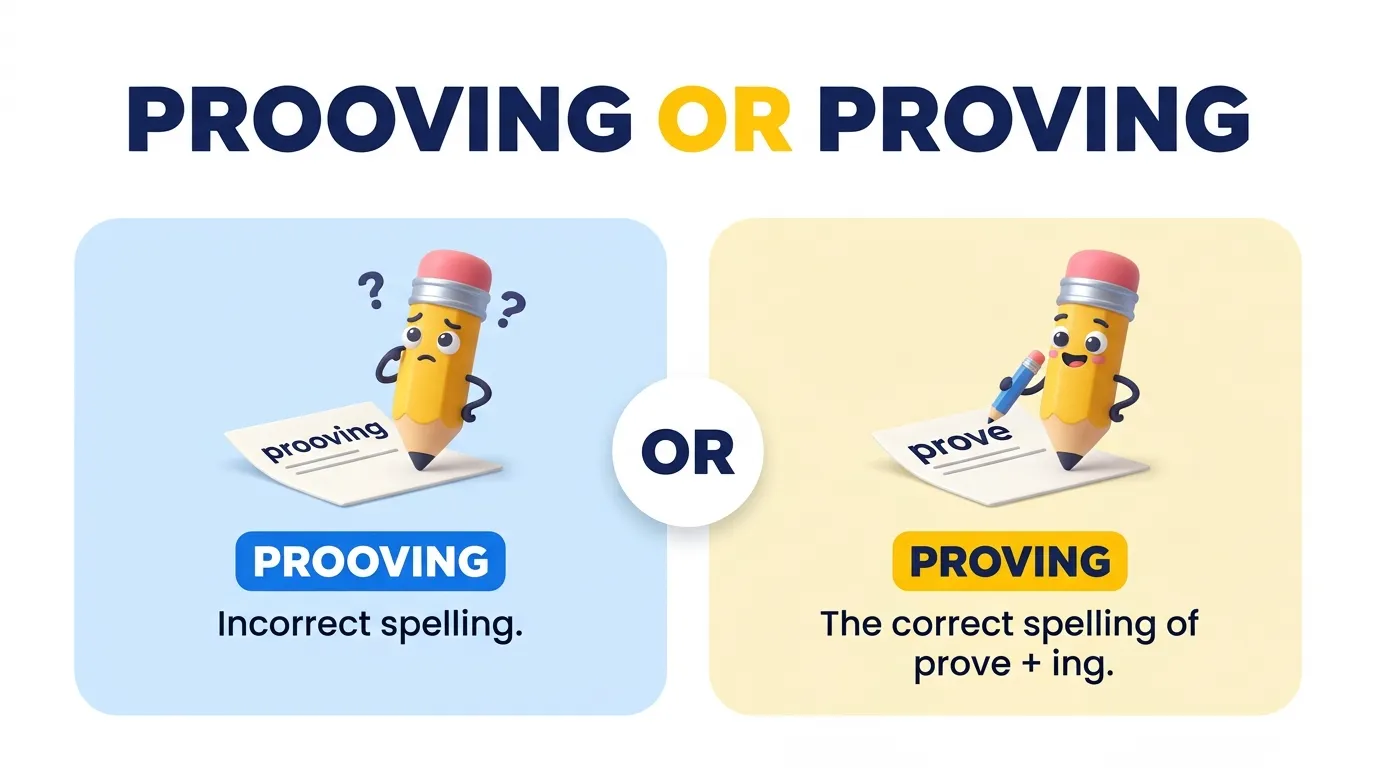
Proving is the correct spelling. It is the present participle of prove, which means to show that something is true. Prooving is a misspelling because the word prove keeps one o when you add -ing.
When you are writing an email or finishing a school assignment, a red squiggly line under prooving can make you stop and wonder which spelling is right. The answer is simple: use proving, not prooving. Once you learn the spelling rule, you can write this word with confidence and avoid the same mistake in other words.
Prooving or Proving: Quick Answer
Proving is the only correct spelling in standard English. You form it by taking prove and adding -ing, without changing the spelling of the word’s main part.
- Correct: She is proving her point with facts.
- Incorrect: She is prooving her point with facts.
Remember, the word prove already has two vowels, but you do not add another o when you form proving.
The Origin of Proving
The word prove has a long history. It came into English through Old French and can be traced back to the Latin word probare, which meant to test, check, or show that something was true.
Over time, the word became common in law, science, school, and daily life. For example, people use it to show that a fact is true or that a claim is correct.
The spelling rule is also easy to understand. English often drops a silent e before adding -ing. As a result, prove becomes proving, just as move becomes moving and write becomes writing*.**
Prooving or Proving Explained: Key Differences
The main difference is spelling. Proving is correct, while prooving is not a standard English word.
The correct form also works in many settings. You can use it when talking about facts, skills, test results, or even bread dough that is rising.
Here are a few examples:
- Correct: He is proving that his answer is right.
- Incorrect: He is prooving that his answer is right.
- Correct: The team is proving its skills on the field.
- Incorrect: The team is prooving its skills on the field.
The rule stays the same in American and British English.
Proving and Prooving: A Quick Comparison
| Term | Meaning | When to Use | Region/Context |
|---|---|---|---|
| Proving | Showing that something is true | All standard writing | American and British English |
| Prooving | Incorrect spelling of proving | Do not use in standard writing | Not a standard regional spelling |
| Prove | To show that something is true | Present tense or after words like to | Standard English |
| Proved | The past form of prove | When something was shown to be true | Standard English |
| Proven | Often used to mean shown to be true | With forms of have or as an adjective | Standard English |
For example, you can write, “She is proving her point,” or “She has proven her point.” However, you should never write “She is prooving her point” in standard English.
Which One Should You Use?
The choice is simple because proving is the correct form for everyone who writes in standard English.
- For students: Use proving in homework, essays, and tests because it follows the correct spelling rule.
- For workers: Choose proving in emails, reports, and work messages to keep your writing clear.
- For bloggers and writers: Write proving in articles and social posts because it is the accepted form.
- For British English users: Use proving when you mean showing that something is true.
- For American English users: The same rule applies, so use proving rather than prooving.
If you are unsure, remember this simple pattern: prove + ing = proving.
Common Mistakes with Prooving or Proving
Many people make spelling mistakes when they add endings to words. However, you can avoid this error by learning a few simple rules.
Adding an Extra O
Mistake: The test is prooving his answer.
Correction: The test is proving his answer.
This error happens because the writer keeps the full spelling of prove and adds -ing without removing the silent e.
Keeping the Silent E
Mistake: She is proveing her point.
Correction: She is proving her point.
The final e is usually dropped before you add -ing. Therefore, the correct spelling is proving.
Confusing Proving with Proved
Mistake: Yesterday, he was proved his point.
Correction: Yesterday, he proved his point.
Use proved for a completed action in the past. By contrast, use proving for an ongoing action or when the word acts like a noun.
Using Prooving in Formal Writing
Mistake: The report is prooving that sales have grown.
Correction: The report is proving that sales have grown.
Although readers may understand the mistake, it can make your writing look less polished. So, check the spelling before sending a report or publishing an article.
Confusing Proving with Proofing
Mistake: The scientist is proofing the result when the intended meaning is showing that the result is true.
Correction: The scientist is proving the result.
The words proving and proofing can have different meanings. Proofing is often used when checking written work or allowing bread dough to rise, while proving often means showing that something is true.
Proving in Real-World Examples
You can use proving in many types of writing. These examples show how it fits into daily life.
In a Professional Email
“Hello Sarah, the new test results are proving that our plan is working well.”
Here, proving shows that the results support the plan.
In a News Headline
“Young Athlete Is Proving Her Talent on the National Stage”
In this headline, proving tells readers that the athlete is showing her skills through her actions.
In a Social Media Post
“I’m proving to myself that small steps can lead to big changes.”
This sentence uses proving to describe personal growth and effort.
In a Formal Document
“The latest records are proving useful in checking the accuracy of the report.”
In formal writing, proving can describe evidence that helps show whether something is true.
In a School Assignment
“The student is proving the answer by showing each part of the math problem.”
This example shows how proving can describe the process of giving reasons or evidence.
In a Baking Recipe
“Leave the dough in a warm place while it is proving.”
In this case, proving means allowing yeast dough to rise before baking. The spelling is still correct, even though the meaning differs from showing that a claim is true.
Prooving or Proving: Data, Trends and Usage
People who search for prooving or proving usually want to know which spelling is correct. They may be writing a school assignment, checking an email, or editing an article.
This search has a clear purpose. The reader wants a quick answer, a simple spelling rule, and examples that make the difference easy to remember.
The main groups who may need this answer include:
- Students who want to avoid spelling errors in schoolwork.
- English learners who are learning how to add endings to verbs.
- Office workers who need clear and correct emails.
- Content writers who want clean, professional articles.
- Teachers and editors who help others improve their writing.
A useful lesson is that this spelling rule applies to many common verbs. Once you learn prove to proving, you can also remember move to moving and write to writing.
There is no need to memorize a different rule for every word. Instead, learn how a silent e often disappears before -ing. This simple pattern can help you avoid similar mistakes in the future.
Prooving or Proving: Comparison at a Glance
| Term/Variant | Meaning | Region/Context | Best Used When |
|---|---|---|---|
| Proving | Showing something is true | Standard English worldwide | Talking about evidence or an ongoing action |
| Prooving | Misspelling of proving | Not accepted as a standard form | Never in standard writing |
| Prove | To show something is true | Standard English worldwide | Talking about an action in its basic form |
| Proved | Showed something was true | Standard English worldwide | Describing a completed action |
| Proven | Shown to be true or effective | Standard English worldwide | Describing a result or a quality |
| Proofing | Checking text or letting dough rise | Editing and baking | Talking about proofreading or dough preparation |
Keep this table handy if you often mix up these forms. It can help you choose the right word without spending too much time thinking about the spelling.
Frequently Asked Questions
Is it prooving or proving?
Proving is the correct spelling. The word prove loses its final silent e before you add -ing, so the result is proving.
What does proving mean?
Proving means showing that something is true, correct, or real. For example, “The facts are proving his claim” means the facts support what he says.
Why is prooving incorrect?
The spelling prooving adds an extra o and keeps the silent e from the base word. However, English spelling rules usually drop that final e before adding -ing, which gives us proving.
Is proving correct in American English?
Yes, proving is the correct spelling in American English. It is also correct in British English, so you do not need to change it based on your audience.
What is the difference between proving and proofing?
Proving usually means showing that something is true, but it can also describe dough rising in baking. Proofing often means checking written work for errors or letting dough rise, depending on the context.
What is the past tense of prove?
The simple past tense is proved. For example, “The test proved that the answer was correct.” The word proven is also used as a past participle and as an adjective, as in “a proven method.”
Can I use proving in formal writing?
Yes, proving is fully acceptable in formal writing. You can use it in reports, school essays, research papers, business emails, and other professional documents because it is the standard spelling.
Final Thoughts on Prooving or Proving
The correct spelling is proving, not prooving. The word comes from prove, and its final silent e is dropped before adding -ing. This rule also helps explain why we write moving instead of moveing.
Remember that proving can mean showing that something is true. It can also describe dough rising before baking. Meanwhile, proved and proven have their own uses, so choose the form that fits your sentence.
My final advice is simple: write proving whenever you mean the -ing form of prove. Before you send an email or finish an assignment, check the spelling once more. Practice this rule today, and you will find it easier to write with confidence.
Curious about more confusing English words? Explore Is It Suprise or Surprise.

I started writing about English word differences after years of teaching students who kept making the same mistakes. My focus is on making spelling rules feel simple and easy to remember. At WordsCombo, I turn confusing word pairs into clear comparisons.