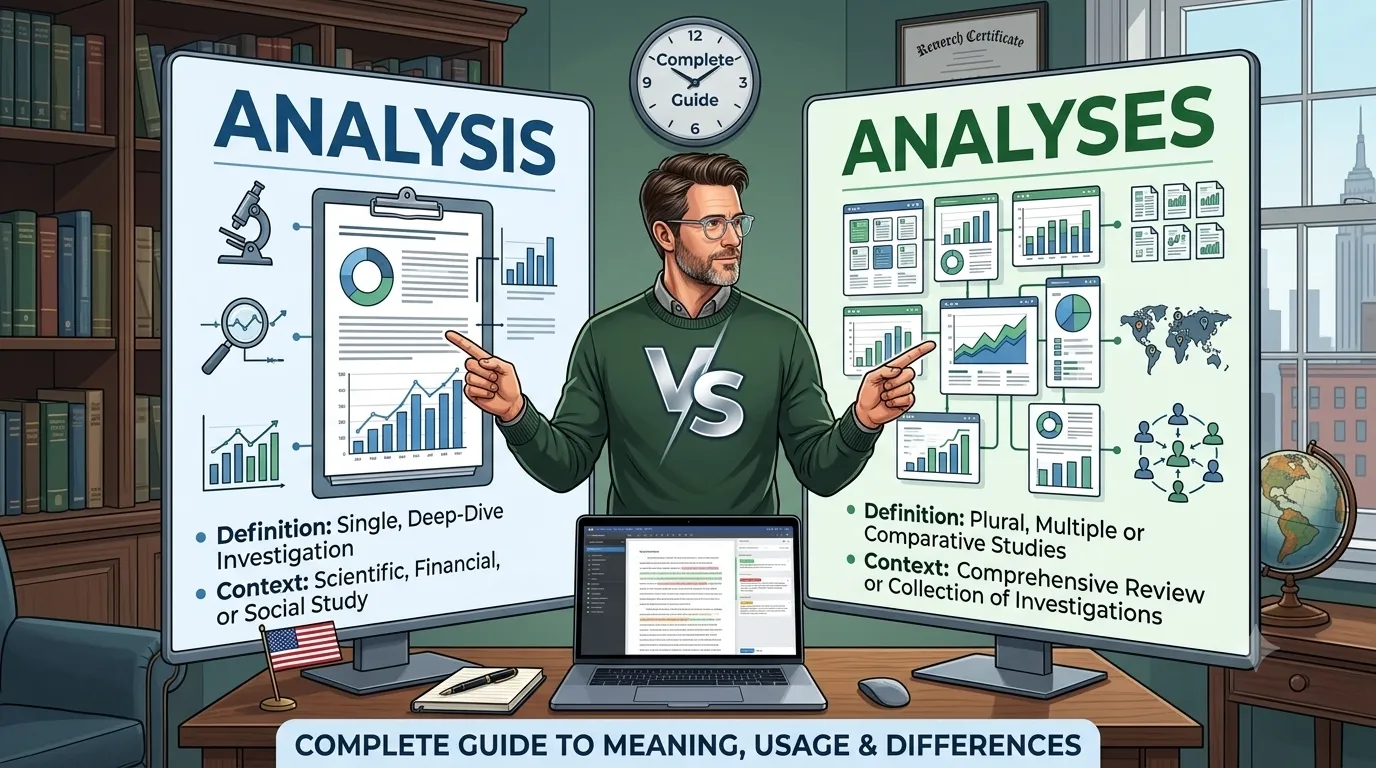
📊 Analysis is singular, while analyses is the plural form. 💡 Easy trick: One = analysis | More than one = analyses.
I learned the difference between “analysis” and “analyses” while helping students improve their academic writing. Many smart writers made the same mistake, using “analyses” for one study and “analysis” for multiple reports.
This confusion happens because both words look almost identical. They share the same root, sound similar, and appear in fields such as research papers, business reports, news articles, and school assignments.
The key is simple: analysis is singular, and analyses is plural.
In this guide, you will learn when to use each word. You will see examples, common mistakes, and simple tricks to remember the difference. Whether you are a student, writer, researcher, or professional, this article will help you use these terms with confidence.
Let’s begin by breaking down the meaning behind both words.
Analysis vs Analyses : Quick Answer
Analysis is the process of examining something carefully to understand its parts, meaning, or results.
Analyses refers to two or more separate examinations or studies.
Simple examples:
- One analysis: The scientist completed an analysis of the water sample.
- Multiple analyses: The researchers conducted several analyses of water samples.
Think of it like this:
- Analysis = one study
- Analyses = multiple studies.
The Origin and Background of Analysis
The word analysis comes from the Greek word “analyein,” which means “to break apart” or “to loosen.”
The idea behind analysis is simple: you take something complex and break it into smaller parts to understand it better.
Over time, the word became common in many fields, including:
- Science
- Education
- Business
- Medicine
- Technology
- Literature
- Finance
For example:
A doctor analyses medical results.
A company performs an analysis of customer behaviour.
A student writes an analysis of a novel.
The plural form, analyses, follows an older Greek-style spelling pattern, which is why it does not become “analysises.” The spelling changes because the word comes from Greek, not standard English rules.
Analysis Explained : Key Differences and Variations
The biggest difference between analysis and analyses is the number of examinations being discussed.
| Term | Meaning | When to Use | Region/Context |
| Analysis | A single detailed examination | When discussing one study, report, or evaluation | Used worldwide |
| Analyses | More than one detailed examination | When discussing multiple studies or evaluations | Used worldwide, especially academic contexts |
Examples of Analysis
- The market analysis shows that customers prefer affordable products.
- Her financial analysis helped the company reduce costs.
- The doctor reviewed the blood test analysis.
In each statement, there is only one examination.
Examples of Analyses
- The researchers compared different analyses of climate change data.
- The company reviewed several market analyses before launching the product.
- These medical analyses revealed different health patterns.
Here, multiple studies or evaluations are involved.
Which Version Should You Use?
Choosing between “analysis” and “analyses” depends on what you are discussing.
For Students and Learners
Use analysis when writing about one topic, book, article, or idea.
Example:
My analysis of Shakespeare’s play focuses on the main character.
Use analyses when comparing multiple studies or viewpoints.
Example:
The paper includes analyses from different researchers.
For Researchers
Researchers often use both terms.
Use analysis for:
- One research method
- One dataset review
- One conclusion process
Example:
The statistical analysis was completed using new software.
Use analyses for:
- Multiple experiments
- Different research methods
- Several data evaluations
Example:
The study includes analyses of five different populations.
For General and Professional Writing
For everyday writing, analysis appears more often.
If you are unsure, ask yourself:
“Am I talking about one examination or many?”
- One → analysis
- Many → analyses
Common Mistakes with Analysis and Analyses
Many people make small grammar mistakes with these words. Here are the most common ones.
| Mistake | Correction | Why |
| I wrote three analysis reports. | I wrote three analyses reports. | Three means more than one |
| The analyses is complete. | The analysis is complete. | One study needs singular form |
| Many analysis were performed. | Many analyses were performed. | Many requires plural |
| The research has several analysis. | The research has several analyses. | Several means multiple |
Mistake 1: Using “Analyses” for One Thing
❌ The analysis of the data are complete.
✅ The analysis of the data is complete.
Why?
Because analysis is singular.
Mistake 2: Adding “-es” Incorrectly
❌ analysises
✅ analyses
The plural form changes completely.
Mistake 3: Confusing Pronunciation
The two words also sound different.
- Analysis → uh-NAL-uh-sis
- Analyses → uh-NAL-uh-seez
The ending sound helps you identify the difference.
Analysis vs Analyses in Actual Examples
Professional Email
Correct use of analysis: I completed the market analysis and attached the final report.
Meaning: One market study was completed.
Research Paper
Correct use of analyses:
The study delivers several analyses of economic trends across several countries.
Meaning: Multiple evaluations were performed.
News Article
Example:
New economic analysis shows changes in consumer spending.
One examination of economic data.
Social Media Post
Example:
Our latest customer analysis shows what buyers really want.
One business evaluation.
Formal Report
Example:
The report contains in-depth analyses of sales performance, customer behaviour, and market patterns.
Multiple evaluations.
Analysis vs Analyses : Data, Trends & Usage
The word “analysis” is searched more often because people usually look for explanations on a single topic.
Common searches include:
- Data analysis
- Market analysis
- SWOT analysis
- Literary analysis
- Financial analysis
The term analyses appears more often in academic, scientific, and research settings.
People commonly encounter analyses in:
- Research journals
- University papers
- Medical studies
- Scientific reports
The reason this topic matters today is that analytics-based decisions are everywhere. Businesses, schools, and researchers constantly examine information, so knowing the correct term helps your writing look professional and accurate.
Standalone Comparison Table
| Term/Variant | Meaning | Region/Context | Best Used When |
| Analysis | A detailed examination of one subject | Global English | Talking about one study or evaluation |
| Analyses | Multiple detailed examinations | Academic, scientific, professional writing | Talking about two or more studies |
| Data analysis | Examining data to find patterns | Business, science, technology | Studying information sets |
| Market analysis | Studying market conditions | Business and marketing | Understanding customers and competition |
| Literary analysis | Examining a written work | Education and literature | Studying books, poems, or texts |
Frequently Asked Questions About Analysis vs Analyses
Q: What does analysis mean?
A: Analysis means carefully examining something to comprehend its parts, meaning, or results. It is used when referring to a single detailed study or evaluation.
Q: How do you use analysis correctly?
A: Use analysis for a single examination. For example, “The analysis of the report shows positive results.”
Q: Analysis vs analyses : what is the difference?
A: The difference is the number. Analysis is singular, while analyses is plural. One study is an analysis; multiple studies are analyses.
Q: Is analysis acceptable in formal writing?
A: Yes. Analysis is commonly used in academic papers, business documents, research reports, and executive communication.
Q: Which version is correct: analysis or analyses?
A: Both are correct. The right choice depends on meaning. Use analysis for one item and analyses for multiple items.
Q: Where does the word analysis come from?
A: The word comes from the Greek term “analyein,” meaning to break apart or separate. It describes the process of examining something thoroughly.
Q: Can analyses be used in scientific writing?
A: Yes. Analyses is common in scientific writing when researchers discuss multiple tests, experiments, or evaluations.
Conclusion
Understanding the difference between analysis and analyses is simple once you remember one rule: analysis means one, and analyses means more than one.
The singular form appears in everyday writing, business discussions, and general explanations. The plural form is more common when researchers, scientists, or professionals discuss multiple studies or evaluations.
Before using these words, check the number of things you are describing. One report? Use analysis. Several reports? Use analyses.
Correct word choice makes your writing clearer and more professional. Small grammar details can create a big difference in how readers see your work.
Now you know how to use analysis vs analyses, try using these words correctly in your next article, report, or assignment.
Read more: Openning and Opening: The Easy Guide to Correct Spelling

I started writing about English word differences after years of teaching students who kept making the same mistakes. My focus is on making spelling rules feel simple and easy to remember. At WordsCombo, I turn confusing word pairs into clear comparisons.