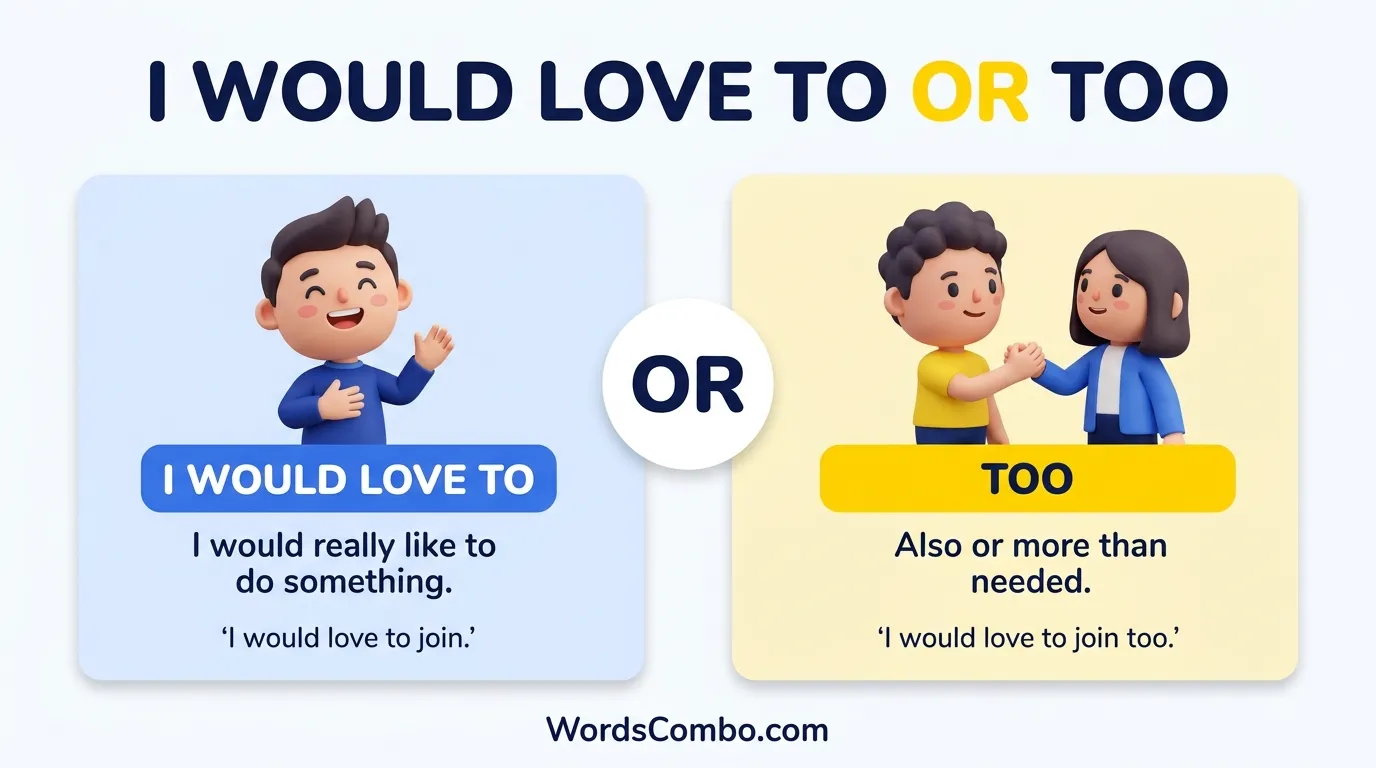
“I would love to” is correct when you want to say you would enjoy doing something or accepting an offer. Use “too” to mean “also” or “more than needed.”
When you are writing an email to accept an invitation, you might type “I would love to” and wonder if it should be “I would love too.” The two words sound the same, but they have different meanings.
The correct phrase is “I would love to” when another action follows or is understood. For example, “I would love to join you for dinner.” Once you learn this simple rule, you can use the phrase with confidence in emails, texts, and everyday conversations.
“I Would Love To” or “Too”: The Quick Answer
The correct phrase is “I would love to” when you want to do something. The word to can introduce an action or stand in for an action already mentioned.
For example:
- “Would you like to come with us?” “I would love to.”
- “I would love to learn English.”
- “I would love to visit New York.”
However, too is correct when you mean “also.”
Example: “I would love to come too.”
The Origin of “I Would Love To”
The words in this phrase have different histories and uses. The word to comes from Old English, where it was used to show direction or movement. Today, it also helps form verbs, as in “to read” or “to play.”
Meanwhile, too comes from an older English word meaning “also” or “in addition.” Over time, it also came to mean “more than needed.”
Because both words sound alike in modern English, people often mix them up when writing. However, their meanings make it easy to choose the right spelling.
“I Would Love To” Explained: Key Differences
The easiest way to understand this phrase is to look at the job each word does.
What Does “To” Mean?
To can introduce an action that you want to do. It can also stand alone when the action is clear from the conversation.
For example:
- I would love to help you.
- I would love to join the team.
- “Would you like to dance?” “I would love to.”
In the last example, the word to stands for “to dance.” Therefore, you do not need to repeat the whole action.
What Does “Too” Mean?
Too has two common meanings: “also” and “more than needed.”
For example:
- I would love to come too. (I would also love to come.)
- The coffee is too hot. (The coffee is hotter than I want.)
So, never use too before a verb when you mean to introduce an action.
Comparison Table
| Term | Meaning | When to Use | Region/Context |
| To | Introduces an action or shows direction | I would love to help. | Standard English |
| Too | Also or more than needed | I would love to help too. | Standard English |
| I would love to | Shows that you want to do something | I would love to join you. | Formal and casual |
| I would love too | Usually incorrect as a standalone reply | Choose “I would love to.” | Common spelling mistake |
Why Do “To” and “Too” Sound the Same?
These words are homophones, which means they sound alike but have different meanings or spellings.
For example, you might hear someone say, “I would love to join you.” However, when you write the sentence, you must choose the spelling that fits its meaning.
Which One Should You Use?
Your choice depends on what you want to say.
- For emails: Use “I would love to” when accepting an offer. For example, “I would love to discuss the project.”
- For text messages: Use “I’d love to” for a short, friendly reply. For example, “I’d love to come!”
- For schoolwork: Use to before an action. For example, “I would love to learn French.”
- For expressing agreement: Add too when you mean “also.” For example, “I would love to join too.”
- For describing something excessive: Use too before a word such as hot, cold, or expensive.
In short, use to when an action is stated or understood. Use too when you mean “also” or “more than needed.”
Common Mistakes With “I Would Love To” or “Too”
Here are five mistakes to watch for.
| Incorrect | Correct | Why |
| I would love too help. | I would love to help. | To introduces the action. |
| I would love too visit you. | I would love to visit you. | Too cannot replace to before a verb. |
| I would love to come to. | I would love to come too. | The last word means “also.” |
| I would love two join you. | I would love to join you. | Two refers to the number 2. |
| I would love too much to go. | I would love to go. | The first sentence does not express the intended meaning clearly. |
These errors often happen because people type quickly or rely on how words sound. However, checking the meaning of each word can help you catch the mistake before sending a message.
“I Would Love To” in Real-World Examples
The phrase works in many settings. Here are some natural examples you can use.
In a Professional Email
Example: “Thank you for the invitation. I would love to attend the meeting next Friday.”
This sounds polite and shows that you are happy to accept.
In a News Headline
Example: “Young Volunteers Would Love to Help Local Families”
Here, to introduces the action help.
In a Social Media Post
Example: “I would love to visit this beautiful place one day!”
The phrase shows excitement about a future plan.
In a Formal Document
Example: “I would love to contribute to the project and support the team.”
This is a friendly way to show interest in a work opportunity.
In a Text Message
Example:
Friend: “Would you like to watch a movie tonight?”
You: “I would love to!”
Because your friend has already mentioned watching a movie, you do not need to repeat the action.
“I Would Love To” or “Too”: Usage Trends and Search Intent
People who search for “I would love to or too” usually want a quick grammar answer. They may be writing a message, replying to an invitation, or checking an email before sending it.
The main reason for this confusion is simple: to and too sound alike. However, they do different jobs in a sentence.
Three useful points explain the issue:
- Grammar learners want to know which spelling is correct.
- Students and writers need examples they can follow in their own work.
- Professionals want their emails and replies to sound clear and polished.
The main lesson is that context matters more than sound. Once you know whether you mean an action, “also,” or “more than needed,” you can choose the right word with confidence.
“I Would Love To” or “Too”: Comparison at a Glance
| Term/Variant | Meaning | Region/Context | Best Used When |
| I would love to | I would really like to do something | Standard English | Accepting an offer |
| I would love too | Usually incorrect as a standalone reply | Standard English | Avoid this form when to is intended |
| I would love to come too | I would also like to come | Standard English | Joining someone else’s plan |
| I would love that too | I would also like that | Standard English | Agreeing with someone’s idea |
| I’d love to | Short form of I would love to | Casual and professional English | Friendly replies and emails |
Frequently Asked Questions
Is “I would love to” or “I would love too” correct?
“I would love to” is the correct standalone reply when you want to do something. However, you can use too later in a sentence when it means “also,” as in “I would love to come too.”
What does “I would love to” mean?
It means that you would really like to do something. For example, “I would love to travel” shows that you want to travel.
Can I say “I would love to come too”?
Yes, this sentence is correct. The first to introduces the action come, while too means “also.”
Is “I would love to” acceptable in formal writing?
Yes, it is polite and natural in many professional emails and formal replies. However, for very formal documents, you may prefer “I would be pleased to attend.”
Why do people confuse “to” and “too”?
Both words sound alike, so it is easy to choose the wrong spelling when typing. However, to introduces an action or shows direction, while too means “also” or “more than needed.”
What is the difference between “I would love to” and “I would love that”?
“I would love to” usually refers to an action, such as joining a meeting. In contrast, “I would love that” shows that you like an idea, offer, or plan.
How can I remember when to use “to” or “too”?
Use to when you mean an action or direction. Choose too when you can replace it with “also” or “more than needed.”
Final Thoughts on “I Would Love To” or “Too”
The correct choice is usually “I would love to” when you want to accept an invitation or say that you want to do something. Remember that to can also stand alone when the action is already clear.
On the other hand, too means “also” or “more than needed.” That is why “I would love to come too” is correct, but “I would love too come” is not.
Keep this simple rule in mind whenever you write a text, email, or school assignment. If you are unsure, check the meaning before choosing the word. Practice with your own sentences today, and you will find it easier to use to and too correctly.
Curious about more confusing words? Explore Too Bad or To Bad.

I have a background in academic writing and spent several years as a proofreader for digital publications. Spotting differences between easily confused words became second nature to me. At WordsCombo, I share that knowledge so readers can write with confidence.