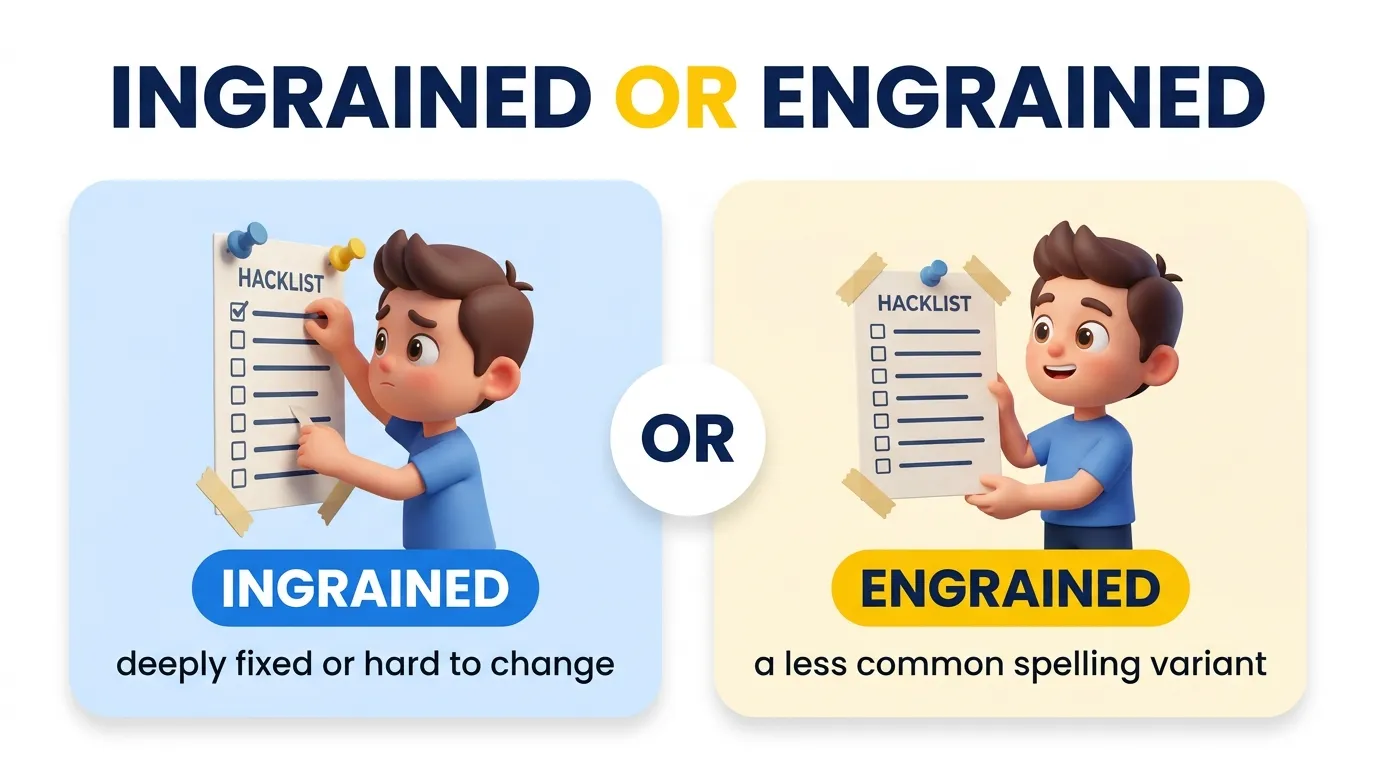
Ingrained is the standard and more common spelling for something deeply fixed, rooted, or hard to change. Engrained is also used as a less common variant with the same basic meaning.
You are ready to send an email when the red squiggly line stops you at one word: ingrained or engrained. Both forms look right, and both sound the same, so the choice can feel tricky. However, the good news is that the meaning is nearly the same. So, in most writing, ingrained is the safer choice.
Still, engrained is a real English variant, not a made-up word. Also, this guide explains the difference, shows when each form fits, and gives you simple examples for work, school, news, and everyday writing.
Ingrained or Engrained: Quick Answer
In short, ingrained means firmly fixed in a person, habit, belief, or material. It often describes something that has become so deep that changing or removing it is hard.
For example, you can write, “Checking her email each morning is an ingrained habit.” You can also say, “Years of use left ingrained dirt in the carpet.”
Engrained can carry the same meaning. However, it is much less common, so ingrained is usually the better pick.
The Origin of Ingrained or Engrained
The story starts with the word grain. Long ago, grain could refer to the fibers or texture of a material. As a result, a color worked into those fibers could become deeply fixed.
Over time, however, the idea moved beyond cloth and other materials. A habit could become ingrained in a person, just as color could become fixed in fabric. In fact, the word later became common for ideas, feelings, habits, and beliefs.
Meanwhile, engrained developed as an alternative form. In fact, both spellings are tied to the same basic idea of something being deeply fixed or worked into something.
That history also explains why the two forms are easy to mix up. They look almost alike, sound alike, and can appear in the same kinds of sentences.
Ingrained or Engrained Explained: Key Differences
The main difference, however, is not meaning. Instead, it is spelling preference and how often readers see each form.
So, ingrained is the form most writers should choose. It works well for habits, beliefs, attitudes, behavior, culture, and physical things such as dirt or stains.
Engrained is recognized as a variant. Still, it appears less often in current general writing. For that reason, some readers may treat it as a spelling mistake even when the intended meaning is clear.
| Term | Meaning | When to Use | Region/Context |
| Ingrained | Deeply fixed, rooted, or embedded | General, formal, school, work, and online writing | Standard modern choice |
| Engrained | Same basic meaning | When following a source, style, or known variant | Less common variant |
Consider these pairs:
- Ingrained: “Her ingrained habit of planning ahead saves time.”
- Engrained: “Her engrained habit of planning ahead saves time.”
- Ingrained: “The belief is deeply ingrained in the team.”
- Engrained: “The belief is deeply engrained in the team.”
Both pairs are understandable. However, the first spelling is more familiar to most readers.
Which One Should You Use?
For school essays, use ingrained because it is the familiar standard form. Your teacher or editor is more likely to expect this spelling.
For business emails, choose ingrained because clear, familiar wording helps readers move through your message quickly. A phrase such as “deeply ingrained habits” sounds natural.
For formal reports, use ingrained as the default, because it fits both abstract ideas and physical things.
For general online writing, use ingrained because it is the form most readers expect. Engrained may still be understood, but it can cause a reader to pause.
For a quote or a title, keep engrained if that exact spelling belongs to the original text. Changing a quoted word can change the source’s wording.
Either way, for a neutral choice, pick ingrained. It gives you the clearest and safest option in most situations.
Common Mistakes with Ingrained or Engrained
Still, writers often make a few simple mistakes with these spellings. Fortunately, each one has an easy fix.
Mistake: Treating engrained as always wrong.
Correction: Engrained is a recognized variant. However, ingrained is the better default for most modern writing. The mistake happens because one spelling is far more familiar.
Mistake: Using engraved instead of ingrained.
Correction: Engraved means marked or cut into a surface. For example, “Her name was engraved on the ring.” By contrast, an ingrained habit is deeply fixed.
Mistake: Using ingrained when you mean a fresh habit.
Correction: A habit can be ingrained only after it becomes deeply fixed. So “a new habit” and “an ingrained habit” do not carry the same idea.
Mistake: Adding an extra word that changes the meaning.
Correction: Say “deeply ingrained belief” when you mean a belief that is strongly fixed. Avoid piling on words that repeat the same idea.
Mistake: Assuming the two spellings have different meanings.
Correction: In most adjective uses, they mean the same basic thing. The real choice is usually which spelling your readers will find more familiar.
Ingrained or Engrained in Real-World Examples
For that reason, words become easier to remember when you see them in places where you actually write.
Professional email:
“An ingrained habit of checking every figure helps our team catch small errors.”
News headline:
“Old ingrained habits shape the way shoppers make daily choices.”
Social post:
“Some ingrained habits are hard to break, but small changes can help.”
Formal document:
“The policy became an ingrained part of the company’s daily work.”
Everyday conversation:
“Waking up early is so ingrained in her routine that she rarely needs an alarm.”
Physical example:
“The shoes had ingrained dirt after months of heavy use.”
Notice the pattern. However, the word works for both ideas and physical things. The meaning always points to something that has become deeply fixed or hard to remove.
Ingrained or Engrained: Data, Trends & Usage
Usually, people search this keyword when they are unsure about spelling. That makes the search intent strongly informational and language focused.
Students may search the phrase while checking an essay or homework. Meanwhile, writers and editors may search it while preparing emails, reports, articles, or business copy.
Also, the search fits a common spelling pattern. Two words sound the same, but one form is much more familiar in everyday writing. As a result, people often want a quick answer before they finish a sentence.
Search interest also connects with related phrases such as “ingrained meaning,” “ingrained definition,” “ingrained habit,” and “ingrained vs engrained.” These searches show that readers want more than a spelling choice. They also want meaning, examples, and a simple rule they can remember.
In short, one useful insight is that this is a low-risk word choice with a simple solution. When you are unsure, choose ingrained. That choice is easy for readers to recognize and works across most common writing settings.
Ingrained vs Engrained: Comparison at a Glance
| Term/Variant | Meaning | Region/Context | Best Used When |
| Ingrained | Deeply fixed or embedded | General English | You want the standard, familiar spelling |
| Engrained | Deeply fixed or embedded | Less common English usage | You are keeping an original spelling or following a specific style |
| Engraved | Cut or marked into a surface | Physical objects and writing | You mean a name, design, or words cut into something |
Frequently Asked Questions About Ingrained or Engrained
Is ingrained the correct spelling?
Yes, ingrained is the standard spelling most writers should choose. Engrained is also used as a variant, but it is less common.
Is engrained a real word?
Yes, engrained is a real English variant. However, most readers are more familiar with ingrained, so it is usually the safer choice.
What is the difference between ingrained and engrained?
In most adjective uses, there is little or no difference in meaning. Both can describe something deeply fixed, rooted, or embedded, but ingrained is the more common spelling.
Should I use ingrained in formal writing?
Yes, ingrained is a strong choice for formal writing. It works naturally in essays, reports, business writing, and professional documents.
Is ingrained the same as engraved?
No, these words are different. Engraved means words, marks, or designs have been cut into a surface, while ingrained means something is deeply fixed or embedded.
Where does the word ingrained come from?
The word comes from the idea of something being worked into the grain or fibers of a material. Later, the same idea was used for habits, beliefs, feelings, and other things that become deeply fixed.
Can I say deeply ingrained?
Yes, deeply ingrained is a natural and common phrase. For example, “Her deeply ingrained habit of saving money helped her reach her goal.”
Final Thoughts on Ingrained or Engrained
Choosing between ingrained or engrained is easier once you separate meaning from spelling. Both forms can point to something deeply fixed, but ingrained is the familiar choice for most modern writing.
For school, work, formal documents, and everyday posts, use ingrained. Meanwhile, keep engrained when you need to preserve an original spelling or a specific wording choice.
So, remember the simple rule: if you are writing the word yourself and you are unsure, choose ingrained. That choice will fit most readers and most settings. Now you can send that email, finish that sentence, or submit that essay with confidence.
Curious about similar words? Explore Wooly or Woolly.

I started writing about English word differences after years of teaching students who kept making the same mistakes. My focus is on making spelling rules feel simple and easy to remember. At WordsCombo, I turn confusing word pairs into clear comparisons.







1 thought on “Ingrained or Engrained: Choose the Right Spelling”