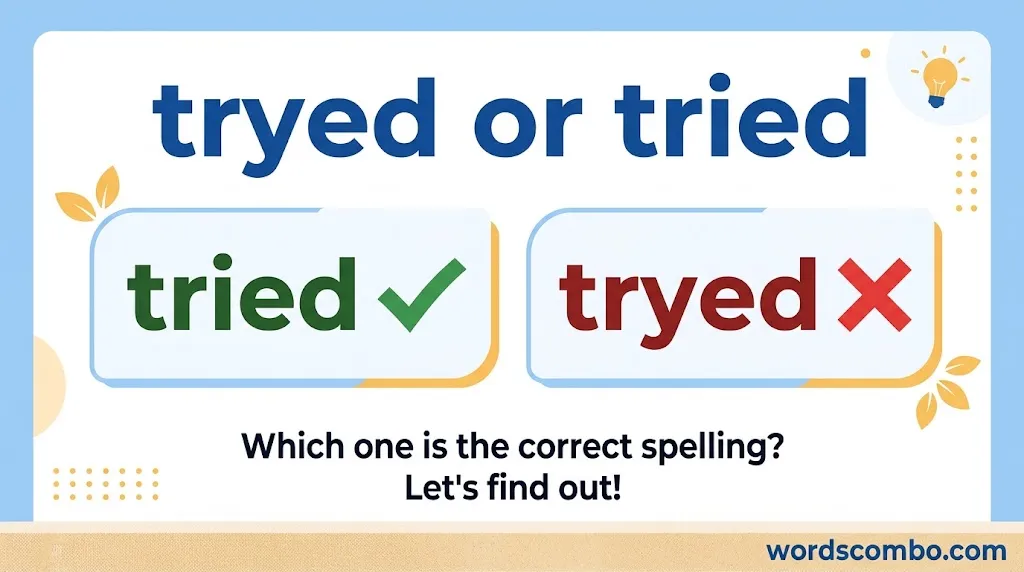
Tryed or tried means choosing between two spellings of the past form of try, and tried is the correct spelling.
I caught this exact mistake once while checking a short email before sending it. The sentence was simple: “I tryed to reach you yesterday.” Nothing looked strange at first glance. Then the final three letters stood out, and I changed tryed to tried before hitting Send.
That small mistake is easy to make because many English verbs form the past tense by adding -ed. You see walk → walked, help → helped, and call → called, so writing try → tryed can feel perfectly logical.
The problem is that try follows a different spelling pattern. When a verb ends in a consonant followed by y, the y changes to i before -ed is added.
That gives us try → tried, not try → tryed.
Once you see the rule, the spelling becomes much easier to remember. This guide will show you exactly why tried is correct, how to use it, which mistakes to avoid, and how the same pattern works with words such as cried, studied, and carried.
Tryed or Tried: Quick Answer
Tried is the correct spelling. Tryed is a common spelling mistake.
Use tried when talking about an attempt or action that happened in the past.
- I tried to call you yesterday.
- She tried her best to finish the work.
The basic spelling change is:
try → tried
The final y changes to i before -ed is added.
The Background Behind Tried
The word try has a long history in English. It developed from older French forms connected with examining, testing, or judging something.
Over time, try became a common English verb for making an attempt, testing something, or seeing whether something works.
The past form developed as tried rather than tryed because English spelling uses a special pattern for verbs ending in a consonant followed by y.
This is not a random change. You can see the same pattern in several everyday words:
- cry → cried
- carry → carried
- study → studied
- hurry → hurried
- worry → worried
- reply → replied
The confusion usually comes from treating every verb as if it simply takes -ed. That works for many verbs, but not for verbs ending in consonant + y.
Tryed or Tried Explained: The Key Difference
There is no real difference in meaning between tryed and tried in modern standard English because tryed is not the correct spelling of the past form.
The important difference is spelling and grammatical use.
| Term | Meaning | When to Use | Region/Context |
| try | Make an attempt or test something | Present or base form | Standard English |
| tried | Made an attempt or tested something | Past tense or past participle | Standard English |
| trying | Making an attempt | Present participle | Standard English |
| tries | Makes an attempt | Third-person present | Standard English |
| tryed | Incorrect spelling of tried | Do not use | Nonstandard |
Try
Use try for the base form of the verb.
I will try again tomorrow.
Tried
Use tried when the action happened in the past.
I tried again yesterday.
It can also be used after helping verbs:
She has tried everything.
Trying
The spelling changes again when you add -ing.
He is trying to help.
Notice that the y stays in trying.
Tries
For the third-person singular present form, the spelling becomes tries.
She tries to arrive early.
So the main word family looks like this:
try → tries → tried → trying
Which Form Should You Use?
For normal English writing, the choice is simple:
- For a present or base form: use try
- For something that happened in the past: use tried
- For an action happening now: use trying
- For he, she, or it in the present: use tries
- For formal, academic, or professional writing: always use the standard form tried, not tryed
If you are writing an email, school assignment, resume, report, or social media post, tried is the form you want when describing a past attempt.
For example:
I tried to contact the customer yesterday.
Not:
I tryed to contact the customer yesterday.
The first sentence is correct and natural.
The Spelling Rule That Makes Tried Easy
Here is the rule to remember:
Consonant + y → change y to i before adding -ed.
For try:
try → tri + ed → tried
The letter r comes before the final y, so the word ends in consonant + y.
Compare these examples:
| Base Verb | Correct Past Form |
| try | tried |
| cry | cried |
| fry | fried |
| carry | carried |
| study | studied |
| marry | married |
| reply | replied |
| worry | worried |
But What About Words Like Played?
This is where many learners get confused.
When a verb ends in a vowel + y, the y normally stays.
For example:
- play → played
- stay → stayed
- enjoy → enjoyed
- destroy → destroyed
Compare:
try → tried
play → played
In try, the letter before y is r, a consonant.
In play, the letter before y is a, a vowel.
That small difference controls the spelling.
Common Mistakes with Tryed or Tried
Here are some of the mistakes you are most likely to see.
| Mistake | Correction | Why |
| I tryed to help. | I tried to help. | Change y to i before -ed. |
| She tryed again. | She tried again. | Try becomes tried. |
| He trys every day. | He tries every day. | The present form is tries. |
| They tryied to call. | They tried to call. | Do not write tryied. |
| She is triing to learn. | She is trying to learn. | Keep y before -ing. |
Mistake 1: Adding -ed Directly
❌ try + ed = tryed
This looks logical, but it is not the correct spelling.
✅ try → tried
The y changes to i first.
Mistake 2: Writing Trys
Some people write:
❌ He trys every day.
The correct form is:
✅ He tries every day.
The spelling changes from y to ie before the final s.
Mistake 3: Writing Tryied
Another common error is:
❌ They tryied again.
The correct spelling is:
✅ They tried again.
There is no extra y in tried.
Mistake 4: Changing the Y Before -ing
Do not write:
❌ She is triing to help.
Write:
✅ She is trying to help.
The y stays when try takes -ing.
Tryed or Tried in Real-World Examples
Knowing the rule is useful, but seeing tried in real situations makes it easier to remember.
Professional Email
Subject: Update on the Customer Request
I tried to contact the customer this morning, but I could not reach them.
This is clear and professional.
News Headline
Local Team Tried a New Strategy in the Second Half
Here, tried describes an action that already happened.
Social Media Post
I tried making homemade pizza for the first time. It turned out better than expected!
The word describes a past experience.
Formal Report
The research team tried several methods before selecting the final approach.
Again, tried refers to attempts made in the past.
Tryed or Tried: Data, Trends & Usage
Searches around tryed or tried are strongly informational. People are usually not looking for a product or service. They want a quick spelling answer and a simple explanation of the rule.
Common search intentions include questions such as:
- tryed or tried
- how do you spell tried
- how to spell tried
- what is the past tense of try
- is tryed a word
- why is tried spelled with i
- tried meaning
- try vs tried
The strongest audience is likely to include students, English learners, beginner writers, and people checking a sentence before sending or submitting it.
There is also a useful reason this topic continues to matter. Spellings such as tryed can look reasonable at a quick glance because the word try already contains the letters needed to form the sound. The problem becomes clear only when you know the spelling rule.
The easiest takeaway is this:
If you see consonant + y at the end of a verb, check whether you need to change y to i before adding -ed.
Tryed or Tried: Comparison at a Glance
| Term/Variant | Meaning | Region/Context | Best Used When |
| try | Make an attempt | Standard English | Present or base form |
| tries | Makes an attempt | Standard English | He, she, or it in present tense |
| tried | Made an attempt | Standard English | Past tense or past participle |
| trying | Making an attempt | Standard English | Action in progress |
| tryed | Incorrect spelling | Nonstandard | Do not use |
The key form to remember is:
try → tried
Not:
try → tryed
FAQs About Tryed or Tried
Is it tryed or tried?
Tried is correct. Tryed is a misspelling of the past tense and past participle of try.
How do you spell tried?
The correct spelling is T-R-I-E-D, or tried. The final y in try changes to i before -ed is added.
What is the past tense of try?
The past tense of try is tried.
For example:
I tried to call you yesterday.
Why is tried spelled with an i?
The verb try ends in a consonant followed by y. When this type of verb takes -ed, the y changes to i, giving us tried.
Is tryed a word?
Tryed is not the standard modern spelling when you mean the past tense of try. In normal English writing, use tried.
Is tried acceptable in formal writing?
Yes. Tried is completely standard and can be used in emails, essays, reports, academic work, business writing, and other formal contexts.
Why is it tried but trying?
Different endings follow different spelling rules. With -ed, try becomes tried. With -ing, the y stays, so the correct form is trying.
Is it tried my best or tryed my best?
The correct phrase is tried my best.
I tried my best to finish the project.
Do not write tryed my best.
Is it tried to help or tryed to help?
The correct phrase is tried to help.
She tried to help her friend.
The spelling tryed is incorrect in standard English.
What is the difference between try and tried?
Try is the base form of the verb. Tried is its past form.
I try every day.
I tried yesterday.
Final Thoughts on Tryed or Tried
When choosing between tryed or tried, the answer is simple: tried is correct.
The spelling becomes easier when you remember the rule. A verb ending in consonant + y usually changes the y to i before -ed is added. That gives us try → tried, just as we get cry → cried and study → studied.
Do not confuse this with trying, where the y stays. Also remember that tries is the correct present-tense form for he, she, or it.
So if you are writing about an attempt that already happened, choose tried with confidence.
tried ✅
tryed ❌
trying ✅
trys ❌
Keep the pattern in mind, and this spelling is one less thing you will need to second-guess.
Curious about similar words? Explore Comprable or Comparable: The Easy Spelling Fix.

I started writing about English word differences after years of teaching students who kept making the same mistakes. My focus is on making spelling rules feel simple and easy to remember. At WordsCombo, I turn confusing word pairs into clear comparisons.


1 thought on “Tryed or Tried: The Easy Spelling Rule”