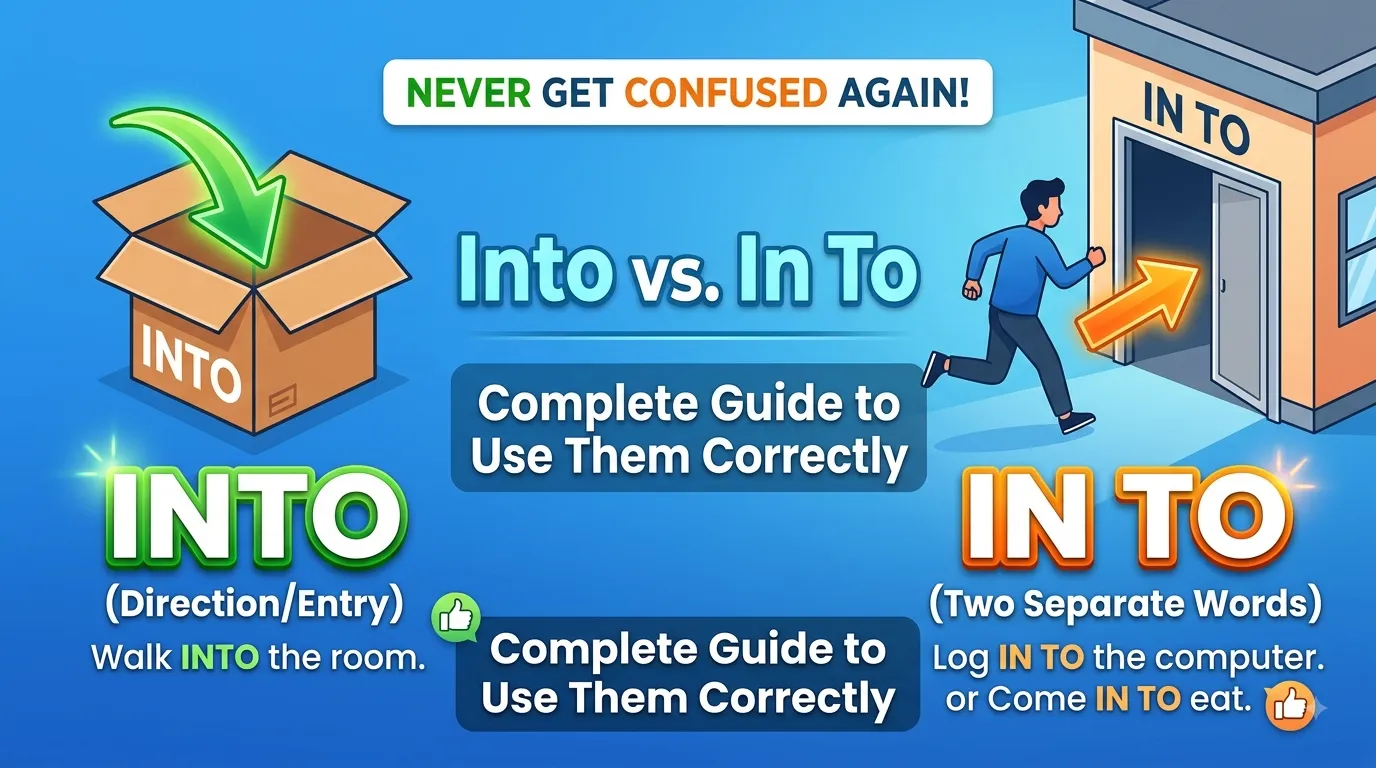
Into or in to are often confused, but they have different uses. “Into” shows movement or change from one place/state to another, while “in to” is two separate words used when “in” and “to” keep their own meanings in a sentence.
Have you ever written a sentence and suddenly stopped because you were unsure whether to use “into” or “in to”? You are not alone. Even experienced writers sometimes pause when these two combinations appear.
I remember helping a student review an English assignment where almost every sentence looked correct except for a few small word choices. One sentence said, “She walked in to the room.” The student thought it was right because the words sounded the same. However, the correct choice was “into” because it showed movement toward a place.
This small difference can change the meaning of your sentence. Many English learners search for “into or in to” because both forms sound identical when spoken, but they work differently in writing.
Into or In To : Quick Answer
“Into” is a preposition that shows movement, direction, or a change of condition.
Examples:
- She walked into the office.
- The water turned into ice.
“In to” is not a single phrase. It is the combination of two separate words: the adverb/preposition “in” and the infinitive marker “to.”
Examples:
- He came in to speak with the manager.
- She logged in to check her account.
The easiest way to remember:
If something moves inside or changes, use “into.”
If “in” and “to” have separate jobs, use “in to.”
The Origin and Background of Into
The word “into” developed from the Old English words that combined the ideas of “in” and “to.”
Historically, English often joined smaller words together to create new words with a stronger meaning. Over time, “in + to” became “into” when people used it to describe movement toward the inside of something.
For example:
- “He went in to the house” slowly became “He went into the house.”
Today, into has a fixed grammatical role. It is considered a single preposition.
The confusion exists because English still uses the separate combination “in to” when the words perform different functions.
This is similar to other word pairs in English where spelling and meaning change depending on whether words work together or separately.
Examples:
- everyday vs every day
- alot (incorrect) vs a lot
- maybe vs may be
Understanding word structure helps you make better writing choices.
Into or In To Explained : Key Differences
The biggest difference between into and in to is their function.
1. Into Shows Movement
Use into when someone or something moves from outside to inside.
Examples:
- The cat jumped into the box.
- She entered into the agreement.
- He poured milk into the glass.
The word answers the question:
“Where did something move?”
2. Into Shows Change or Transformation
“Into” can also show that something becomes different.
Examples:
- The caterpillar changed into a butterfly.
- The company grew into a global brand.
- The discussion turned into an argument.
Here, “into” does not show physical movement. It shows a change of state.
3. In To Means Two Separate Actions
Use in to when “in” belongs to the first part of the sentence and “to” belongs to the next verb.
Examples:
- She went in to talk to her teacher.
- He logged in to download the file.
- They stopped in to visit their friends.
Here:
- in = entered or participated
- to = purpose or infinitive marker
Comparison Table: Into vs In To
| Term | Meaning | When to Use | Region/Context |
|---|---|---|---|
| Into | Movement inside or transformation | When something enters, changes, or becomes something else | Standard English worldwide |
| In to | Two separate words with separate meanings | When “in” and “to” belong to different parts of the sentence | All English varieties |
Which Version Should You Use?
Choosing between into and in to depends on what you want to say.
For English Beginners
Use into when describing movement.
Examples:
- Walk into the room.
- Put the book into your bag.
Ask yourself:
“Is something going from outside to inside?”
If yes, use into.
For Students and Writers
Pay attention to the verb after “to.”
Example:
- She went in to study.
Here, “to study” explains the purpose. “In” means she entered.
For Professional Writing
Always check meaning instead of pronunciation.
Correct:
- The company entered into a partnership.
Incorrect:
- The company entered in to a partnership.
Professional writing requires accuracy because small grammar errors can affect credibility.
Common Mistakes with Into or In To
Many learners make mistakes because both forms sound identical.
| Common Mistake | Correct Form | Why |
|---|---|---|
| She walked in to the building. | She walked into the building. | Shows movement inside |
| He logged into check email. | He logged in to check email. | “In” and “to” have separate jobs |
| The frog jumped in to the pond. | The frog jumped into the pond. | Shows direction |
| She went into speak with him. | She went in to speak with him. | “To speak” shows purpose |
Why These Mistakes Happen
The main reasons are:
- They sound the same when spoken.
- English spelling does not always follow pronunciation.
- Learners focus on sound instead of grammar function.
The best solution is to look at the meaning of the sentence.
Into or In To in Real-World Examples
1. Professional Email
Example:
“Please log in to your account before submitting the report.”
Why?
“Log in” is the action. “To submit” shows purpose.
2. News Headline
Example:
“New Technology Turns Waste Into Clean Energy”
Why?
Waste changes into something new.
3. Social Media Post
Example:
“I finally walked into my dream career after years of hard work.”
Why?
The person moved toward a new stage of life.
4. Formal Report
Example:
“The organization entered into a long-term agreement with international partners.”
Why?
The phrase “enter into an agreement” is a standard formal expression.
Into or In To : Data, Trends & Usage
Search interest for “into or in to” mainly comes from:
- English learners
- Students
- Content writers
- Grammar teachers
- Professionals improving writing skills
The topic has strong informational search intent because people are looking for a quick grammar solution.
The reason this topic remains popular is simple: spoken English hides the difference. When people hear the words, both forms sound identical. Writing reveals the difference.
Understanding small grammar details like into vs in to improves:
- Academic writing
- Business communication
- SEO content quality
- Professional emails
- Everyday English confidence
Standalone Comparison Table: Into vs In To
| Term/Variant | Meaning | Region/Context | Best Used When |
|---|---|---|---|
| Into | Movement inside or transformation | Global English | Showing direction or change |
| In to | Separate words working independently | Global English | “In” and “to” have different grammar roles |
| Enter into | Formal phrase meaning start or join | Business/legal writing | Agreements, contracts, relationships |
| Log in to | Access something digitally | Technology context | Websites, apps, accounts |
Frequently Asked Questions About Into or In To
Q: What does into or in to mean?
A: Into means movement toward the inside or a change from one state to another. In to means the words “in” and “to” are separate and perform different roles in a sentence.
Q: How do you use into correctly?
A: Use into when something moves inside a place or changes into something else. For example, “She walked into the store” and “The ice melted into water.”
Q: What is the difference between into and in to?
A: Into is one word with its own meaning. In to contains two separate words that work independently, such as “log in to your account.”
Q: Is into acceptable in formal writing?
A: Yes. Into is completely correct in formal writing. It is commonly used in business, academic, and professional documents.
Q: Which version is correct: enter into or enter in to?
A: The correct phrase is usually “enter into.” It means to begin or become involved in something, such as entering into an agreement.
Q: Where does the word into come from?
A: Into developed from the combination of “in” and “to” in Old English. Over time, it became a separate preposition.
Q: Can into be used for ideas and emotions?
A: Yes. Into can describe changes that are not physical. Examples include “turn into success” or “break into laughter.”
Conclusion
Understanding into or in to becomes easy once you focus on meaning instead of sound.
Remember these three simple rules:
- Use into for movement inside something.
- Use into for changes or transformations.
- Use in to when “in” and “to” have separate jobs.
This small grammar difference can make your writing clearer and more professional. Whether you are writing an email, article, assignment, or social media post, choosing the correct form shows strong English skills.
Do not rely only on how words sound. Look at the role each word plays in the sentence.
Now you know exactly how to use into and in to, bookmark this guide and never second-guess this grammar rule again.
Read more: i.e. or e.g.: Complete Guide to Use Them Correctly

I have been writing about English spelling and word usage for the past five years. My goal is to give readers a clear answer without overwhelming them with complicated rules. At WordsCombo, I focus on making everyday English easier for everyone.