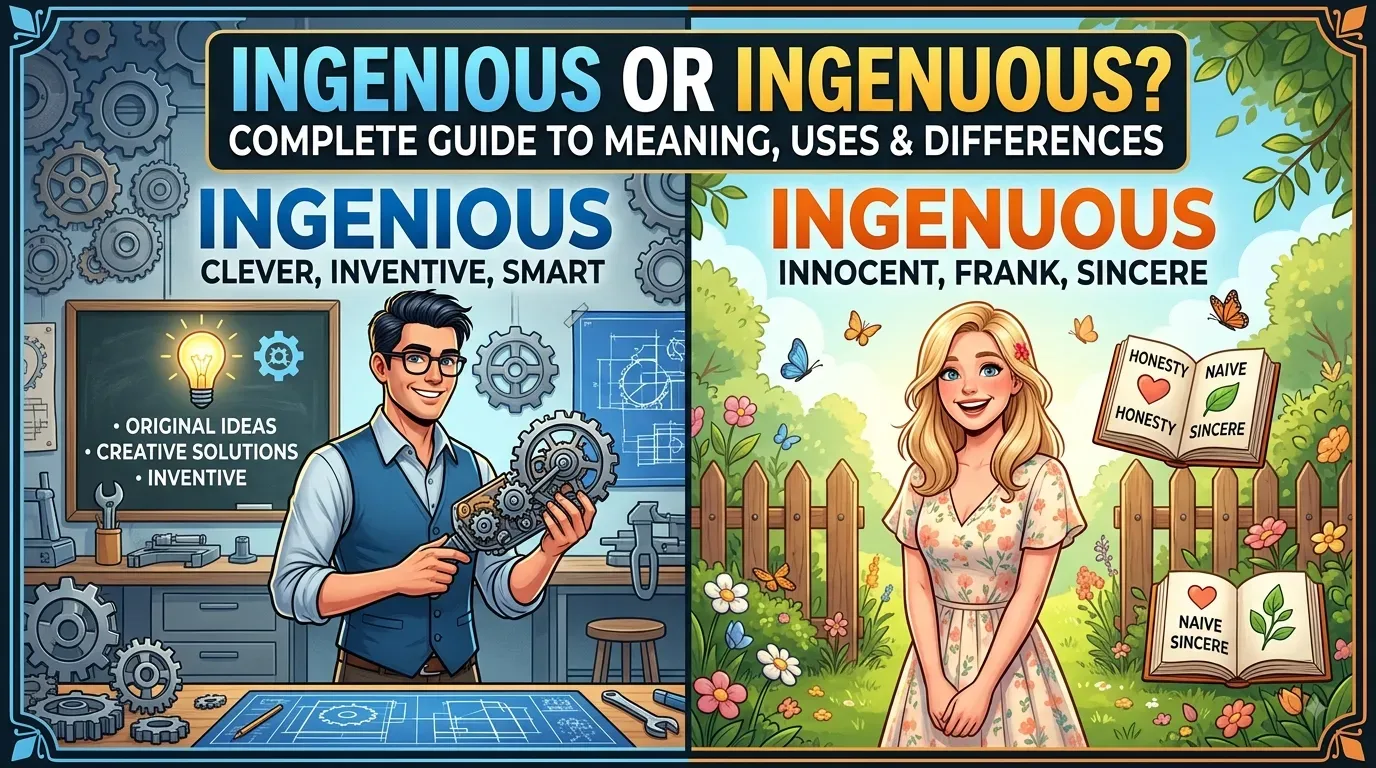
Ingenious means creative, clever, and showing original thinking, while ingenuous means honest, innocent, and sincere. The two words sound similar but have completely different meanings.
I learned the difference between ingenious and ingenuous the hard way while reviewing a student’s essay. The student described a scientist’s clever invention as an “ingenuous idea.” At first glance, the word looked correct because it sounded similar to “ingenious.” But the meaning was completely wrong.
This small mistake is common among English learners, writers, and even native speakers. Words that look and sound almost identical are called confusing words or commonly misused words. They can easily change the meaning of a sentence.
Have you ever wanted to describe someone as smart and creative but accidentally used a word that means honest and innocent instead?
Ingenious or Ingenuous : Quick Answer
Ingenious describes something clever, inventive, or created with skill and imagination.
Example: The engineer designed an ingenious solution to save energy.
Ingenuous describes someone who is honest, innocent, open, and sincere.
Example: The child gave an ingenuous answer because she did not know how to lie.
The easiest way to remember:
- Ingenious = Genius = Smart ideas
- Ingenuous = Genuine = Honest feelings
The Origin and Background of Ingenious and Ingenuous
Both words come from the Latin word ingenium, which means natural ability, talent, or inborn quality.
However, their meanings developed in different directions over time.
The History of Ingenious
The word ingenious entered English in the 1500s. It originally described someone with a natural ability or a clever mind.
Over time, its meaning became connected with:
- Creativity
- Innovation
- Problem-solving
- Original ideas
- Technical skill
Today, when we call an invention “ingenious,” we mean it is surprisingly clever and effective.
Example:
The smartphone’s design was an ingenious combination of technology and convenience.
The History of Ingenuous
The word ingenuous also came from Latin ingenuus, meaning:
- Free-born
- Noble
- Natural
- Honest
Later, it developed the meaning of someone who is open, truthful, and without deception.
Example:
Her ingenuous personality made people trust her immediately.
Why Do People Confuse Them?
The confusion happens because:
- They look almost identical.
- They share the same Latin root.
- They have similar pronunciation.
- Both words describe positive qualities.
But remember:
Ingenious describes the mind.
Ingenuous describes the character.
Ingenious Explained : Key Differences and Variations
Understanding the difference becomes easy when you focus on what the word describes.
| Term | Meaning | When to Use | Region/Context |
|---|---|---|---|
| Ingenious | Clever, creative, inventive | When talking about ideas, solutions, designs, or inventions | Global English |
| Ingenuous | Honest, sincere, innocent | When describing personality, behavior, or communication | Formal and literary contexts |
Examples of Ingenious
Use ingenious when something shows intelligence or creativity.
Example 1:
The inventor created an ingenious device that uses less electricity.
Meaning:
The device is clever and innovative.
Example 2:
Her ingenious marketing strategy increased sales within weeks.
Meaning:
Her idea was smart and original.
Examples of Ingenuous
Use ingenuous when someone is naturally honest or innocent.
Example 1:
The child gave an ingenuous reply because he believed everything he heard.
Meaning:
The child was honest and innocent.
Example 2:
His ingenuous nature made him easy to trust.
Meaning:
He was sincere and straightforward.
Which Version Should You Use?
Choosing between ingenious and ingenuous depends on what you are describing.
For Students and English Learners
Use ingenious when describing:
- A clever idea
- A creative project
- A smart solution
- A new invention
Example:
This is an ingenious way to learn vocabulary faster.
Use ingenuous when describing:
- A person’s honesty
- Someone’s innocence
- A sincere reaction
Example:
She gave an ingenuous response during the interview.
For Writers and Content Creators
Writers often use ingenious more because it relates to:
- Technology
- Business ideas
- Design
- Innovation
- Strategies
Example:
The company developed an ingenious approach to customer service.
Use ingenuous carefully because it describes personality and can sound more formal or literary.
For Professional or Academic Writing
Both words are acceptable in formal writing.
However:
- Use ingenious for research methods, inventions, theories, and solutions.
- Use ingenuous for human behavior, communication, and personality.
Choosing the wrong word can make your writing look inaccurate.
Common Mistakes with Ingenious and Ingenuous
Many learners confuse these words because they focus on spelling instead of meaning.
Here are the most common errors.
| Mistake | Correction | Explanation |
|---|---|---|
| She created an ingenuous machine. | She created an ingenious machine. | Machines need creativity, not honesty. |
| He was an ingenious person who always told the truth. | He was an ingenuous person who always told the truth. | Honesty relates to personality. |
| This is an ingenuous solution to the problem. | This is an ingenious solution to the problem. | Solutions require clever thinking. |
| Her ingenious smile showed her innocence. | Her ingenuous smile showed her innocence. | Innocence relates to character. |
Why These Mistakes Happen
People often remember the spelling but forget the meaning.
A simple memory trick:
Ingenious contains “genius.”
A genius creates smart ideas.
Ingenuous sounds like “genuine.”
A genuine person is honest and real.
Ingenious and Ingenuous in Real-World Examples
1. Professional Email
Ingenious Example:
Your team developed an ingenious solution that improved our workflow and reduced costs.
Meaning:
The solution was clever.
Ingenuous Example:
Thank you for your ingenuous feedback during the discussion.
Meaning:
The feedback was honest and sincere.
2. News Headline Style
Ingenious:
“Young Engineer Creates Ingenious Device to Reduce Plastic Waste”
Meaning:
The device shows creativity.
Ingenuous:
“The Actor’s Ingenuous Interview Wins Public Support”
Meaning:
The actor appeared honest and sincere.
3. Social Media Post
Ingenious:
This kitchen tool is absolutely ingenious. It solves a problem I never knew I had.
Meaning:
The tool is smart and useful.
Ingenuous:
I appreciate her ingenuous personality. She always speaks honestly.
Meaning:
She is sincere.
4. Formal Report
Ingenious:
The research team introduced an ingenious model for improving workplace efficiency.
Ingenuous:
The participant provided an ingenuous explanation of his experience.
Ingenious or Ingenuous: Data, Trends & Usage
Search interest in ingenious or ingenuous remains strong because many English learners search for the difference between these two words.
The main search intent is:
Informational
People usually want to know:
- Which spelling is correct?
- Are these words synonyms?
- How can I use them in a sentence?
- Why do they look similar?
The topic is especially useful for:
- ESL students
- Writers
- Bloggers
- Teachers
- Exam candidates
As English becomes more important in global communication, understanding confusing word pairs helps people write with greater accuracy and confidence.
Standalone Comparison Table: Ingenious vs Ingenuous
| Term/Variant | Meaning | Region/Context | Best Used When |
|---|---|---|---|
| Ingenious | Creative, clever, inventive | Everyday and professional English | Talking about ideas, inventions, solutions, designs |
| Ingenuous | Honest, sincere, innocent | Formal and descriptive English | Talking about people, emotions, behavior |
| Genius-related meaning | High intelligence or talent | Informal and academic | Describing smart thinking |
| Genuine-related meaning | Real and truthful | Personal communication | Describing honesty |
Frequently Asked Questions (FAQs)
Q: What does ingenious mean?
A: Ingenious means clever, creative, and skillfully designed. It is used for ideas, inventions, methods, or solutions that show intelligence and originality.
Example: The engineer found an ingenious way to fix the problem.
Q: What does ingenuous mean?
A: Ingenuous means honest, sincere, innocent, or straightforward. It usually describes a person’s character, behavior, or communication style.
Example: Her ingenuous answer showed that she was being completely honest.
Q: Ingenious vs ingenuous : what is the difference?
A: The main difference is that ingenious relates to creativity, while ingenuous relates to honesty. An ingenious person creates smart ideas, while an ingenuous person speaks and behaves sincerely.
Q: Is ingenious acceptable in formal writing?
A: Yes. Ingenious is commonly used in professional, academic, and technical writing when describing creative solutions, inventions, or methods.
Q: Which version is correct : ingenious or ingenuous?
A: Both words are correct, but they have different meanings. Use ingenious for clever ideas and ingenuous for honest behavior.
Q: Where does ingenious come from?
A: Ingenious comes from the Latin word ingenium, meaning natural ability or talent. Over time, it developed the meaning of creativity and cleverness.
Q: Can ingenious describe a person
A: Yes. You can describe a person as ingenious when they are highly creative or skilled at solving problems.
Example: She is an ingenious inventor.
Conclusion
The difference between ingenious and ingenuous is simple once you connect each word with its core idea.
Remember these three points:
- Ingenious = creative thinking
- Ingenuous = honest character
- They are not interchangeable even though they look similar.
Use ingenious when you talk about inventions, strategies, designs, and clever solutions. Use ingenuous when you describe someone’s honesty, innocence, or sincere behavior.
Learning confusing word pairs like this improves your vocabulary and makes your writing more professional. A single letter can change the entire meaning of a sentence, so choosing the right word matters.
Now you know exactly how to use ingenious or ingenuous, try using both words correctly in your next conversation or piece of writing.
Read more: Adverse or Averse: The Complete Easy Guide

I have been working with English language content for over six years. I specialize in word comparisons and spelling differences that most people overlook. At WordsCombo, I help readers choose the right word every time.