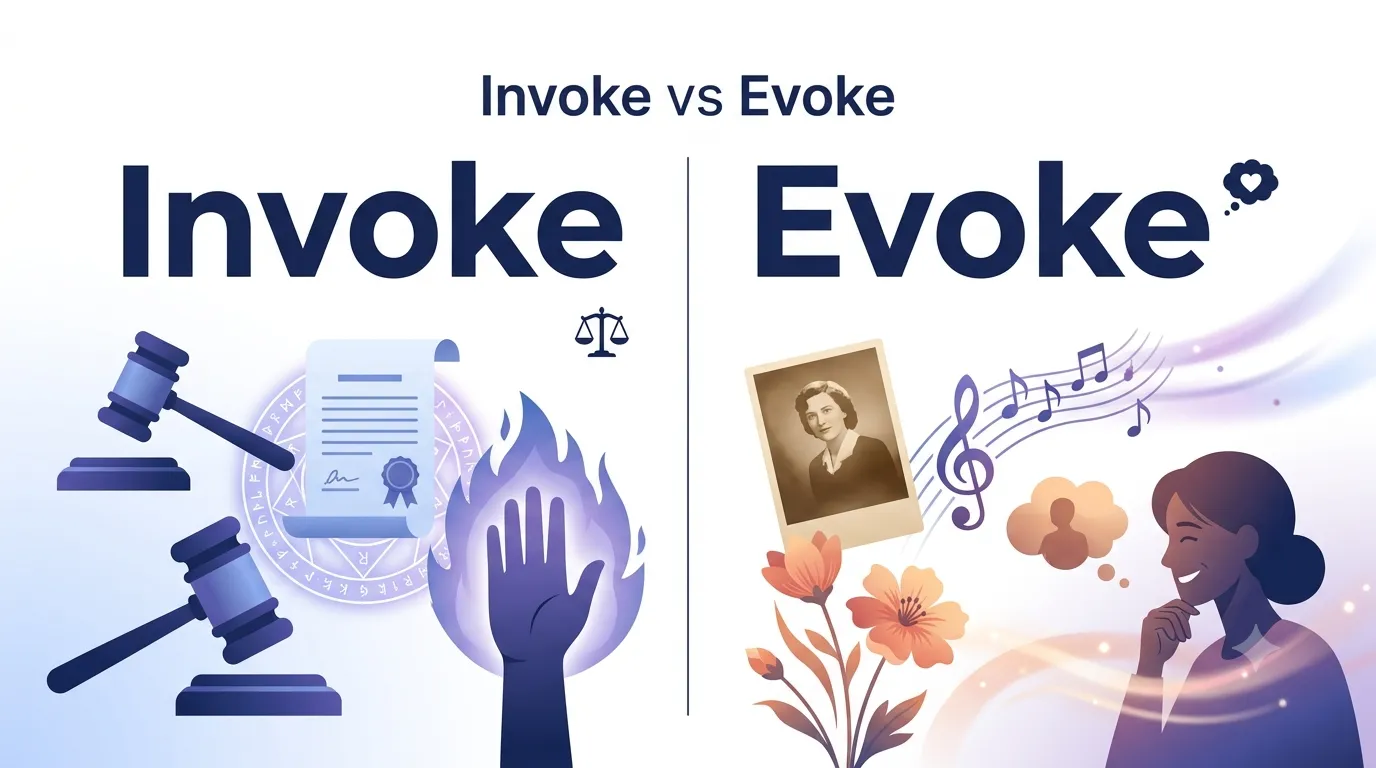
Invoke means to call upon, bring into effect, or appeal to someone or something, while evoke means to bring a feeling, memory, or image into someone’s mind. If you’re asking for help or using a rule, choose invoke. If you’re creating emotions or memories, choose evoke.
Have you ever stopped while writing and wondered, Should I use invoke or evoke here? I have. Years ago, while editing an article, I wrote that a photograph “invoked childhood memories.” It sounded right—until another editor pointed out that the photo didn’t call upon memories. It simply brought them to mind. The correct word was evoked.
That small correction stuck with me because these two words look and sound similar. They even come from related Latin roots. Yet their meanings are very different.
Many students, writers, bloggers, and professionals mix them up because both words involve something being “brought about.” The difference lies in how it happens. One word is about making something happen by calling on it. The other is about causing thoughts or feelings naturally.
By the end of this guide, you’ll know exactly when to use invoke and when to use evoke. You’ll also see simple examples, common mistakes, and an easy trick you’ll remember every time you write.
Invoke or Evoke: Quick Answer
The easiest way to remember the difference is this:
- Invoke = Call upon or activate
- Evoke = Bring to mind or create a feeling
Examples
✅ The lawyer invoked the Constitution.
✅ The old song evoked happy memories.
Think of it this way:
- You invoke rules, laws, rights, or help.
- You evoke emotions, memories, images, and ideas.
The Origin of Invoke and Evoke
Although these words are often confused, their histories explain why they mean different things.
Invoke
The word invoke comes from the Latin word invocare, meaning to call upon.
People originally used it when asking gods, spirits, or higher powers for help. Today, the meaning has expanded.
You can invoke:
- A law
- A policy
- A legal right
- Authority
- A person’s name
- A tradition
Evoke
Evoke comes from the Latin word evocare, meaning to call out.
Over time, English speakers began using it to describe memories, emotions, and mental images that appear naturally.
You can evoke:
- Happiness
- Fear
- Nostalgia
- Curiosity
- Sympathy
- Strong emotions
The words share similar roots, which explains why so many people confuse them.
Invoke vs Evoke Explained
Here’s the simplest comparison.
| Term | Meaning | When to Use | Context |
|---|---|---|---|
| Invoke | Call upon, activate, appeal to | Laws, rules, authority, rights, magic, traditions | Legal, formal, religious |
| Evoke | Bring to mind or create a feeling | Emotions, memories, images, reactions | Writing, art, conversation |
Invoke Examples
- The company invoked its refund policy.
- She invoked her legal rights.
- The speaker invoked the words of a famous leader.
- The magician invoked an ancient spell.
Evoke Examples
- The painting evoked sadness.
- The smell of bread evoked childhood memories.
- His speech evoked hope.
- The movie evoked laughter from the audience.
Notice the pattern.
Invoke involves action or authority.
Evoke involves emotion or imagination.
Which Word Should You Use?
The right choice depends on what you’re trying to say.
For students
Use invoke when writing about:
- Laws
- Government
- Rights
- Rules
- Formal arguments
Use evoke when describing:
- Literature
- Poems
- Stories
- Music
- Art
For business professionals
Choose invoke when discussing:
- Company policies
- Contracts
- Regulations
- Procedures
Example:
“The customer invoked the warranty.”
For writers and bloggers
Choose evoke when describing feelings.
Example:
“The opening paragraph evokes curiosity.”
For global English
The meanings are identical in American, British, Canadian, and Australian English.
No regional spelling difference exists.
Common Mistakes with Invoke and Evoke
These errors happen often.
| Mistake | Correct Version | Why |
|---|---|---|
| The song invoked memories. | The song evoked memories. | Songs create memories, not call upon them. |
| She evoked her legal rights. | She invoked her legal rights. | Rights are invoked. |
| The smell invoked happiness. | The smell evoked happiness. | Feelings are evoked. |
| The lawyer evoked the law. | The lawyer invoked the law. | Laws are invoked. |
| His speech invoked emotion. | His speech evoked emotion. | Emotions are evoked. |
Easy Memory Trick
Think of this phrase:
Invoke = Involve Authority
Evoke = Emotion
If authority is involved, use invoke.
If emotions appear, use evoke.
Invoke and Evoke in Real World Examples
Professional Email
“Our legal team has decided to invoke the confidentiality clause outlined in the agreement.”
News Headline
“The President invokes emergency powers after severe flooding.”
Social Media Post
“This sunset evokes peace every single time I see it.”
Marketing Copy
“Our new fragrance evokes memories of summer holidays.”
Book Review
“The novel evokes both joy and heartbreak through its unforgettable characters.”
Legal Report
“The company officially invoked the force majeure clause.”
Data, Trends & Usage
Search interest for invoke vs evoke stays strong throughout the year because many English learners and even native speakers confuse the two words.
Search Intent
Primary intent: Informational
People usually want to know:
- Which word is correct?
- What’s the difference?
- Which word fits a sentence?
- Is one more formal than the other?
Who Searches Most?
This topic is popular among:
- Students
- Bloggers
- Content writers
- Copywriters
- Teachers
- Business professionals
- ESL learners
Why It Matters Today
With AI writing tools, online publishing, and remote work becoming common, clear communication matters more than ever. Using the wrong word can change your meaning and make your writing sound less polished.
Invoke vs Evoke Comparison Table
| Term | Meaning | Region/Context | Best Used When |
|---|---|---|---|
| Invoke | Call upon, appeal to, activate | Legal, religious, formal, professional | Referring to laws, rights, policies, authority, traditions, or requests |
| Evoke | Bring to mind, inspire emotion | Creative writing, everyday English, literature | Describing memories, emotions, moods, images, or reactions |
Frequently Asked Questions
Q: What does invoke mean?
A: Invoke means to call upon, appeal to, or activate something such as a law, rule, authority, tradition, or legal right. It often appears in formal or legal writing.
Q: What does evoke mean?
A: Evoke means to bring a memory, emotion, image, or feeling into someone’s mind. Writers often use it to describe the emotional impact of music, stories, art, or photographs.
Q: What is the difference between invoke and evoke?
A: Invoke is about calling upon something for help, authority, or action. Evoke is about naturally creating thoughts, emotions, or memories.
Q: Can invoke and evoke be used interchangeably?
A: No. Although they sound alike, they have different meanings. Using the wrong one can make your sentence inaccurate.
Q: Is invoke more formal than evoke?
A: Yes. Invoke commonly appears in legal, political, religious, and business writing. Evoke is common in both formal and everyday English, especially when discussing emotions or creativity.
Q: How can I remember the difference?
A: Remember this simple trick:
- Invoke = Authority
- Evoke = Emotion
That quick reminder helps you choose the correct word almost every time.
Q: Can evoke be used in business writing?
A: Yes. Marketing teams often say a brand or advertisement evokes trust, excitement, or nostalgia. The word is common whenever emotional responses are important.
Conclusion
The difference between invoke and evoke is simpler than it first appears. Invoke means to call upon, activate, or appeal to something, such as a law, right, policy, or authority. Evoke, on the other hand, means to bring feelings, memories, or images into someone’s mind.
A quick way to remember is this: if you’re dealing with rules or authority, use invoke. If you’re talking about emotions or memories, use evoke. That one distinction will help you avoid one of the most common vocabulary mistakes in English.
The next time you’re writing an email, article, essay, or social media post, pause for a second and ask yourself: Am I calling on something, or am I creating a feeling? The answer will tell you which word belongs.
Bookmark this guide so you never confuse “invoke” and “evoke” again, and share it with anyone who wants clearer, more confident English.

I have been working with English language content for over six years. I specialize in word comparisons and spelling differences that most people overlook. At WordsCombo, I help readers choose the right word every time.