A dash is a punctuation mark used to separate or emphasize ideas, while a hyphen joins words or parts of words. Knowing the difference helps you write more clearly and professionally.
Have you ever paused while writing because you weren’t sure whether to use a dash or a hyphen? You’re not alone. I remember editing one of my first blog posts and realizing I had used hyphens everywhere—even where dashes belonged. It seemed like a tiny mistake, but it changed how the sentences looked and flowed.
Many people think a dash and a hyphen are the same. They are not. Although they look similar, they have different jobs in English writing. Using the wrong one can make your writing look less polished.
In this guide, you’ll learn what a dash and a hyphen are, how they differ, when to use each one, and how to avoid common mistakes. By the end, you’ll know exactly which punctuation mark to choose.
Dash or Hyphen: Quick Answer
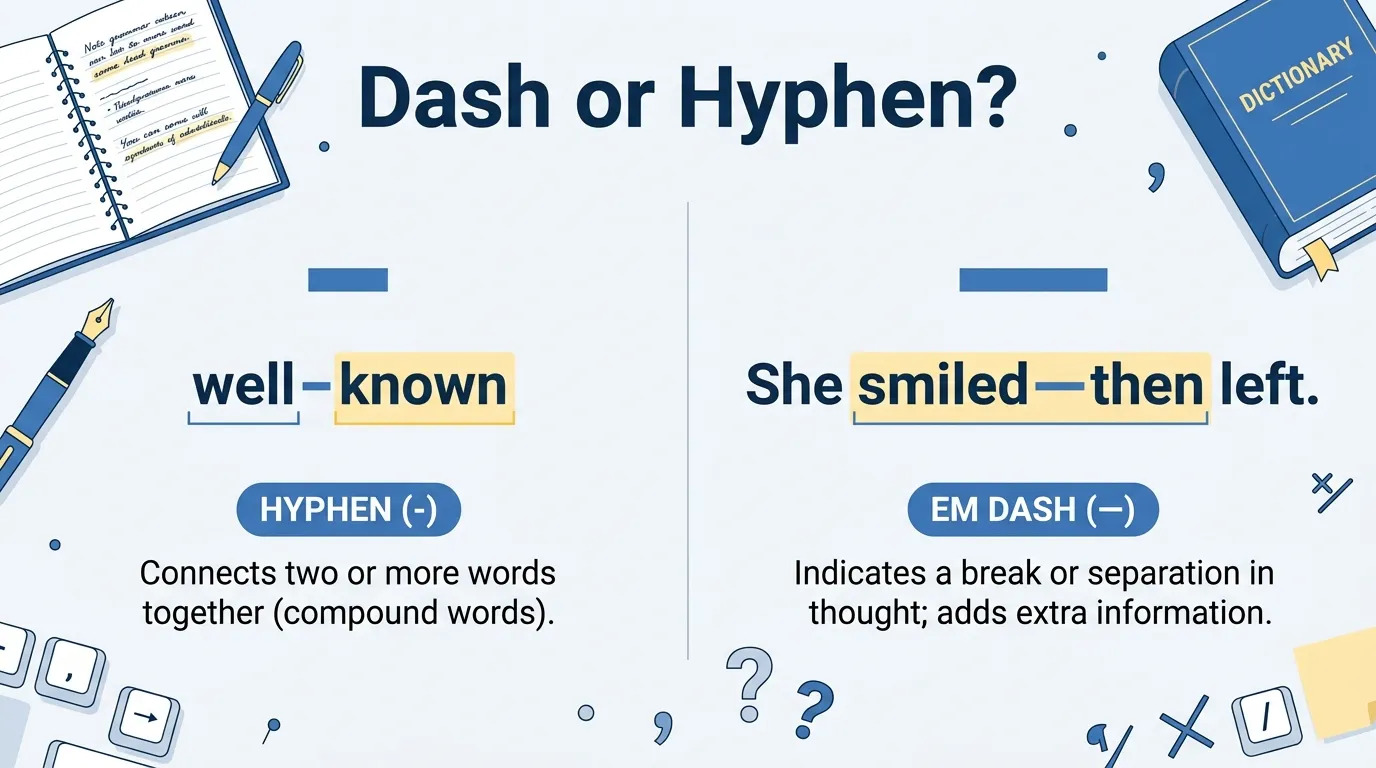
A hyphen (-) connects words or parts of words to form a single idea.
A dash (— or –) separates ideas, adds emphasis, or shows a pause in a sentence.
Examples
- Hyphen: well-known author
- Dash: She had one goal—success.
The Origin of Dash and Hyphen
The hyphen has been used for centuries to join words together. It comes from the Greek word huphen, meaning “under one.”
The dash appeared later as writers wanted a punctuation mark that created pauses stronger than commas but softer than periods.
Today, English mainly uses three similar-looking marks:
- Hyphen (-) – joins words.
- En dash (–) – shows ranges like 2019–2025.
- Em dash (—) – separates thoughts or adds emphasis.
Many people confuse them because they look alike, especially on keyboards where only the hyphen is easy to type.
Dash or Hyphen Explained
The easiest way to remember the difference is this:
| Term | Meaning | When to Use | Region/Context |
|---|---|---|---|
| Hyphen (-) | Joins words | Compound words, prefixes | Worldwide |
| En Dash (–) | Shows a range or connection | Dates, pages, scores | Formal publishing |
| Em Dash (—) | Breaks or emphasizes ideas | Sentences, dialogue | Common in American English |
Hyphen Examples
- full-time job
- high-quality product
- twenty-one
- self-confidence
Em Dash Examples
- I was ready—but the meeting was canceled.
- She knew the answer—everyone did.
En Dash Examples
- Pages 10–20
- London–Paris flight
- 2023–2026
Which One Should You Use?
Your choice depends on what you’re writing.
For students
Use hyphens when joining words such as well-written essay or part-time student.
For business writing
Use em dashes sparingly to add emphasis without overusing commas.
For bloggers and content writers
Use hyphens correctly in compound adjectives. Use em dashes only when they improve readability.
For formal documents
Follow your style guide. Some publishers prefer em dashes, while others recommend commas or parentheses.
Best general advice
If you’re joining words, choose a hyphen.
If you’re separating ideas, choose a dash.
Common Mistakes
Many writers make the same punctuation errors.
| Mistake | Correct |
|---|---|
| well known book | well-known book |
| 2019-2022 | 2019–2022 |
| She smiled – then left. | She smiled—then left. |
| self confidence | self-confidence |
Why these mistakes happen
- Most keyboards make the hyphen easy to type.
- Many people don’t know there are different types of dashes.
- Auto-correct sometimes replaces punctuation automatically.
Dash or Hyphen in Real World Examples
Professional Email
“Our well-prepared team completed the project—thank you for your support.”
News Headline
“City launches long-term housing plan—officials expect positive results.”
Social Media
“Today was exhausting—but totally worth it!”
Formal Report
“The company recorded year-over-year growth during 2025–2026.”
Dash or Hyphen: Data, Trends & Usage
Searches for dash or hyphen increase during the school year because students, teachers, and writers often check punctuation rules while working on assignments.
People in the United States, the United Kingdom, Canada, Australia, and other English-speaking countries search for this topic regularly.
Search intent: Informational.
This topic matters because clear writing builds trust. Whether you’re writing emails, blog posts, reports, or school papers, correct punctuation makes your work easier to read.
Quick Comparison Table
| Term | Meaning | Region/Context | Best Used When |
|---|---|---|---|
| Hyphen (-) | Connects words | Global English | Compound words |
| En Dash (–) | Shows range | Publishing | Dates, scores, page numbers |
| Em Dash (—) | Separates ideas | Mostly American English | Emphasis or interruptions |
Frequently Asked Questions
Q: What does dash or hyphen mean?
A dash and a hyphen are different punctuation marks. A hyphen joins words, while a dash separates ideas or shows a pause.
Q: How do you use a hyphen correctly?
Use a hyphen when combining words into a single adjective before a noun, such as well-known actor or high-speed train.
Q: What’s the difference between a dash and a hyphen?
A hyphen connects words. A dash separates parts of a sentence or adds emphasis.
Q: Is a hyphen acceptable in formal writing?
Yes. Hyphens are common in formal, academic, and professional writing when used according to grammar rules.
Q: Which is correct: dash or hyphen?
Both are correct, but they serve different purposes. Choose the one that matches your sentence.
Q: Where does the hyphen come from?
The hyphen comes from the Greek word huphen, meaning “under one,” referring to joining words together.
Q: Can dashes be used in business writing?
Yes. Em dashes can improve readability when used sparingly, but avoid overusing them in formal documents.
Conclusion
Although they look similar, dashes and hyphens are not the same. A hyphen joins words to create a single idea, while a dash separates thoughts, adds emphasis, or shows a pause. Understanding this simple difference makes your writing clearer, more professional, and easier to read.
Remember these key points:
- Hyphens connect words.
- En dashes show ranges.
- Em dashes separate ideas for emphasis.
- Choose punctuation based on its purpose, not appearance.
The more you practice, the more natural these punctuation marks will become. Soon, you’ll spot mistakes instantly and write with greater confidence.
Now you know exactly when to use a dash or a hyphen. Bookmark this guide, and share it with anyone who still mixes them up.

I have a background in academic writing and spent several years as a proofreader for digital publications. Spotting differences between easily confused words became second nature to me. At WordsCombo, I share that knowledge so readers can write with confidence.