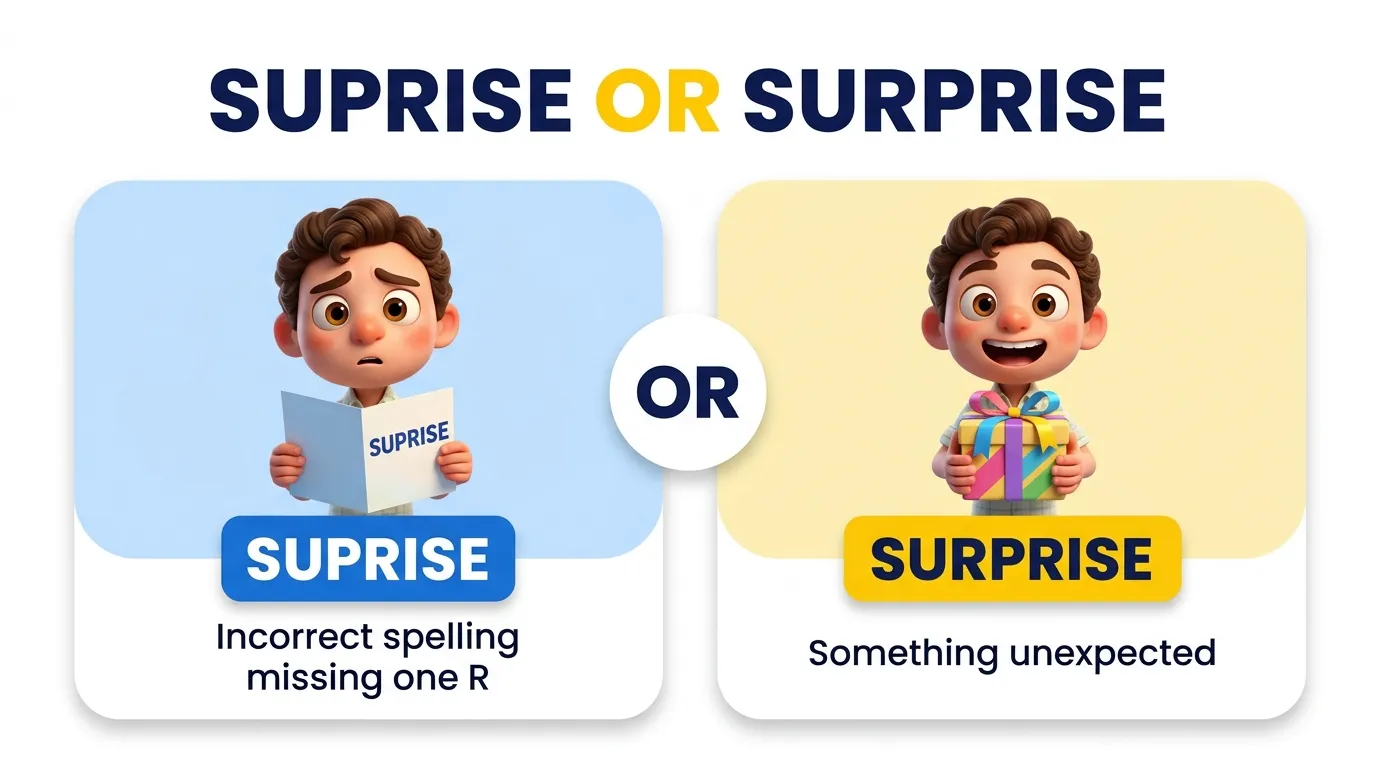
The correct spelling is surprise, not suprise. Use surprise when you mean something unexpected or an event that you did not see coming.
When you type a birthday message, write an email, or post a happy update, a small spelling error can slip through. The word is it suprise or surprise is a common spelling question because the word sounds as if it might have one less letter.
However, the correct spelling always includes the first r after the initial “su.” Once you learn this simple rule, you can spell surprise with confidence in schoolwork, work emails, and everyday messages.
Is It Suprise or Surprise? The Quick Answer
Surprise is the correct spelling in American English and British English. Suprise is a misspelling because it leaves out the letter r.
For example:
- Correct: I have a surprise for your birthday.
- Incorrect: I have a suprise for your birthday.
So, if you are writing a card, sending a text, or sharing good news, always choose surprise.
The Origin of Surprise and Why It Is Easy to Misspell
The word surprise came into English through French. It is linked to the idea of catching someone unexpectedly or doing something they did not expect.
Over time, the word became a common part of everyday English. People use it for gifts, sudden news, unexpected visits, and happy events.
But why do so many people write “suprise”? The word is often spoken quickly, so the first r may be hard to hear. As a result, writers sometimes leave it out when typing.
The best way to avoid this error is to remember the full spelling: s u r p r i s e.
Is It Suprise or Surprise? Key Differences Explained
The main difference is simple: surprise is correct, while suprise is a spelling mistake. Both forms may appear in online posts or messages, but only one is the standard spelling you should use.
The word surprise can work as both a noun and a verb. For example, a gift can be a surprise, and you can surprise someone with that gift.
How to Use Surprise as a Noun
A noun names a person, place, thing, or idea. In this case, surprise means something unexpected or the feeling you get when something happens without warning.
- We planned a surprise for Dad’s birthday.
- Her visit was a pleasant surprise.
How to Use Surprise as a Verb
A verb tells what someone does. When you surprise someone, you make them feel amazed because they did not expect something to happen.
- I want to surprise my best friend.
- The news may surprise everyone.
Surprise vs. Suprise vs. Surprize
| Term | Meaning | When to Use | Region/Context |
| Surprise | Something unexpected, or to make someone feel amazed | Use it in all normal writing | Standard in American and British English |
| Suprise | Misspelling of surprise | Do not use it | Typing and spelling errors |
| Surprize | An old spelling of surprise | Avoid it in modern writing | Rare, old-fashioned usage |
Although you may see surprize in older writing, surprise is the spelling to choose for modern schoolwork, emails, and online content.
Which Spelling Should You Use?
The right choice is surprise, no matter where you live or who you are writing for.
- For American readers: Use surprise because it is the standard spelling in the United States.
- For British readers: Choose surprise as well, since British English uses the same spelling.
- For school assignments: Write surprise to keep your work correct and clear.
- For business emails: Use surprise in messages, reports, and client notes.
- For social media: Spell surprise correctly in captions, comments, and birthday posts.
In short, there is no need to choose between two regional spellings. The standard form is the same in both major varieties of English.
Common Spelling Mistakes with Surprise
Even strong writers can make small spelling errors. However, a few simple checks can help you avoid the most common ones.
- Mistake: Suprise party. Correction: Surprise party. The first form leaves out an r, often because the sound is hard to hear.
- Mistake: I have a big suprise for you. Correction: I have a big surprise for you. The correct form needs the full spelling, even in a quick text.
- Mistake: I was surprized. Correction: I was surprised. Although surprize appeared in older English, surprised is the usual modern form.
- Mistake: A surprizing gift. Correction: A surprising gift. The related word uses an s, not a z.
- Mistake: She was surprise by the news. Correction: She was surprised by the news. The sentence needs the past form of the verb.
To remember the spelling, break the word into parts: sur + prise. Then check that it contains two r letters and two s letters.
Surprise in Real-World Examples
You can use surprise in many kinds of writing. The examples below show how it fits into daily life, work, and formal writing.
Professional Email
Subject: A Pleasant Surprise
I’m happy to share a small surprise with the team. We have finished the project ahead of schedule, so we can begin the next task sooner.
News Headline
Surprise Win Gives Local Team a Place in the Final
The team beat its stronger rivals in a match that surprised many fans.
Social Media Post
What a lovely surprise! My friends planned a birthday party, and I had no idea they were doing it.
Formal Document
The unexpected result came as a surprise to the review team. However, the group checked the facts before making its final decision.
Everyday Conversation
- “I bought you a surprise!”
- “Wow, you really surprised me!”
- “What a nice surprise to see you here.”
These examples show that the word works in both casual and formal settings. Just remember to keep the first r in every form.
Surprise: Search Intent and Everyday Usage
People search for is it suprise or surprise when they want a quick spelling answer. Many are checking a message, fixing a school assignment, or making sure a public post looks right.
The search intent is mainly informational. Readers want to know which spelling is correct, why the error happens, and how to use the word in a sentence.
This question also matters for people who write online content. A small spelling mistake can distract readers, while correct spelling helps keep writing clear and professional.
Since people often type quickly on phones, the missing r can slip into texts, comments, and emails. Therefore, a quick spelling check can save time and help you share your message with confidence.
Suprise vs Surprise: Comparison at a Glance
| Term/Variant | Meaning | Region/Context | Best Used When |
| Surprise | Something unexpected, or to amaze someone | Standard English worldwide | Writing, speaking, emails, and posts |
| Suprise | Incorrect spelling | Common typing error | Never use as the intended standard word |
| Surprize | Rare old spelling | Historical or unusual text | When quoting an old text exactly |
The key point is that surprise is the safest and correct choice for everyday English. You do not need a different spelling for American or British readers.
Frequently Asked Questions About Suprise or Surprise
Is it spelled suprise or surprise?
The correct spelling is surprise, with an r after the first two letters. Suprise is a common spelling error because the first r may not be clear when you say the word aloud.
Why is surprise spelled with two r letters?
The word keeps the spelling it gained through its history in French and English. Although the first r can be easy to miss when speaking, you must include it when writing the word.
Is surprise correct in American English?
Yes, surprise is the standard spelling in American English. It is also standard in British English, so you can use it for readers in either country.
Is suprise ever acceptable in formal writing?
No, suprise is not the standard spelling and should be corrected in formal writing. Use surprise in essays, reports, job applications, business emails, and other important documents.
Is surprize another correct spelling of surprise?
Surprize is an old spelling that appears in some older texts, but surprise is the usual modern form. For clear, everyday writing, choose surprise.
Where did the word surprise come from?
The word entered English through French and first had links to catching someone unexpectedly. Over time, it gained the familiar meaning of an unexpected event or the feeling caused by something you did not expect.
How do you spell surprise party correctly?
Write it as surprise party, with an r in surprise. For example, “We planned a surprise party for our teacher” is correct.
Final Thoughts on Is It Suprise or Surprise
The correct spelling is surprise, and the word suprise is a mistake. Although the missing letter may seem small, it can make your writing look less polished. Therefore, always check the spelling before you send an email, finish an assignment, or share a post.
Remember these simple points: surprise has two r letters, it works as both a noun and a verb, and the same spelling is used in American and British English. You can also remember the word by breaking it into smaller parts: sur + prise.
Now, whenever you write surprise, include that first r and share your words with confidence!
Curious about similar spelling questions? Explore Enpower or Empower.

I started writing about English word differences after years of teaching students who kept making the same mistakes. My focus is on making spelling rules feel simple and easy to remember. At WordsCombo, I turn confusing word pairs into clear comparisons.