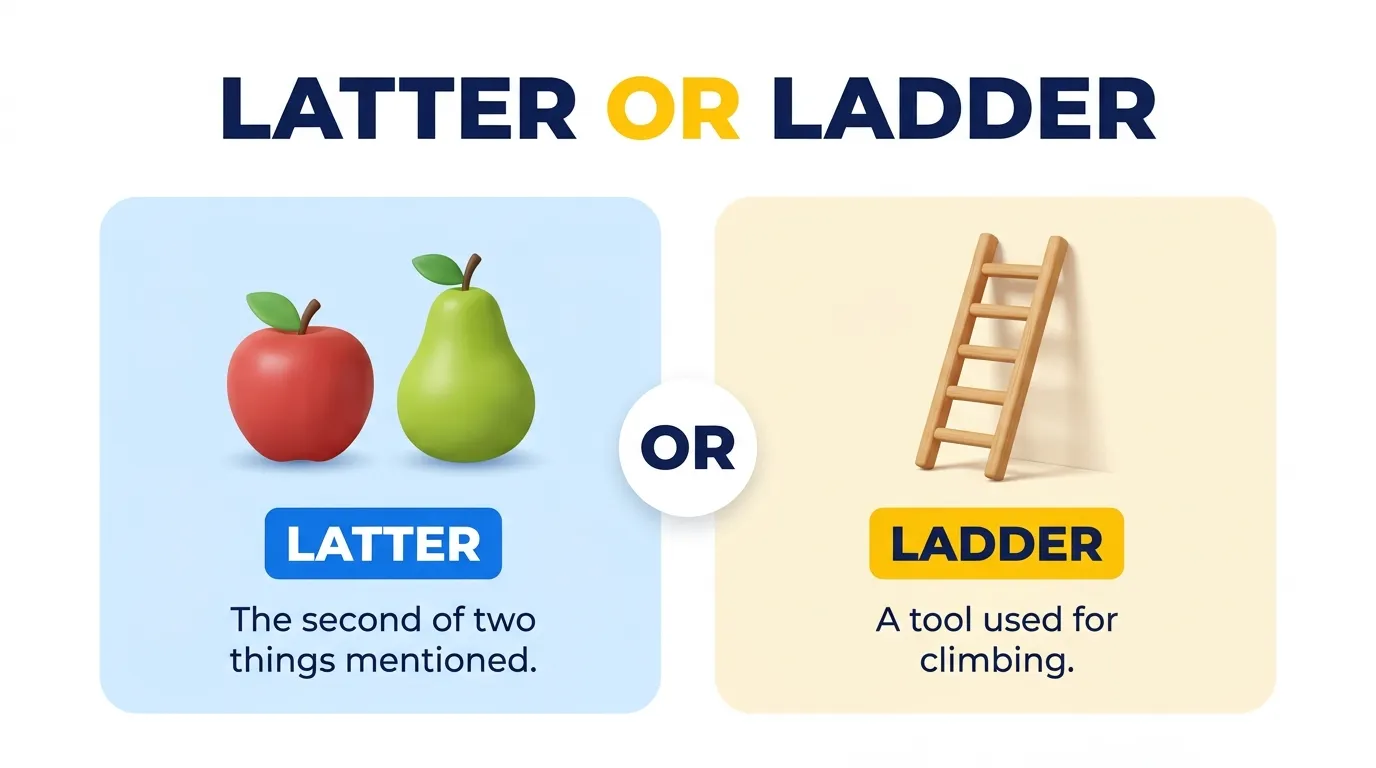
Latter means the second of two things mentioned, while ladder is a tool with steps that helps you climb up or down.
When you are writing an email, the words latter or ladder can cause confusion because they sound similar. However, they have very different meanings. One helps you talk about the second choice, while the other helps you reach a high place.
If you type the wrong word in a work message or school paper, your meaning may change. So, learning the difference between these words can help you write with more care. Let’s look at their meanings, spelling, and everyday use.
Latter or Ladder: Quick Answer
Use latter when you mean the second of two things you have named. Use ladder when you mean a tool with steps for climbing.
For example:
- I like tea and coffee, but I prefer the latter. This means you prefer coffee.
- Dad used a ladder to fix the roof. This means Dad climbed up using a tool with steps.
The easiest way to remember the difference is to link latter with the second choice and ladder with climbing.
The Origin of Latter and Ladder
Although latter and ladder look and sound alike, they come from different word histories.
The word latter comes from an old form of English that meant the second or more recent of two things. Today, it often points to the second item in a pair. For example, if you mention cats and dogs, the latter means dogs.
On the other hand, ladder comes from an old English word for a climbing tool. Its meaning has stayed close to its original use. People still use ladders to reach roofs, paint walls, and pick fruit from trees.
Because the words have similar sounds, it is easy to mix them up. However, their meanings give you a simple way to tell them apart.
Latter or Ladder Explained: Key Differences
The main difference between these words is what they describe. Latter points to the second of two things already mentioned, while ladder names a physical tool or a structure with steps.
What Does Latter Mean?
Latter is used when you mention two people, things, ideas, or choices and then refer to the second one.
For example, consider this sentence: “We can travel by bus or train, and I prefer the latter.” The word latter means train because it is the second choice.
You can also use it when talking about the last part of a period. For example, “During the latter half of the year, sales went up.” Here, latter means the second half.
What Does Ladder Mean?
A ladder is a tool with steps or rungs that help you climb. It may stand against a wall or open out on its own.
For example, “The painter carried a ladder to the house.” The ladder helps the painter reach high places.
The word can also describe levels of progress. For example, “She climbed the career ladder.” This means she moved to higher positions at work.
Latter vs. Ladder at a Glance
| Term | Meaning | When to Use | Region or Context |
| Latter | The second of two things mentioned | Talking about the second choice or later part | Standard English |
| Ladder | A tool with steps for climbing | Talking about climbing or levels of progress | Standard English |
Both words are correct English words. However, they cannot replace each other because their meanings are different.
Which One Should You Use?
The right word depends on what you want to say. However, you can choose correctly by checking the meaning of your sentence.
- For school essays: Use latter when you compare two ideas and refer to the second one.
- For work emails: Choose latter when you need to refer to the second of two options, but name the option directly if it makes your message clearer.
- For home repairs: Use ladder when you mean a tool for climbing.
- For formal writing: Use latter to describe the second choice or a later part of a period.
- For everyday conversations: Say the name of the item if the meaning might confuse your reader.
For example, “I prefer the latter” works when you have already named two choices. However, “I need a ladder” is correct when you need a tool to reach a high shelf.
Common Mistakes with Latter or Ladder
These mistakes happen because the two words sound alike. However, a few simple rules can help you avoid them.
Mistake: Using Ladder for the Second Choice
Incorrect: I like apples and oranges, but I prefer the ladder.
Correct: I like apples and oranges, but I prefer the latter.
Why it happens: People may think of a ladder because the word sounds similar. However, latter is the right choice because oranges are the second item.
Mistake: Using Latter for a Climbing Tool
Incorrect: Please bring the latter so I can paint the wall.
Correct: Please bring the ladder so I can paint the wall.
Why it happens: Both words sound alike, but only a ladder is a tool for climbing.
Mistake: Using Latter for Three Choices
Incorrect: I can choose tea, coffee, or juice. I prefer the latter.
Better: I can choose tea, coffee, or juice. I prefer juice.
Why it happens: Latter is clearest when you compare two things. So, name the last item directly when you have three or more choices.
Mistake: Mixing Up Latter and Later
Incorrect: I will call you the latter.
Correct: I will call you later.
Why it happens: These words are related in meaning, but they work differently. Later refers to a time in the future, while latter points to the second of two things or a part nearer the end.
Mistake: Using Latter Without Naming Two Things
Incorrect: The latter is my favorite.
Correct: I like reading and drawing, but the latter is my favorite.
Why it happens: Readers need to know which two things you mean. Therefore, name both choices before using the latter.
Latter or Ladder in Real World Examples
Seeing these words in common settings makes their meanings easier to remember. Here are examples you can use as a guide.
Professional Email
“Both plans could work for our team. However, I recommend the latter because it costs less.”
Here, latter means the second plan mentioned in the email.
News Headline
“New Safety Rules Require Workers to Use a Ladder.”
In this headline, ladder refers to the climbing tool needed for the job.
Social Media Post
“I tried walking and cycling this week, but I enjoyed the latter more!”
Because cycling comes second, latter refers to cycling.
Formal Document
“During the latter half of the year, the company plans to hire more staff.”
In this example, latter refers to the part closer to the end of the year.
Home Repair Note
“Please place the ladder near the wall before painting begins.”
Here, ladder names the equipment needed to reach a high area.
Latter or Ladder: Data, Trends and Usage
People look up latter or ladder when they are unsure which spelling fits a sentence. The search usually shows a clear need: readers want a quick definition, a simple rule, and examples they can trust.
The confusion can affect students, English learners, office workers, and people who write online. Since the words sound similar, a writer may choose the wrong spelling even when the rest of the sentence is correct.
There are three main reasons this difference matters:
- For search intent: Most readers want to know which word is correct and how to use it.
- For clear writing: The wrong word can change the meaning of a sentence.
- For everyday communication: A short example often explains the difference better than a long grammar rule.
However, exact search volumes and current ranking figures can change over time. The safest approach is to focus on meaning instead of guessing which word is more popular.
Latter or Ladder: Comparison at a Glance
Use this table as a quick guide whenever you are unsure which word fits your sentence.
| Term or Variant | Meaning | Region or Context | Best Used When |
| Latter | The second of two things mentioned | Standard English | Referring to the second choice |
| Latter | Nearer to the end of a period | Standard English | Describing the latter half of a year |
| Ladder | A tool with steps for climbing | Standard English | Talking about repairs or reaching high places |
| Ladder | A path to higher levels or success | Work, sports, and other settings | Talking about a career ladder or ranking |
Remember, both spellings are correct words. The sentence decides which one you need.
Frequently Asked Questions
What is the difference between latter and ladder?
Latter means the second of two things mentioned or a part nearer the end of a period. In contrast, ladder is a tool with steps that helps people climb.
Is latter or ladder the correct spelling?
Both spellings are correct, but they have different meanings. Use latter for the second choice and ladder for a climbing tool.
How do you use latter in a sentence?
Use latter after naming two things when you want to refer to the second one. For example, “I enjoy reading and writing, but I prefer the latter,” means you prefer writing.
Can you use latter in formal writing?
Yes, latter is correct in formal writing, especially in essays, reports, and business documents. However, naming the second choice directly can make your meaning clearer.
What is the difference between latter and later?
Latter usually refers to the second of two things or the later part of a period. Later means after the present time or after another event, as in “I will finish the task later.”
Where does the word latter come from?
Latter comes from an old English word related to the idea of being late or coming after something else. Over time, it gained its common meaning of the second of two things.
Does latter mean the last item in a list?
Usually, latter refers to the second of two items already mentioned. If you have a list of three or more items, it is clearer to say last or name the item directly.
Final Thoughts on Latter or Ladder
Choosing between latter or ladder becomes easy when you focus on the meaning. Use latter for the second of two choices or the part nearer the end of a period. On the other hand, use ladder for a climbing tool or a path to higher success.
Remember, both words are correct, but they cannot replace each other. If you are writing for school, work, or your own blog, check what your sentence means before choosing a spelling. Also, name your choices clearly so readers can follow your ideas without confusion.
Now, try using both words in your own sentences. A little practice will help you remember the difference and write with confidence.
Curious about more confusing words? Read our guide to I Would Love To or Too.

I have a background in academic writing and spent several years as a proofreader for digital publications. Spotting differences between easily confused words became second nature to me. At WordsCombo, I share that knowledge so readers can write with confidence.