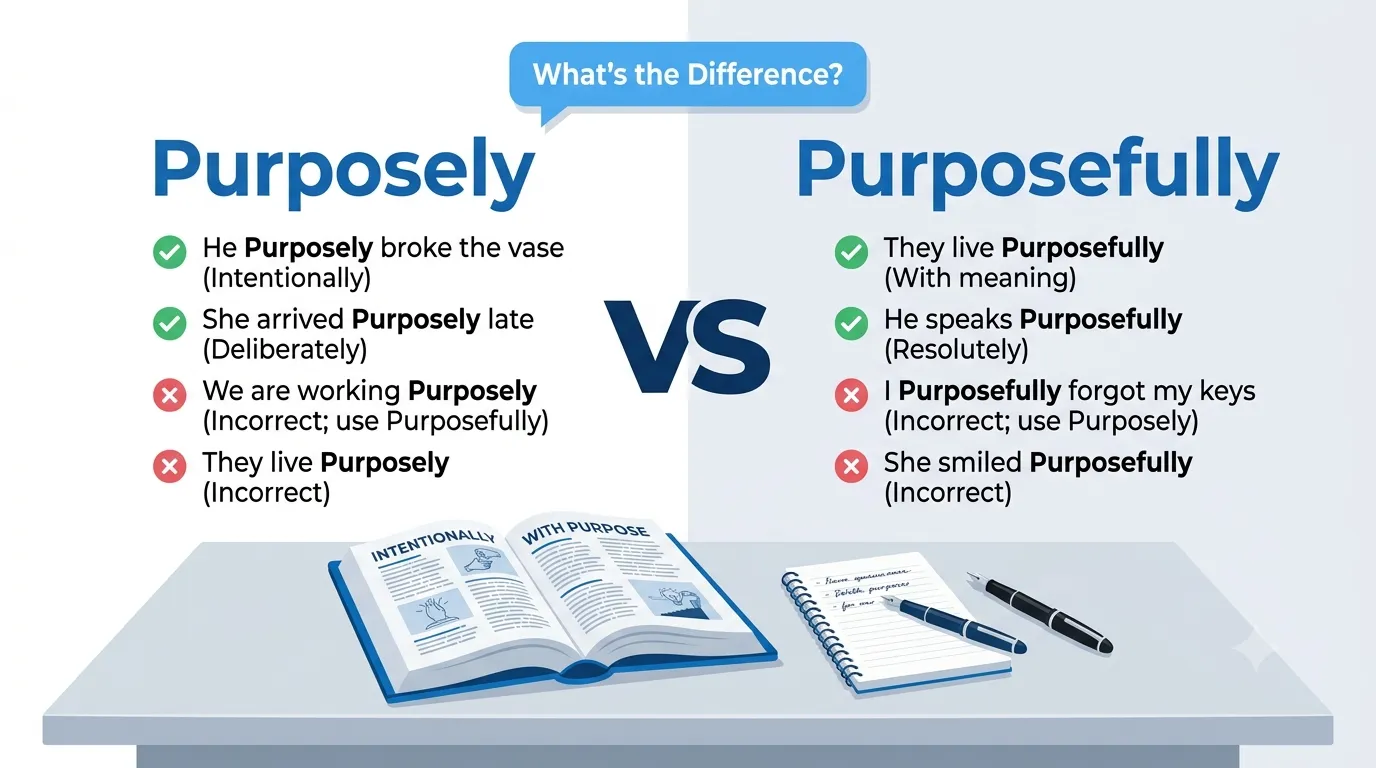
“Purposely” and “purposefully” are both correct English words, but they are not always interchangeable. Purposely means on purpose or intentionally, while purposefully usually means with determination or in a way that shows purpose.
A few years ago, I was editing an article for a client who had written, “She purposefully ignored my email.” At first glance, nothing looked wrong. But after reading the sentence again, I stopped. Did they mean she ignored it intentionally, or did they mean she ignored it with determination? That small difference changed the meaning.
Moments like this happen more often than you might think. Even experienced writers mix up purposely and purposefully because both words come from the same root and seem almost identical. Many dictionaries even note that people often use them interchangeably in everyday English. Still, careful writing benefits from knowing the distinction.
If you’ve ever paused before choosing between these two words, you’re not alone. Students, professionals, bloggers, and native English speakers all search for the answer.
By the end of this guide, you’ll know exactly what each word means, when to use it, and how to avoid one of the most common vocabulary mistakes in English.
Purposely or Purposefully: Quick Answer
The easiest way to remember the difference is this:
- Purposely = intentionally or on purpose
- Purposefully = with purpose, determination, or a clear sense of direction
Although many people use purposefully to mean intentionally, most style experts recommend using purposely when you simply mean on purpose. This choice makes your writing clearer.
Examples
✅ She purposely left the door unlocked.
(She did it intentionally.)
✅ She walked purposefully toward the stage.
(She walked with confidence and determination.)
Notice how the second example describes how she walked, not why she acted.
The Origin and Background of “Purposely” and “Purposefully”
Both words come from the English noun purpose, which means an aim, goal, or intention.
Over time, English created two different adverbs from the same word.
Purposely
The word purposely developed to express the idea of doing something deliberately. It answers the question:
Did someone mean to do it?
For centuries, writers have used it to describe intentional actions.
Example:
- He purposely arrived early to avoid traffic.
Purposefully
Purposefully came later and originally described the manner in which someone acted.
Instead of focusing on intention, it focused on having a clear purpose or determination.
Example:
- The coach walked purposefully across the field.
Here, the sentence tells us how the coach walked.
Why Do People Confuse Them?
The confusion exists because language changes over time.
Many modern speakers use purposefully to mean intentionally, especially in everyday conversation. Some dictionaries now list this as an accepted secondary meaning.
However, many editors, teachers, and professional writers still prefer keeping the traditional distinction because it avoids confusion.
That is why you’ll often see grammar guides recommending:
- Purposely → intentional action
- Purposefully → determined manner
This small choice makes your writing more precise.
Purposely or Purposefully Explained: Key Differences
Although these words are closely related, they answer different questions.
- Purposely answers Why was the action done?
- Purposefully answers How was the action done?
Think of it this way:
Purposely = intention
Purposefully = determination
Comparison Table
| Term | Meaning | When to Use | Region/Context |
|---|---|---|---|
| Purposely | Intentionally; on purpose | When someone deliberately does something | Standard English worldwide |
| Purposefully | With purpose, determination, or confidence | When describing the manner of an action | Standard English worldwide |
| Purposefully (secondary use) | Intentionally | Common in modern speech and some dictionaries | Informal and everyday English |
More Examples
Purposely
- She purposely turned off her phone.
- They purposely changed the schedule.
- He purposely avoided the question.
Each sentence shows intent.
Purposefully
- The doctor walked purposefully into the emergency room.
- The team moved purposefully toward their goal.
- She spoke purposefully during the meeting.
Each sentence describes the way someone acted.
A Simple Memory Trick
Ask yourself one question:
Can I replace the word with “on purpose”?
If yes, use purposely.
Example:
- He purposely missed the call.
- He missed the call on purpose.
Both mean the same thing.
Now try:
- She walked on purpose to the office.
That sounds strange.
Instead:
- She walked purposefully to the office.
Which Version Should You Use?
The best choice depends on who you’re writing for and what you want to say.
For Students
Use purposely when your teacher asks for clear and correct grammar.
Example:
- The student purposely left the answer blank.
This matches what most grammar books teach.
For Professional Writers
If you’re writing articles, business documents, reports, or academic work, keep the traditional distinction.
- Use purposely for intentional actions.
- Use purposefully for determined actions.
Editors appreciate precise word choice.
For Everyday Conversation
People often use both words interchangeably, and most listeners will understand you.
Even so, choosing the more precise word makes your communication stronger.
Instead of saying:
She purposefully ignored me.
You can make your meaning clearer:
She purposely ignored me.
Or, if you mean determination:
She walked purposefully past me without stopping.
For Global or Neutral English
If you’re writing for an international audience, use this simple rule:
- ✅ Purposely = intentionally
- ✅ Purposefully = with determination
This avoids confusion for readers whose first language isn’t English.
Key Takeaways So Far
- Purposely means on purpose or intentionally.
- Purposefully usually means with determination or clear purpose.
- Many people use purposefully to mean intentionally, but careful writing often keeps the meanings separate.
- When in doubt, ask yourself: “Can I replace it with ‘on purpose’?” If yes, choose purposely
Common Mistakes with Purposely and Purposefully
Even native English speakers confuse these two words. The good news is that the mistakes are easy to fix once you know what each word means.
Mistake 1: Using purposefully when you mean intentionally
❌ She purposefully broke the vase.
✅ She purposely broke the vase.
Why?
The sentence is about intent. She broke the vase on purpose, so purposely is the better choice.
Mistake 2: Using purposely to describe someone’s manner
❌ The manager purposely walked into the meeting.
✅ The manager purposefully walked into the meeting.
Why?
This sentence describes how the manager walked. It suggests confidence and determination.
Mistake 3: Thinking both words always mean the same thing
❌ Both words are identical in every situation.
✅ They can overlap in everyday English, but they often carry different shades of meaning in careful writing.
Why?
Choosing the right word makes your writing more precise.
Mistake 4: Replacing every purposely with purposefully
Some writers think purposefully sounds more formal.
That is not always true.
Example:
❌ The child purposefully spilled the milk.
✅ The child purposely spilled the milk.
The second sentence is clearer.
Mistake 5: Ignoring the context
Always ask yourself:
- Was the action intentional? → Purposely
- Was the action done with determination? → Purposefully
That one question solves most problems.
Purposely and Purposefully in Real World Examples
Seeing these words in real situations makes the difference much easier to remember.
Professional Email
I purposely scheduled the meeting for Monday so everyone could attend.
Here, purposely means intentionally.
News Headline
Firefighters moved purposefully through the burning building to rescue residents.
Here, purposefully describes how they moved.
Social Media Post
I purposely left my phone at home today. Best decision ever!
The writer made a deliberate choice.
Formal Report
The project team worked purposefully toward completing every milestone before the deadline.
The sentence highlights focus and determination.
Everyday Conversation
A: Did she forget your birthday?
B: No. She purposely didn’t call.
A: How did the coach enter the locker room?
B: He walked purposefully toward the team.
Purposely or Purposefully: Data, Trends & Usage
Although both words are common, purposely appears more often when people talk about actions done on purpose.
Search Intent
Primary search intent: Informational
People usually want to know:
- Which word is correct?
- Are they interchangeable?
- Which one should I use?
- What do grammar experts recommend?
Who Searches for This Topic?
This question is popular among:
- Students
- English learners
- Teachers
- Professional writers
- Editors
- Business professionals
- Content creators
- Copywriters
Where Is It Most Common?
Interest comes from many English speaking countries, including:
- United States
- United Kingdom
- Canada
- Australia
- India
- Other regions where English is widely used
Why Does It Matter Now?
Clear writing matters more than ever.
Whether you’re sending an email, writing a report, publishing a blog post, or posting on social media, choosing the right word helps readers understand your message without stopping to guess what you mean.
Small word choices often make a big difference.
Standalone Comparison Table
| Term/Variant | Meaning | Region/Context | Best Used When |
|---|---|---|---|
| Purposely | Intentionally; on purpose | Standard English | Describing deliberate actions |
| Purposefully | With purpose, confidence, or determination | Standard English | Describing the manner of an action |
| Purposefully (secondary meaning) | Intentionally | Informal or modern usage | Acceptable in casual writing, but may be less precise |
Frequently Asked Questions (FAQs)
Q: What does “purposely” mean?
A: Purposely means intentionally or on purpose. It describes an action someone planned or meant to do.
Q: How do you use “purposefully” correctly?
A: Use purposefully when describing how someone acts. It often suggests confidence, focus, or determination rather than simple intention.
Q: Purposely vs. purposefully: what’s the difference?
A: Purposely focuses on why an action happened. Purposefully focuses on how the action was carried out. Although the meanings sometimes overlap, keeping this distinction makes your writing clearer.
Q: Is “purposefully” acceptable in formal writing?
A: Yes. It is perfectly acceptable when it means with purpose or determination. If you simply mean intentionally, many editors still prefer purposely because it is more precise.
Q: Which version is correct: purposely or purposefully?
A: Both are correct. The right choice depends on your meaning. Use purposely for intentional actions and purposefully for determined actions.
Q: Where do these words come from?
A: Both words come from the noun purpose, meaning an aim or goal. Over time, English developed two adverbs with related but slightly different meanings.
Q: Can I use “purposefully” in business writing?
A: Yes, especially when describing focused or determined actions. If you mean someone did something on purpose, purposely is usually the clearer choice.
Conclusion
The difference between purposely and purposefully is small, but understanding it can make your writing stronger and more precise.
Here are the key points to remember:
- Purposely means intentionally or on purpose.
- Purposefully means with determination, confidence, or clear purpose.
- While many people use the words interchangeably in everyday speech, careful writing benefits from keeping their traditional meanings separate.
- When you’re unsure, try replacing the word with “on purpose.” If the sentence still makes sense, purposely is usually the better choice.
Language changes over time, and both words have their place. What matters most is choosing the one that matches your intended meaning. That simple habit will make your emails, essays, reports, and conversations easier to understand.
Now you know exactly how to use “purposely” and “purposefully.” Try using them in your next piece of writing with confidence. If you found this guide helpful, bookmark it so you never second guess these words again, and share it with someone who has wondered about the difference.

I started writing about English word differences after years of teaching students who kept making the same mistakes. My focus is on making spelling rules feel simple and easy to remember. At WordsCombo, I turn confusing word pairs into clear comparisons.