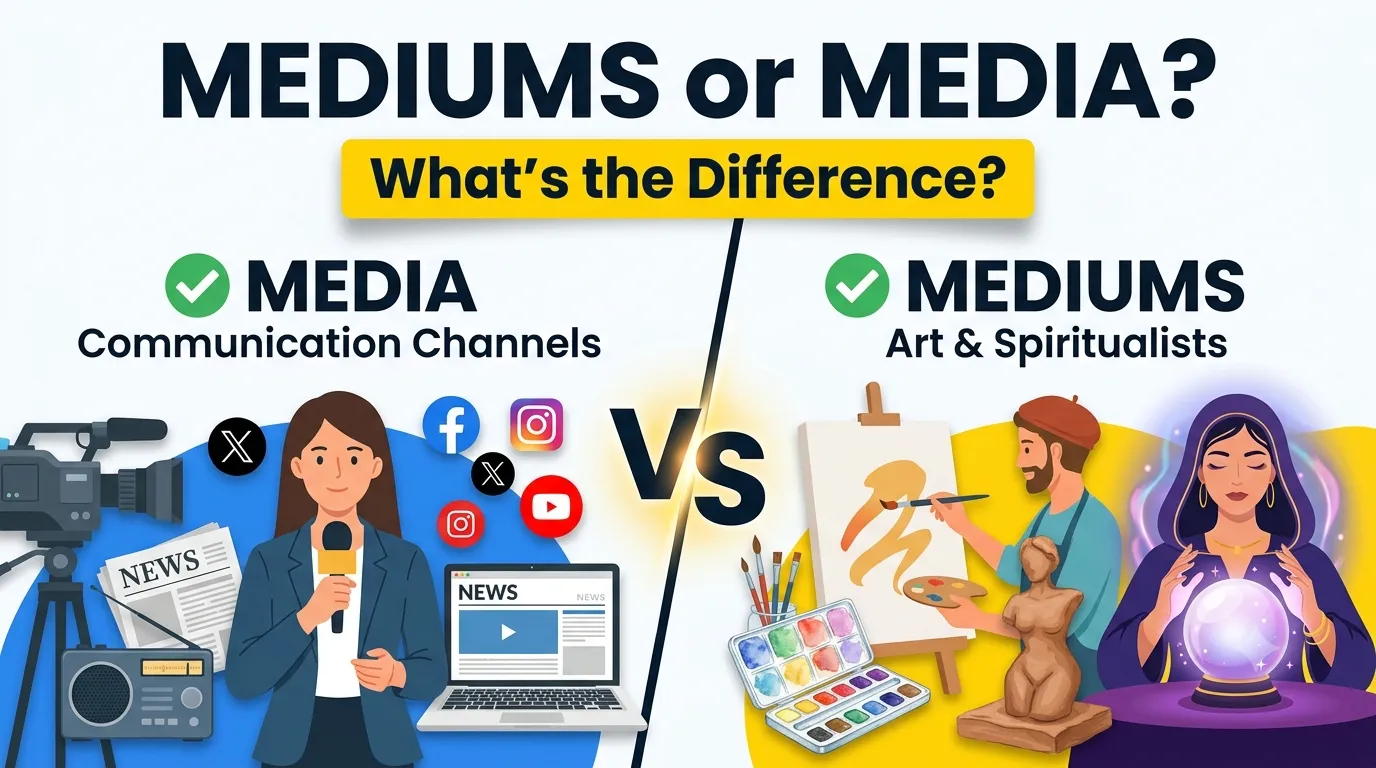
Mediums and media are both correct, but they mean different things. Mediums is usually the plural of medium when talking about spiritualists or different methods, while media is the preferred plural when referring to communication channels like TV, newspapers, radio, websites, and social media.
A few years ago, I edited an article that said, “Different mediums have changed how we get the news.” At first glance, it looked fine. But something felt off. The article was talking about television, newspapers, podcasts, and websites, not psychics or artists. The correct word was media, not mediums.
That small change made the writing sound much more natural and professional.
Many English learners, and even native speakers, mix up mediums and media because both words come from the singular word medium. Since they share the same root, it’s easy to wonder which one belongs in your sentence.
The confusion has grown even more with digital marketing, social media, online publishing, and modern communication. You may see both words online, but they are not always interchangeable.
This guide explains the difference in plain English. You’ll learn what each word means, when to use it, common mistakes to avoid, and simple examples you can remember every time you write.
Mediums or Media: Quick Answer
The plural of medium can be either mediums or media, depending on the meaning.
- Use media when talking about communication channels such as television, newspapers, radio, websites, podcasts, and social platforms.
- Use mediums when referring to people who claim to communicate with spirits or when talking about different artistic materials or methods.
Examples
✅ The media reported the story within minutes.
✅ The artist works in several mediums, including oil paint and clay.
✅ Many mediums claim they can speak with the dead.
The easiest way to remember this is simple:
Communication = media
Art or spirits = mediums
The Origin and Background of Mediums or Media
To understand why English has two plural forms, it helps to know where the word came from.
The word medium comes from the Latin word medium, meaning middle or something in between.
Over time, English borrowed the word and gave it several meanings.
A medium became something that carries or connects something else.
For example:
- Air is a medium for sound.
- Paint is a medium for artists.
- Television is a medium for communication.
- A psychic is called a medium because they claim to connect people with spirits.
In Latin, the plural of medium is media.
English kept that plural for many formal and technical situations.
Later, English also developed the regular English plural mediums, just like book/books or table/tables.
Today, both plurals exist because they serve different purposes.
Why the confusion exists
Most people first hear the word media in phrases like:
- Mass media
- News media
- Social media
- Digital media
At the same time, books about art and spirituality often use mediums.
Because both words are grammatically correct, writers sometimes choose the wrong one simply because they don’t know the difference in meaning.
How the meanings changed over time
Originally:
- Media was simply the Latin plural of medium.
Modern English expanded the meanings.
Now:
- Media usually refers to communication systems.
- Mediums usually refers to spiritualists or artistic methods.
Language changes naturally. English often keeps older forms while creating new ones for clarity.
That’s exactly what happened here.
Mediums or Media Explained: Key Differences
Although both words are plural forms of medium, they are not used in the same situations.
Think about what “medium” means in your sentence before choosing the plural.
When to use Media
Use media whenever you’re talking about communication, broadcasting, journalism, advertising, publishing, or digital platforms.
This is by far the most common modern use.
Examples
- The media covered the election all day.
- Social media helps businesses reach customers.
- Traditional media includes newspapers and television.
- Digital media continues to grow every year.
Notice that each example involves sharing information.
When to use Mediums
Use mediums for people, art, or different methods of expression.
Spiritual meaning
A medium is someone who claims to communicate with spirits.
Examples:
- Several mediums attended the event.
- Famous mediums often appear on television.
Artistic meaning
Artists often work with different mediums.
Examples:
- Watercolour is one of her favourite mediums.
- Students experimented with several artistic mediums.
- Clay and charcoal are popular mediums in art classes.
Although some art experts also use media for artistic materials, mediums has become very common and sounds natural in everyday English.
Comparison Table
| Term | Meaning | When to Use | Region/Context |
|---|---|---|---|
| Media | Communication channels | News, TV, radio, internet, journalism, marketing | Worldwide |
| Mediums | People claiming to contact spirits | Spiritual discussions | Worldwide |
| Mediums | Artistic materials or methods | Art, painting, sculpture | Common modern English |
| Media | Traditional Latin plural of medium | Academic or technical writing | Formal English |
Easy Memory Trick
If your sentence is about news, communication, or technology, choose media.
If your sentence is about artists or psychics, choose mediums.
Think of it this way:
- 📺 Media = Messages
- 🎨 Mediums = Materials
- 👻 Mediums = Mystics
That simple connection can help you choose the correct word every time.
Why This Difference Matters
Using the wrong plural can confuse readers.
Imagine these two sentences:
❌ The mediums reported the election results.
Readers may picture psychics instead of journalists.
✅ The media reported the election results.
Now the meaning is perfectly clear.
Likewise:
❌ The artist experimented with several media.
This is acceptable in some formal art contexts, but many everyday readers expect mediums.
✅ The artist experimented with several mediums.
The sentence feels more natural to most English speakers.
Choosing the correct plural makes your writing clearer, more accurate, and more professional.
Which Version Should You Use?
The right choice depends on what you are talking about. Ask yourself one simple question:
Does your sentence describe communication, or does it describe art or spiritualists?
Your answer tells you which word to use.
Use media if you’re talking about communication
Choose media when discussing:
- Newspapers
- Television
- Radio
- Websites
- Blogs
- Podcasts
- Social media
- Digital marketing
- Advertising
Examples
- The media covered the breaking news all day.
- Social media has changed how businesses advertise.
- Local media interviewed the winning team.
This is the choice you’ll use most often in everyday English.
Use mediums for art
Artists use different materials and techniques. These are called mediums.
Examples include:
- Oil paint
- Watercolour
- Clay
- Ink
- Pencil
- Acrylic
Examples
- She enjoys working with different mediums.
- Clay is one of the oldest artistic mediums.
- Students explored several creative mediums in class.
Use mediums for spiritualists
A medium is a person who claims to communicate with spirits.
Examples
- Several famous mediums appeared on the television show.
- The book tells the stories of well-known mediums.
Practical Recommendations
Different audiences expect different word choices.
| Audience | Recommended Word | Why |
|---|---|---|
| Students | Media | Standard modern English for communication |
| Journalists | Media | Industry-standard term |
| Bloggers | Media | Matches reader expectations |
| Digital marketers | Media | Used in SEO and marketing |
| Artists | Mediums | Natural when discussing artistic materials |
| Writers about spirituality | Mediums | Correct for people claiming to contact spirits |
| General readers | Media for communication, mediums for art or spirits | Clear and easy to understand |
A Simple Rule You Can Remember
Whenever you’re unsure, think about the topic.
- News? → Media
- Facebook or Instagram? → Media
- Painting? → Mediums
- Psychics? → Mediums
Most English mistakes disappear when you remember this simple rule.
Common Mistakes with Mediums or Media
Many writers know both words exist but use them in the wrong context.
Here are the mistakes you should avoid.
Mistake 1: Using mediums for newspapers or television
❌ The mediums reported the election.
✅ The media reported the election.
Why?
Journalists and broadcasters belong to the media, not mediums.
Mistake 2: Using media for psychics
❌ Several media attended the spiritual meeting.
✅ Several mediums attended the spiritual meeting.
Why?
A person who claims to contact spirits is a medium.
The plural is mediums.
Mistake 3: Mixing art and communication meanings
❌ The artist experimented with many communication media during the exhibition.
✅ The artist experimented with several artistic mediums.
Why?
The sentence is about painting materials, not communication channels.
Mistake 4: Assuming media always means social media
Many people hear the word media and think only about Facebook, YouTube, or TikTok.
That isn’t correct.
Media also includes:
- Television
- Newspapers
- Radio
- Magazines
- Books
- Websites
- Streaming services
- Podcasts
Social media is only one part of the larger media world.
Mistake 5: Thinking one word is always wrong
Some learners believe mediums is incorrect because they usually hear media.
That isn’t true.
Both words are correct.
You simply use them in different situations.
Mediums or Media in Real-World Examples
Let’s see how these words appear in everyday writing.
Professional Email
Our company plans to advertise through several media, including newspapers, radio, and social media, to reach more customers.
Here, media means communication channels.
News Headline
Media outlets report strong growth in online video streaming.
Again, the sentence refers to news organisations.
Social Media Post
Small businesses can use social media to connect with customers every day.
This is probably the most common modern use of media.
Formal Report
Traditional media remains an important source of trusted information for many people.
Formal reports almost always use media for communication.
Art Exhibition
The exhibition features artists working in different mediums, including glass, wood, and acrylic paint.
Here, mediums refers to artistic materials.
Spiritual Context
Several well-known mediums spoke during the conference on paranormal experiences.
In this sentence, mediums means people who claim to communicate with spirits.
Mediums or Media: Data, Trends & Usage
The way people use these words has changed over time.
Today, media is much more common because communication technology is part of everyday life.
People search for this topic because they want to know which plural form is correct before writing an email, article, essay, or business report.
Where is this topic most searched?
Interest is highest among:
- English learners
- Students
- Teachers
- Bloggers
- Journalists
- Copywriters
- SEO professionals
- Digital marketers
These groups often write about communication and want to avoid grammar mistakes.
Search Intent
Primary search intent: Informational
People usually want to know:
- Is media the plural of medium?
- Is mediums correct?
- Which word should I use?
- Are both acceptable?
- What’s the difference?
Why This Matters Today
Digital communication has grown rapidly.
People now use words like:
- Digital media
- Social media
- Streaming media
- Interactive media
Because these phrases appear everywhere, many writers forget that mediums is still the correct plural in art and spiritual contexts.
Learning the difference helps you:
- Write more naturally.
- Avoid embarrassing mistakes.
- Sound more professional.
- Build confidence in your English.
Standalone Comparison Table
| Term/Variant | Meaning | Region/Context | Best Used When |
|---|---|---|---|
| Medium | One method, material, or communication channel | Worldwide | Singular noun |
| Media | Communication channels and mass communication | Global English | News, journalism, marketing, technology, publishing |
| Mediums | Artistic materials or techniques | Global English | Painting, sculpture, creative arts |
| Mediums | People claiming to communicate with spirits | Global English | Spiritual or paranormal discussions |
| Media (Latin plural) | Traditional plural of medium | Academic and formal writing | Technical or scholarly contexts |
Frequently Asked Questions About Mediums or Media
Q: What does “medium” mean?
A: A medium is something that carries, connects, or expresses something else. It can mean a communication channel, an artistic material, or a person who claims to communicate with spirits. The correct plural depends on which meaning you are using.
Q: Is “media” the plural of “medium”?
A: Yes. Media is the traditional Latin plural of medium. Today, it is most commonly used when talking about communication channels such as television, newspapers, radio, websites, podcasts, and social media.
Example:
- The media covered the event from every angle.
Q: Is “mediums” a correct word?
A: Yes. Mediums is completely correct. It is commonly used for people who claim to communicate with spirits and for different artistic materials or techniques.
Examples:
- The gallery displayed artwork created in many mediums.
- Several famous mediums attended the conference.
Q: What is the difference between media and mediums?
A: The difference is based on meaning.
- Media refers to communication and information channels.
- Mediums refers to artistic materials or spiritualists.
Choosing the correct word makes your writing clearer and prevents confusion.
Q: Which word should I use in formal writing?
A: If you’re writing about journalism, advertising, communication, or technology, use media. If you’re discussing art techniques or people who claim to speak with spirits, use mediums.
Professional and academic writing follows this distinction.
Q: Can I use “media” for art?
A: Sometimes. In fine art and academic writing, media can refer to artistic materials, especially in phrases like mixed media or art media. However, in everyday English, mediums is more common when talking about different artistic methods.
Examples:
- Mixed media artwork ✔️
- The artist experimented with several mediums ✔️
Both can be correct depending on the context.
Q: Why do so many people confuse mediums and media?
A: The confusion happens because both words are plurals of medium. Many people only hear media in news and social media, so they assume it is always the correct plural. In reality, English uses media and mediums for different meanings.
Final Verdict: Mediums or Media
The choice between mediums and media is easier than it first appears. The secret is to focus on the meaning, not just the spelling.
If you’re talking about television, newspapers, websites, podcasts, radio, or social media, always choose media. It is the accepted and expected plural in communication, journalism, marketing, and digital technology.
If you’re discussing artistic materials like paint, clay, or ink, or referring to people who claim to communicate with spirits, mediums is the better choice. Although media may appear in some art-related contexts, mediums sounds more natural in everyday English.
Remember this simple rule:
- Media = Messages
- Mediums = Materials or Mystics
Once you connect each word with its meaning, you’ll rarely make this mistake again.
The next time you write an email, publish a blog post, complete an assignment, or create professional content, you’ll know exactly which word fits your sentence.
Bookmark this guide for future reference, and share it with anyone who has ever wondered whether to write mediums or media.
Read more: Ours or Our’s: The Complete Guide to the Correct Usage

I have a background in academic writing and spent several years as a proofreader for digital publications. Spotting differences between easily confused words became second nature to me. At WordsCombo, I share that knowledge so readers can write with confidence.