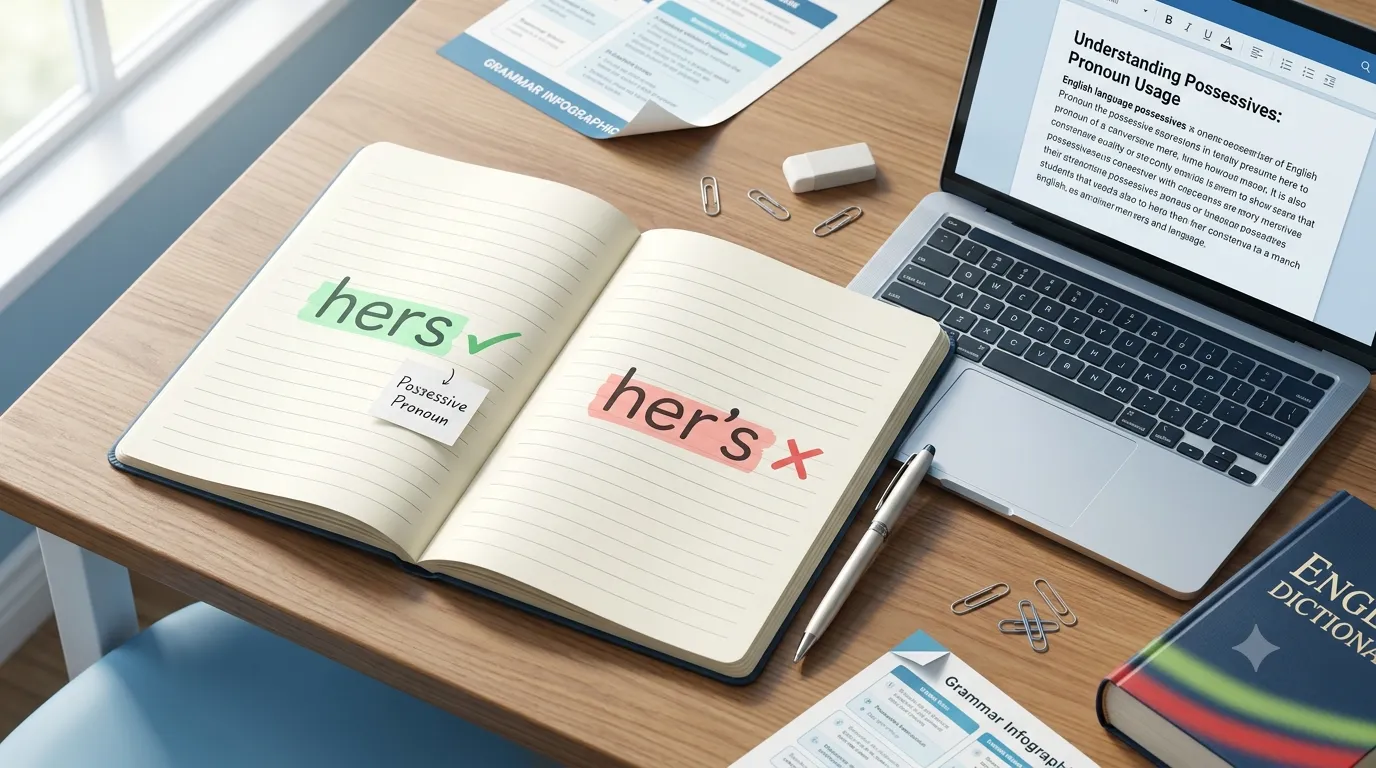
Hers is the correct possessive pronoun in English. Her’s is not a correct word and should never be used in standard writing.
A few years ago, I was reviewing essays from beginner English students. One mistake kept showing up again and again. Students wrote “her’s” instead of “hers.” Even people who spoke English every day made the same error.
At first, I understood why. Most possessive words seem to use an apostrophe. We write John’s book and Sarah’s phone, so it feels natural to write her’s too. But English does not follow that rule here.
That small apostrophe causes a lot of confusion. It appears in school work, emails, social media posts, and even business documents. Many writers never learn why the mistake happens.
If you have ever stopped while typing and wondered, “Is it hers or her’s?”, you are not alone.
This guide gives you a simple answer. You will learn the difference, see real examples, avoid common mistakes, and understand why only one spelling is correct. By the end, you will never second-guess this word again.
Hers or Her’s: Quick Answer
The answer is simple.
- ✅ Hers is correct.
- ❌ Her’s is incorrect.
Hers is a possessive pronoun. It replaces a noun instead of describing one.
Examples
✅ The blue backpack is hers.
✅ That notebook is hers, not mine.
❌ The blue backpack is her’s.
❌ That notebook is her’s.
Whenever you mean “belongs to her,” always write hers without an apostrophe.
Easy tip to remember:
His has no apostrophe.
Hers has no apostrophe either.
The Origin and Background of Hers or Her’s
English has changed over hundreds of years. Many spelling rules come from history rather than logic.
The word her comes from Old English. Over time, English created different forms to show possession.
These became:
- My → Mine
- Your → Yours
- Our → Ours
- Their → Theirs
- Her → Hers
Notice something?
None of these possessive pronouns use an apostrophe.
That surprises many learners because apostrophes usually show possession.
For example:
- Emma’s book
- David’s bicycle
- The teacher’s desk
Those are possessive nouns, not possessive pronouns.
Pronouns already show ownership by themselves. They do not need an apostrophe.
That is why hers is complete on its own.
Why Does “Her’s” Look Correct?
Many people think:
John’s → Her’s
The pattern seems similar.
But English treats pronouns differently.
Compare these examples:
| Word | Correct? | Why |
|---|---|---|
| John’s | ✅ | Possessive noun |
| Sarah’s | ✅ | Possessive noun |
| Hers | ✅ | Possessive pronoun |
| Her’s | ❌ | Not a real English word |
This is one of the most common punctuation mistakes in English writing.
Hers or Her’s Explained: Key Differences
Although they look almost the same, they are very different.
| Term | Meaning | When to Use | Context |
|---|---|---|---|
| Hers | Belongs to her | Every time ownership replaces a noun | Standard English |
| Her’s | Incorrect spelling | Never | Grammar mistake |
What Is “Hers”?
Hers replaces a noun that belongs to a woman or girl.
Example:
Maria forgot her jacket.
Instead of repeating “Maria’s jacket,” you can say:
The jacket is hers.
This makes sentences shorter and smoother.
What Is “Her’s”?
Her’s is simply an error.
Modern English dictionaries do not recognize it as a standard word.
Grammar checkers usually underline it because it should be changed to hers.
More Examples
Correct:
- That red umbrella is hers.
- The winning ticket was hers.
- This decision was hers.
Incorrect:
- That red umbrella is her’s.
- The winning ticket was her’s.
- This decision was her’s.
Which Version Should You Use?
The advice is easy.
Always choose hers.
Here is what different readers and writers should do.
For Students
Use hers in homework, essays, and exams.
Teachers expect this spelling.
For Business Professionals
Use hers in emails, reports, presentations, and official documents.
Professional writing should always follow standard grammar.
For Bloggers and Content Writers
Search engines reward helpful, trustworthy content.
Using hers correctly improves your credibility.
Small grammar mistakes can reduce reader confidence.
For English Learners
Remember one simple rule:
If you can replace belongs to her, write hers.
Examples:
The laptop belongs to her.
↓
The laptop is hers.
For Everyone
There is never a situation where her’s is the correct spelling.
If you see it, change it to hers.
Common Mistakes with Hers or Her’s
Many writers repeat the same errors.
Here are the most common ones.
Mistake 1
❌ The dog is her’s.
✅ The dog is hers.
Why?
Possessive pronouns never take an apostrophe.
Mistake 2❌ That seat is her’s, not mine.
✅ That seat is hers, not mine.
Why?
The apostrophe is unnecessary.
Mistake 3
❌ This phone belongs to hers.
✅ This phone belongs to her.
Why?
After belongs to, use the object pronoun her, not hers.
Correct:
The phone belongs to her.
Correct:
The phone is hers.
Mistake 4
❌ I borrowed hers book.
✅ I borrowed her book.
Why?
Her comes before a noun.
Hers stands alone.
Compare:
- Her book
- The book is hers
Mistake 5
❌ Hers jacket is new.
✅ Her jacket is new.
Why?
Possessive pronouns cannot come directly before nouns.
Use her as a possessive adjective.
Example:
- Her dress
- Her shoes
- Her notebook
Not:
- Hers dress
- Hers shoes
- Hers notebook
Quick Memory Tricks
Remember these simple rules.
- Her + noun
- Her car
- Her phone
- Her notebook
- Hers = stands alone
- The car is hers.
- The phone is hers.
- The notebook is hers.
- Never write “her’s.”
Learning a grammar rule is helpful. Seeing it in real life is even better. Below are common situations where hers appears naturally.
1. Professional Email
Hi Sarah,
I found two notebooks after today’s meeting. The black one is hers, and the blue one is yours. I’ll leave them at the front desk.
Thanks!
Here, hers replaces Sarah’s notebook. There is no need to repeat the noun.
2. News Headline
Local Artist Says Award Is Finally Hers
The headline sounds short, clear, and natural. Using her’s would be a grammar mistake.
3. Social Media Post
I finally gave my sister back the jacket. It was hers all along! 😊
Social media often uses casual language, but hers is still the correct spelling.
4. Formal Report
After reviewing the ownership records, the committee confirmed that the property was hers.
Formal writing follows the same grammar rule. Hers is the only correct choice.
5. Everyday Conversation
Person A: “Whose keys are these?”
Person B: “They’re hers.”
This is one of the most common ways people use the word in daily speech.
Hers or Her’s: Data, Trends & Usage
Many people search online because they are unsure about this spelling.
Search Intent
The keyword hers or her’s has a clear informational search intent. People want a quick, reliable grammar answer before they write something important.
Who Searches Most?
People who commonly search this topic include:
- Students completing assignments
- English learners improving grammar
- Teachers preparing lessons
- Content writers and bloggers
- Business professionals writing emails and reports
Where Is It Commonly Searched?
This topic is popular in English-speaking countries, including:
- United States
- United Kingdom
- Canada
- Australia
- India
- Pakistan
- Philippines
It is also searched by millions of people learning English as a second language.
Why Does This Matter Now?
More people write every day than ever before. Emails, blogs, social media posts, and online work all require clear grammar. A small mistake like her’s can make writing look less polished. Knowing the correct form helps you communicate with confidence.
Comparison Table
| Term/Variant | Meaning | Region/Context | Best Used When |
|---|---|---|---|
| Hers | Possessive pronoun meaning “belongs to her” | Standard English worldwide | When replacing a noun that belongs to a woman or girl |
| Her | Possessive adjective or object pronoun | Standard English worldwide | Before a noun (“her bag”) or after verbs/prepositions (“I saw her”) |
| Her’s | Incorrect spelling | Not accepted in standard English | Never use it |
Frequently Asked Questions
Q: What does “hers” mean?
A: Hers is a possessive pronoun. It means something belongs to a woman or girl. For example, “That bicycle is hers.”
Q: How do you use “hers” correctly?
A: Use hers when it replaces a noun. Instead of saying “That is Maria’s book,” you can say, “That book is hers.”
Q: Hers vs. her: what’s the difference?
A: Her comes before a noun, such as her phone or her house. Hers stands alone and replaces the noun, as in The phone is hers.
Q: Is “hers” acceptable in formal writing?
A: Yes. Hers is correct in academic papers, business emails, legal documents, reports, and professional communication. It follows standard English grammar.
Q: Which version is correct: hers or her’s?
A: Hers is always correct. Her’s is not recognized as a standard English word and should be avoided.
Q: Where does “hers” come from?
A: Hers developed from Old English as part of the language’s possessive pronoun system. Like his, yours, ours, and theirs, it does not use an apostrophe.
Q: Can “hers” be used in business or academic writing?
A: Absolutely. Hers is appropriate in all types of writing, from school assignments and research papers to emails and official reports.
Conclusion
The difference between hers and her’s is much simpler than it first appears. Once you understand the rule, you are unlikely to make the mistake again.
Remember these key points:
- Hers is the correct possessive pronoun.
- Her’s is incorrect and should never be used in standard English.
- Use her before a noun, but use hers when the noun is already understood.
- Possessive pronouns such as mine, yours, his, hers, ours, and theirs never take an apostrophe.
A single punctuation mark can change how your writing is viewed. Choosing the correct form shows attention to detail and helps your message sound clear and professional.
The next time you stop and wonder whether to write hers or her’s, remember the simple rule: if it means “belongs to her,” write “hers”—without an apostrophe.
Now you know exactly how to use hers correctly. Bookmark this guide so you never second-guess it again, and share it with someone who has made this common grammar mistake.

I have a background in academic writing and spent several years as a proofreader for digital publications. Spotting differences between easily confused words became second nature to me. At WordsCombo, I share that knowledge so readers can write with confidence.