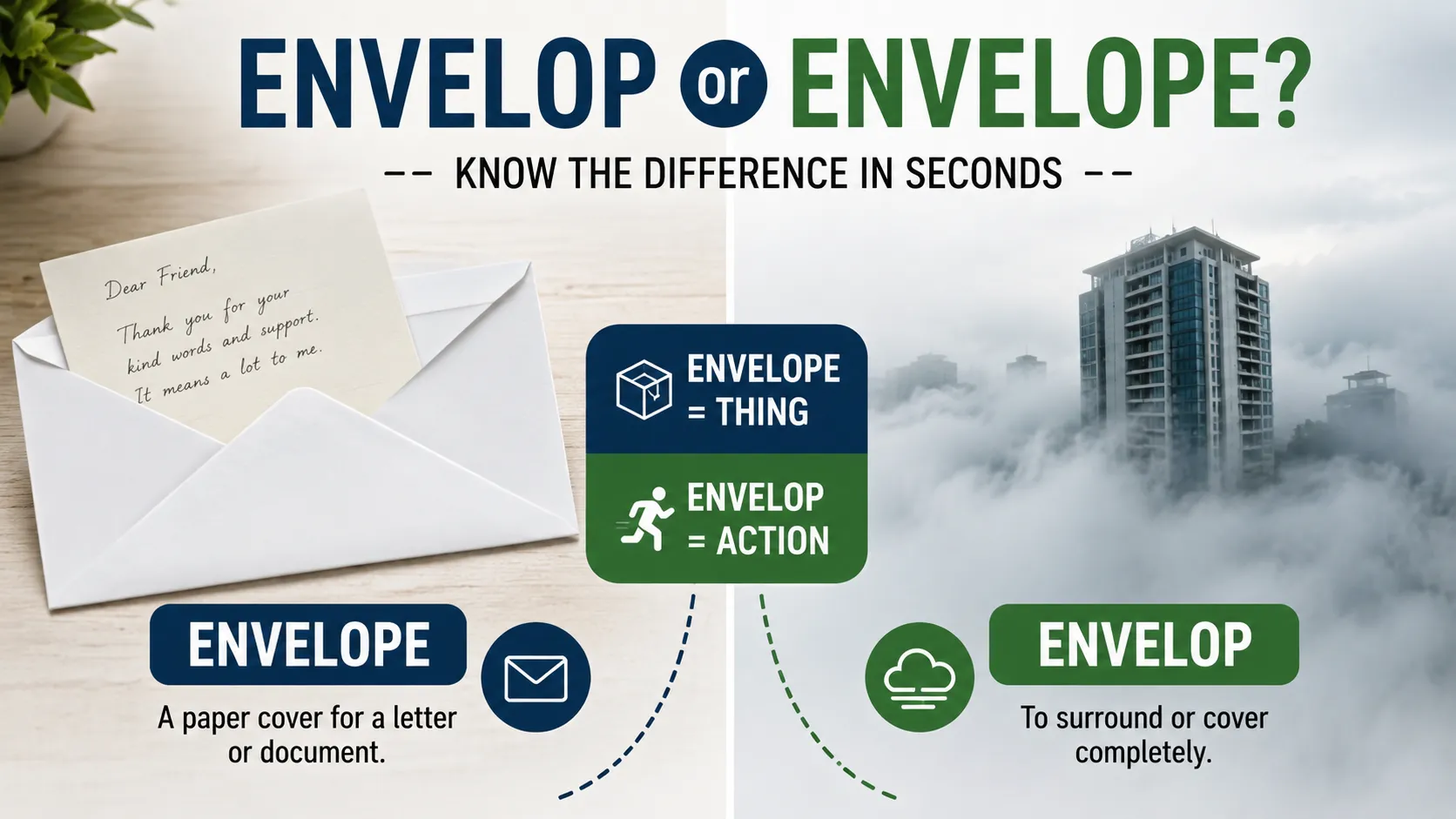
Envelop or envelope? The correct English spelling is envelope when you mean the paper cover used for a letter. Envelop is a different verb that means “to cover or surround completely.”
Have you ever typed “envelop” when you meant the paper case for a letter? You are not alone. This is one of those small spelling questions that can make even careful writers stop and think.
I have seen this mix up many times while helping students improve their English. The two words look almost the same. They even sound similar in some situations. Yet they do not mean the same thing.
The good news is that the difference is easy once you know the simple rule.
If you are talking about the paper item that holds a letter, card, or document, use envelope. If you use envelop as a verb, it means to surround or cover something completely.
This small difference matters in school work, emails, business writing, and everyday English. A single letter can change the meaning of your sentence.
So, how can you remember which one to use? Let’s make it simple.
Envelop or Envelope
Envelope is the noun for the paper cover used to send a letter.
Please put the letter in an envelope.
Envelop is a verb. It means to surround, cover, or wrap something completely.
Thick smoke began to envelop the building.
A simple memory trick
Think of it this way:
- Envelope = the thing you put a letter in
- Envelop = to surround something
The extra e in envelope helps you remember the paper item.
The Origin and Background of Envelop
The two words have an interesting history.
Envelop comes from Old French and is related to a word meaning to wrap or cover. It entered English centuries ago.
The noun envelope developed from the same general word family. It came to describe something that wraps around or covers another thing.
That is why the words look so similar today.
There is another reason learners find them confusing. English spelling often keeps old word forms even when pronunciation changes over time. The result is a pair of words that look related but work differently in a sentence.
The meaning also depends on the word’s grammatical role.
- Envelop is normally a verb.
- Envelope is normally a noun.
This distinction is more useful than trying to memorize two unrelated spellings.
Envelop or Envelope Explained: The Key Difference
The easiest way to understand the difference is to look at how each word works.
| Term | Meaning | When to Use | Region/Context |
|---|---|---|---|
| Envelope | A paper or similar cover for a letter or document | Mailing or holding papers | Standard English |
| Envelop | To surround or cover completely | Describing an action | Standard English |
1. Envelope
Envelope is a noun.
You use it for the paper container that holds a letter, card, check, or document.
Examples:
- I put the invitation inside an envelope.
- Please write your address on the envelope.
- The bank sent the document in a sealed envelope.
Here, envelope names a physical object.
2. Envelop
Envelop is a verb.
It means to surround, cover, or wrap something completely.
Examples:
- Fog began to envelop the road.
- Darkness enveloped the town.
- The warm blanket enveloped the child.
Here, envelop describes an action.
The easiest test
Ask yourself:
“Am I talking about something that holds a letter?”
If yes, use envelope.
“Am I talking about something surrounding or covering another thing?”
If yes, use envelop.
Which Version Should You Use?
Your choice depends on what you mean.
For students
Use envelope when writing about letters, cards, or mail.
She placed the letter inside an envelope.
Use envelop when describing something surrounding another object.
A cloud of dust began to envelop the workers.
For professional writers
The same rule applies. Do not choose the word based only on how it sounds.
Look at its meaning and grammatical role.
If you mean the physical mailing item, choose envelope.
If you mean surround, choose envelop.
For global or neutral English
Envelope is the standard spelling for the mailing item in both American and British English.
There is no need to change it based on your country.
That makes envelope the safest choice when you mean the paper cover for a letter.
Common Mistakes With Envelop or Envelope
These words are easy to mix up. Here are some common mistakes.
| Mistake | Correction | Why? |
|---|---|---|
| Put the letter in an envelop. | Put the letter in an envelope. | The word is a noun for a paper cover. |
| Smoke began to envelope the room. | Smoke began to envelop the room. | The verb is envelop. |
| I bought three envelops. | I bought three envelopes. | The plural of envelope is envelopes. |
| Please envelope the building in fog. | Please envelop the building in fog. | The action is envelop. |
Mistake 1: Using “envelop” for mail
❌ Put the card in an envelop.
✅ Put the card in an envelope.
This happens because envelop looks like a shortened form of envelope.
It is not.
Mistake 2: Using “envelope” as the verb
❌ Darkness envelope the village.
✅ Darkness enveloped the village.
The verb is envelop. In the past tense, it becomes enveloped.
Mistake 3: Forgetting the final “e”
❌ I need two envelops.
✅ I need two envelopes.
When you mean the mailing item, remember the final e.
Envelop or Envelope in Real World Examples
Seeing the words in real situations can make the difference easier to remember.
1. Professional email
Subject: Signed Documents
Please print the documents, place them in an envelope, and send them to our office.
Here, envelope means the physical cover used for the documents.
2. News headline
Heavy Fog Envelops City Before Sunrise
Here, envelops means surrounds or covers the city.
It is a verb.
3. Social media post
Just received my first handwritten letter in a real envelope! 📩
The word refers to the paper item.
4. Formal document
The mountain was enveloped in thick fog during the early morning.
Here, enveloped means completely surrounded or covered.
Notice the pattern
You can often replace envelop with surround.
Fog enveloped the road.
becomes:
Fog surrounded the road.
But you cannot replace envelope with “surround.”
Put the letter in an envelope.
This simple substitution test can help you choose the right word.
Envelop or Envelope: Data, Trends and Usage
The search “envelop or envelope” is mainly an informational search. People usually type it when they are unsure about spelling or want to know which word is correct.
The confusion is common because both forms belong to the same word family.
The difference is especially useful for:
- Students learning English
- ESL learners checking vocabulary
- Writers proofreading their work
- Job seekers writing formal documents
- Professionals preparing letters or reports
- Teachers explaining common English mistakes
There is also a useful writing lesson here.
Many spelling questions are really meaning questions. Instead of asking only, “Which spelling is correct?”, ask, “What am I trying to say?”
If you mean a letter cover, the answer is envelope.
If you mean “surround,” the answer is envelop.
That approach works much better than memorizing spelling rules alone.
Envelop or Envelope: Standalone Comparison
| Term/Variant | Meaning | Region/Context | Best Used When |
|---|---|---|---|
| Envelope | A paper cover for letters or documents | Standard English | Talking about mail or documents |
| Envelop | To surround or cover | Standard English | Describing something that surrounds another thing |
| Enveloped | Surrounded or covered | Standard English | Using envelop in the past tense |
| Envelops | Surrounds or covers | Standard English | Using envelop with he, she, or it |
| Enveloping | Surrounding or covering | Standard English | Describing an ongoing action |
Quick example
The envelope held the letter.
But:
Fog enveloped the house.
The first word is a thing.
The second describes an action.
FAQs About Envelop or Envelope
Q: What does envelope mean?
A: Envelope is a noun. It usually means the paper cover used to hold and send a letter, card, or document. For example, “Put the check in an envelope.”
Q: How do you use envelope correctly?
A: Use envelope when you mean the physical container for a letter or document. For example, “She wrote the address on the envelope.”
Q: Envelop vs envelope — what’s the difference?
A: Envelop is a verb meaning “to surround or cover completely.” Envelope is a noun that usually means a paper cover for a letter or document.
Q: Is envelope acceptable in formal writing?
A: Yes. Envelope is standard English and is completely suitable for formal writing. You can use it in letters, reports, business documents, and academic work.
Q: Which is correct — envelop or envelope?
A: Both are correct words, but they have different meanings. Use envelope for the mailing item and envelop when you mean “surround” or “cover.”
Q: Where does the word envelope come from?
A: Envelope comes from the same word family as envelop, with roots linked to the idea of wrapping or covering something. The words developed different grammatical roles in English.
Q: Can envelop be used in formal writing?
A: Yes. Envelop is a normal English verb. It is often used in descriptions such as “fog enveloped the city” or “darkness enveloped the room.”
A Simple Trick to Never Confuse Them Again
Here is the easiest rule to remember:
Envelope = a thing
Think:
letter → envelope
Envelop = an action
Think:
fog → envelop → city
You can also use this sentence:
An envelope holds a letter. Fog can envelop a city.
Memorize that one line and you will probably never need to search “envelop or envelope” again.
Conclusion
The difference between envelop and envelope is small but useful.
Envelope is the noun. It is the paper cover that holds a letter, card, or document.
Envelop is the verb. It means to surround, cover, or wrap something completely.
The spelling becomes much easier when you focus on meaning. If you are talking about mail, choose envelope. If you mean “surround,” choose envelop.
Remember this simple sentence:
Put the letter in an envelope, but let the fog envelop the road.
That one example captures the whole difference.
English spelling can feel confusing at first. But once you connect a word to its meaning, the rule becomes much easier to remember.
Bookmark this guide so you never second guess “envelop or envelope” again.
Read more: Altar or Alter: What’s the Difference? Never Mix Them Up Again

I have been working with English language content for over six years. I specialize in word comparisons and spelling differences that most people overlook. At WordsCombo, I help readers choose the right word every time.