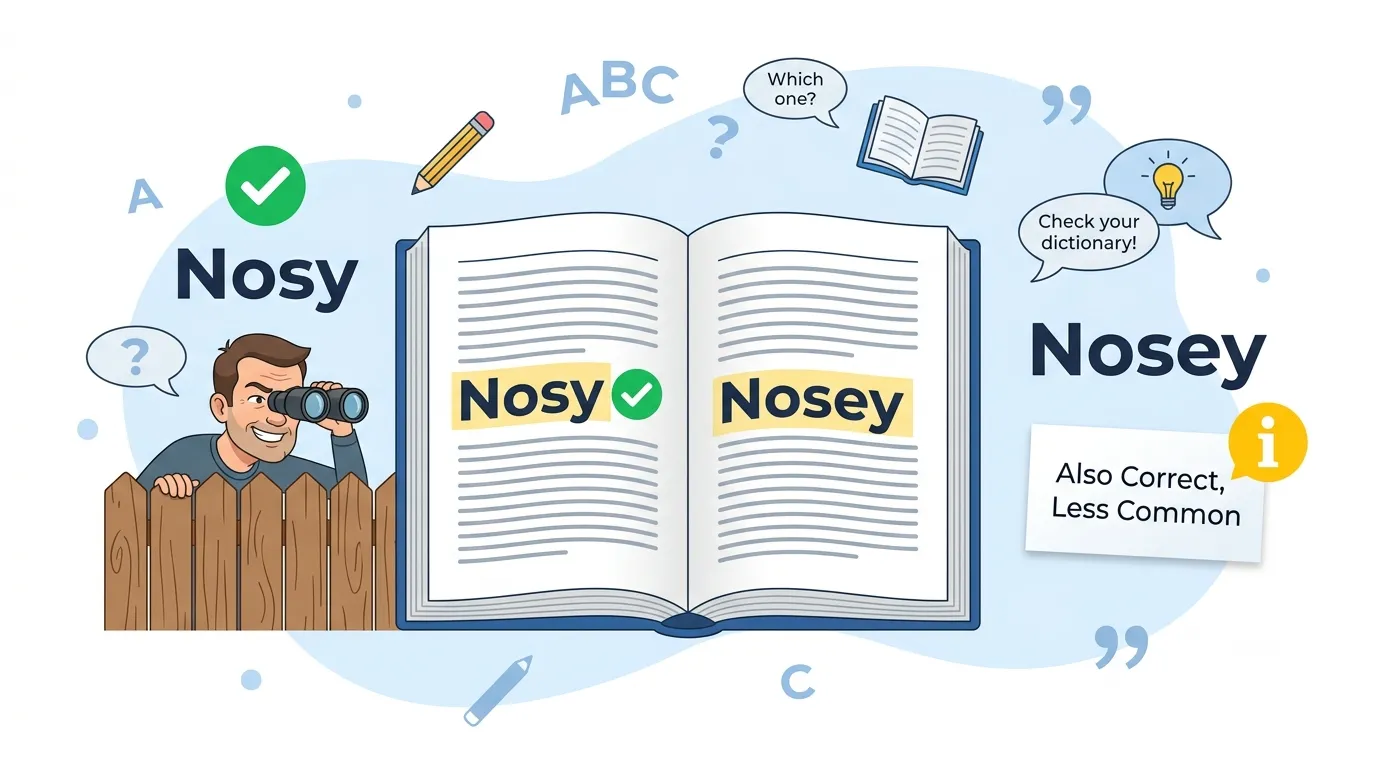
👀 Nosy and nosey both mean too interested in other people’s private lives. ✅ Nosy is the more common and preferred spelling, while nosey is a less common but still correct variant. 💡 Easy trick: Use nosy in most writing.
A few years ago, I was editing a blog post for a client when I spotted the word nosey. My first thought was, “That doesn’t look right.” I checked a few trusted dictionaries and found something surprising. Both nosy and nosey were correct.
That small discovery reminded me how confusing English can be. Two words can have the same meaning, yet one appears much more often than the other. If you’ve ever paused while writing an email, school paper, or social media post because you weren’t sure which spelling to use, you’re not alone.
Many people search for “nosy or nosey” because they want to avoid mistakes. They want to sound natural and confident. The good news is that the answer is simple once you know the difference.
In this guide, you’ll learn which spelling is more common, why both exist, where each one comes from, and which version you should choose for different situations. By the end, you’ll never have to second guess nosy or nosey again.
Nosy or Nosey: Quick Answer
Both nosy and nosey are correct spellings. They describe someone who is too curious about other people’s personal business.
Today, nosy is the spelling you will see most often in books, newspapers, websites, and business writing. Nosey is still accepted, but it appears less frequently.
Examples
- My neighbor is so nosy that she knows everyone’s schedule.
- Don’t be nosey. It’s their private conversation.
Both sentences are correct, but the first follows the spelling most readers expect.
The Origin and Background of Nosy or Nosey
The word comes from the noun nose.
Hundreds of years ago, English speakers began using the idea of someone “sticking their nose into other people’s business.” Over time, that image became the adjective nosy (or nosey), describing a person who asks too many personal questions or tries to learn things that do not concern them.
The meaning has stayed almost the same for generations.
Why are there two spellings?
English spelling has never been perfectly consistent. Many words developed different spellings before dictionaries became standard.
In this case:
- Nosy became the preferred modern spelling.
- Nosey remained as an accepted alternative.
Major dictionaries recognize both forms, although many style guides recommend nosy because it is shorter and more common.
Why does the confusion continue?
There are several reasons.
- The word comes from nose, so many people naturally write nosey.
- Others learned nosy in school or from books.
- Both spellings appear online, making it difficult to know which one is better.
The good news is that readers understand either version.
Nosy or Nosey Explained: Key Differences
The biggest surprise is that there is no difference in meaning.
Both words describe someone who is overly curious about another person’s private life.
The difference is mainly spelling preference and usage.
| Term | Meaning | When to Use | Region/Context |
|---|---|---|---|
| Nosy | Too interested in other people’s private matters | Everyday writing, school, work, websites | Most common worldwide |
| Nosey | Same meaning as nosy | Informal writing, personal messages | Less common but accepted |
Example using nosy
My little brother is always nosy about my phone.
Example using nosey
Stop being nosey and let them finish talking.
Both examples communicate exactly the same idea.
Which spelling appears more often?
Modern English strongly favors nosy.
You are much more likely to find it in:
- Newspapers
- Business articles
- Books
- Academic writing
- Educational websites
- Online dictionaries
Nosey still appears in novels, personal blogs, online comments, and casual conversations.
Does one sound more professional?
Yes.
If you are writing for work, school, or publication, nosy is usually the safer choice.
Readers are more familiar with it, and many editors automatically prefer it.
Which Version Should You Use?
Choosing between nosy and nosey is easier than many people think.
For students
Use nosy.
Teachers, textbooks, and academic style guides usually favor this spelling.
Example
The story describes a nosy neighbor who watches everyone.
For business professionals
Choose nosy.
It looks cleaner and matches modern business English.
Example
Avoid sounding nosy when asking customers personal questions.
For bloggers and content creators
Use nosy if you want the widest audience.
Search engines, dictionaries, and readers are more familiar with this spelling.
For fiction writers
Either spelling works.
If your character speaks casually or uses a regional dialect, nosey may help create a natural voice.
For everyday conversations
Both spellings are acceptable.
Most people won’t notice the difference unless they pay close attention to spelling.
Quick Recommendation
| Audience | Best Choice | Why |
|---|---|---|
| Students | Nosy | Matches educational writing |
| Professionals | Nosy | Preferred in formal English |
| Bloggers | Nosy | Most recognized spelling |
| Fiction writers | Either | Depends on style and character voice |
| Casual texting | Either | Meaning stays the same |
Final advice
If you’re ever unsure, choose nosy.
It is the spelling most English speakers expect, making it the safest choice for nearly every situation.
Standalone Comparison Table
| Term/Variant | Meaning | Region/Context | Best Used When |
|---|---|---|---|
| Nosy | Too curious about other people’s private affairs | Common in American and British English | Formal, academic, professional, and everyday writing |
| Nosey | Same meaning as nosy | Accepted but less common | Informal writing, dialogue, and personal communication |
Common Mistakes with Nosy or Nosey
Even though both spellings are correct, people still make mistakes when using them. Here are the most common ones.
| Mistake | Correct | Why It Happens |
|---|---|---|
| She is very nosey. (formal report) | She is very nosy. | Nosy is the preferred spelling in formal writing. |
| Your so nosy. | You’re so nosy. | The grammar is wrong, not the spelling. |
| He asked a nosy question about my salary. (when you mean “personal”) | He asked a nosy question about my salary. | This is actually correct. A nosy question is too personal. |
| Being nosy means being helpful. | Being nosy means being overly curious. | People sometimes confuse curiosity with being intrusive. |
| Switching between nosy and nosey in one article | Pick one spelling and stay consistent. | Consistency makes your writing look more professional. |
Tips to avoid mistakes
- Use one spelling throughout your writing.
- Choose “nosy” for school, work, and websites.
- Remember that both words have the same meaning.
- Think about your audience before choosing a spelling.
Nosy or Nosey in Real World Examples
Seeing a word in context makes it much easier to remember.
Professional Email
Please avoid asking nosy questions during the interview, as some topics are private.
News Headline
“Nosy Neighbor Helps Police Solve Local Mystery”
Here, nosy describes someone who paid close attention to what was happening nearby.
Social Media Post
My cat is so nosy. She has to inspect every shopping bag I bring home!
The word adds humor and sounds natural.
Formal Report
The survey avoided nosy questions that could make participants uncomfortable.
In formal writing, nosy is usually the better choice.
Nosy or Nosey: Data, Trends & Usage
Search interest shows that people often look up “nosy or nosey” because they want the correct spelling.
Where is it searched most?
The topic is popular in countries where English is widely spoken, including:
- United States
- United Kingdom
- Canada
- Australia
- New Zealand
Students, writers, bloggers, and professionals search for it most often.
Search Intent
Primary intent: Informational
People want to know:
- Which spelling is correct.
- Whether both words are acceptable.
- Which one they should use in formal writing.
- If there is any difference in meaning.
Why does this matter now?
More people write online every day. Emails, blog posts, social media updates, and school assignments all require clear writing. Choosing the preferred spelling helps your work look polished and trustworthy.
Frequently Asked Questions (FAQs)
Q: What does “nosy” mean?
A: Nosy means being too interested in other people’s private lives or personal matters. It usually has a negative meaning because it suggests someone is asking questions they should not ask.
Q: How do you use “nosy” correctly?
A: Use nosy to describe someone who is overly curious about things that do not concern them.
Example:
My coworker is a little nosy about everyone’s weekend plans.
Q: Nosy vs. nosey : what’s the difference?
A: There is no difference in meaning. The only difference is spelling. Nosy is the preferred modern spelling, while nosey is a less common but accepted variant.
Q: Is “nosy” acceptable in formal writing?
A: Yes. Nosy is widely accepted in formal and professional writing. If you’re writing for school, work, or publication, it is the recommended spelling.
Q: Which version is correct nosy or nosey?
A: Both are correct according to major dictionaries. However, nosy is more common and is usually the safest choice.
Q: Where does the word come from?
A: The word comes from nose and the old expression “to stick your nose into someone else’s business.” Over time, it became the adjective nosy (and the variant nosey).
Q: Can “nosy” be used in professional communication?
A: Yes, but use it carefully. It can sound critical. In formal situations, you might choose softer words like curious, inquisitive, or overly interested, depending on the context.
Conclusion
The debate over nosy or nosey is much simpler than it first appears. Both spellings are correct, and both describe someone who takes too much interest in another person’s private life.
Still, one spelling clearly stands out. Nosy is the preferred form in modern English. You’ll see it more often in books, newspapers, business documents, websites, and academic writing. Nosey remains an accepted alternative, but it is less common and is mostly found in informal writing or creative works.
If your goal is to write clearly and confidently, choose nosy. It matches current usage and meets the expectations of most readers. Keeping your spelling consistent also makes your writing look more polished and professional.
Now you know exactly when to use nosy and nosey. Bookmark this guide so you never second guess the spelling again, and share it with anyone who has ever wondered which version is correct.

I started writing about English word differences after years of teaching students who kept making the same mistakes. My focus is on making spelling rules feel simple and easy to remember. At WordsCombo, I turn confusing word pairs into clear comparisons.