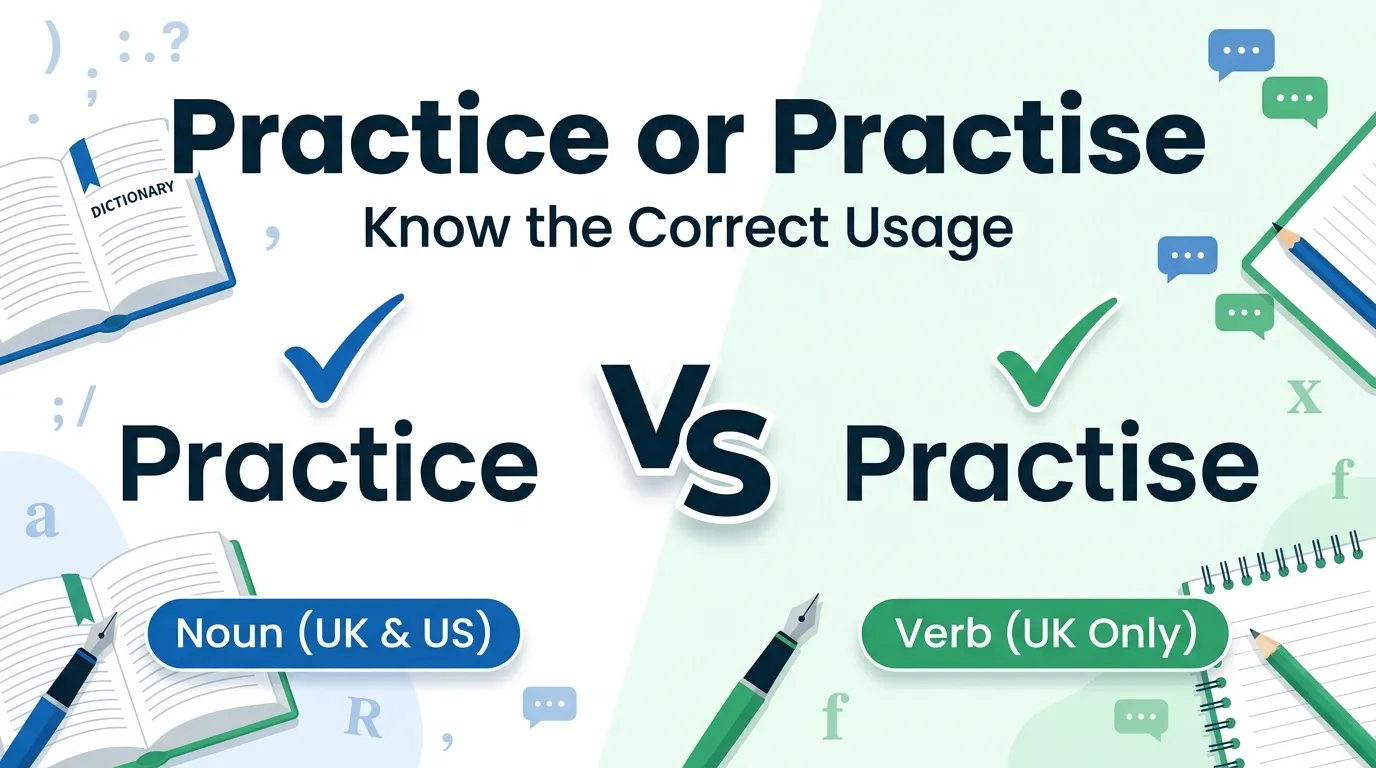
Practice and practise are both correct, but they are used differently. In British English, practice is a noun and practise is a verb. In American English, practice is used as both the noun and the verb.
I still remember proofreading a friend’s university essay when I noticed the sentence, “You should practice your piano practice every day.” It looked strange, but the mistake was easy to miss. Even experienced writers mix up practice and practise because the words look almost identical.
The confusion becomes even bigger when you switch between American and British English. One website tells you to use practice, while another insists on practise. If you’re a student, writer, teacher, or English learner, this can feel frustrating.
The good news is that the rule is actually simple once you know it.
In this guide, you’ll learn the difference between practice and practise, when each one is correct, how they are used in different countries, and how to avoid the mistakes that confuse millions of English learners every year.
Let’s clear up the confusion once and for all.
Practice or Practise: Quick Answer
The easiest way to remember the difference is this:
- Practice = Noun (a thing)
- Practise = Verb (an action)
However, this rule applies only in British English.
In American English, the spelling practice is used for both meanings.
Examples
British English
- I need more practice before the exam. ✅
- I practise speaking English every morning. ✅
American English
- I need more practice before the exam. ✅
- I practice speaking English every morning. ✅
A quick trick is to ask yourself:
Is it an action?
- Yes → practise (British only)
- No → practice
The Origin / Background of Practice and Practise
These two words share the same history.
They come from the Greek word praktikos, meaning fit for action. The word later passed through Latin and Old French before reaching English.
For many years, English speakers used different spellings without strict rules.
Later, British English adopted a helpful pattern:
- Words ending in -ice became nouns.
- Words ending in -ise became verbs.
This is why we have:
- advice → advise
- device → devise
- licence → license (British)
- practice → practise
American English simplified the spelling over time.
Instead of keeping two spellings, American English uses practice for both the noun and the verb.
That is why both versions are correct—they simply follow different regional spelling rules.
Practice or Practise Explained: Key Differences
The biggest difference depends on whether the word is a noun or a verb and which variety of English you are using.
| Term | Meaning | When to Use | Region/Context |
|---|---|---|---|
| Practice | A noun meaning training, habit, or custom | Talking about the activity itself | British & American English |
| Practise | A verb meaning to perform or train | Talking about doing the action | British English |
| Practice | A verb meaning to perform or train | Used instead of practise | American English |
Practice (Noun)
A noun names a person, place, thing, or idea.
Examples:
- Daily practice improves your writing.
- Soccer practice starts at five.
- She has years of medical practice.
In each sentence, practice is a thing rather than an action.
Practise (Verb)
A verb shows an action.
Examples:
- I practise piano every evening.
- They practise English together.
- She practises yoga before work.
Each sentence describes something someone does.
Practice (Verb in American English)
Americans do not normally use practise.
Instead, they write:
- I practice every day.
- She practices law in New York.
- They practice good communication.
This spelling is completely correct in the United States.
Easy Memory Trick
Here’s a simple way to remember it.
- Practice ends with C.
- Think of C as standing for Concept or Class.
- A concept is a noun.
- Practise ends with S.
- Think of S as standing for Something you do.
- That makes it a verb.
It isn’t a grammar rule, but many learners find it easy to remember.
Which Version Should You Use?
The best choice depends on your audience.
If you write in American English
Use practice for everything.
Examples:
- I practice every morning.
- Basketball practice starts at 4 PM.
This is the standard spelling in the United States.
If you write in British English
Follow the noun-versus-verb rule.
Use:
- practice as the noun
- practise as the verb
Examples:
- Good writing takes practice.
- You should practise every day.
If you’re writing for an international audience
Choose one style and stay consistent.
For example:
- If your website follows American English, use practice throughout.
- If it follows British English, use practice and practise correctly according to their grammar.
Mixing the two styles in the same article can confuse readers and make your writing look less professional.
Common Mistakes with Practice or Practise
Even native English speakers confuse practice and practise. The mistakes usually happen because people forget whether the word is a noun or a verb, or they mix American and British spelling.
Here are the most common errors and the correct versions.
| ❌ Mistake | ✅ Correct | Why? |
|---|---|---|
| I need to practice more. (British English) | I need to practise more. | In British English, the verb is practise. |
| Soccer practise starts at 5 PM. | Soccer practice starts at 5 PM. | Here, practice is a noun. |
| She has a dental practise. | She has a dental practice. | A business or profession is a noun. |
| They practise medicine in Texas. | They practice medicine in Texas. | American English uses practice as the verb. |
| My piano practise is helping. | My piano practice is helping. | The activity itself is a noun. |
Mistake 1: Using practise as a noun
Incorrect:
I have football practise today.
Correct:
I have football practice today.
The activity is a thing, so use the noun.
Mistake 2: Using practice as a verb in British English
Incorrect:
I practice French every evening.
Correct (British English):
I practise French every evening.
The sentence describes an action.
Mistake 3: Mixing American and British spelling
Incorrect:
I practice every day because football practise starts tomorrow.
This mixes two spelling systems.
Choose one style:
American English
I practice every day because football practice starts tomorrow.
British English
I practise every day because football practice starts tomorrow.
Mistake 4: Forgetting the noun-versus-verb rule
Ask yourself one question:
Is it something or is it an action?
If it’s something, use practice.
If it’s an action and you’re writing British English, use practise.
Mistake 5: Copying spelling from another website
Many websites use American English, while others use British English.
Always check which style your school, company, or client prefers before you start writing.
Practice or Practise in Real World Examples
Seeing words in context makes them much easier to remember.
Here are examples from everyday writing.
Professional Email
British English
Before next week’s presentation, please practise your speech for at least fifteen minutes each day.
American English
Before next week’s presentation, please practice your speech for at least fifteen minutes each day.
News Headline
British English
Local football club opens new practice ground.
American English
Local football team increases practice sessions before playoffs.
Social Media Post
I’ve been practising guitar every day this month, and I’m finally seeing progress! 🎸
American version:
I’ve been practicing guitar every day this month!
Formal Report
The company follows best practice when handling customer information.
Notice that best practice is always a noun phrase, so the spelling is practice in both British and American English.
Everyday Conversation
British English
Friend: How did you become so good at tennis?
You: I practise every weekend.
Friend: Why are you improving so quickly?
You: Because I get lots of practice.
School Assignment
Students should practise writing one essay every week.
American English:
Students should practice writing one essay every week.
Medical Context
She has worked in medical practice for more than twenty years.
Here, practice refers to the profession or workplace, making it a noun.
Business Context
Regular practice improves customer service skills.
Employees should practise active listening during training sessions. (British English)
Practice or Practise: Data, Trends & Usage
The confusion between practice and practise is one of the most searched English grammar topics online.
People often search for it before exams, while writing reports, or when editing professional documents.
Where is this topic most searched?
The highest interest usually comes from:
- United Kingdom
- United States
- Canada
- Australia
- India
- Pakistan
- New Zealand
These countries use English every day but may follow different spelling standards.
Who searches for it?
Common audiences include:
- Students
- English learners
- Teachers
- Bloggers
- Journalists
- Copywriters
- Business professionals
- IELTS and TOEFL candidates
Search Intent
Primary intent: Informational
People want to know:
- Which spelling is correct
- Whether both words are acceptable
- Which version they should use
- How to remember the difference
Why This Matters Today
More people write online than ever before.
Emails, blogs, social media posts, university assignments, and business reports all require clear writing.
Using the correct spelling helps you:
- Build credibility
- Avoid confusion
- Match your audience’s language style
- Improve professional communication
Even small spelling choices can make your writing appear more polished and trustworthy.
Standalone Comparison Table
| Term/Variant | Meaning | Region/Context | Best Used When |
|---|---|---|---|
| Practice | Noun (training, habit, custom) | British English | Referring to an activity, profession, or habit |
| Practise | Verb (to perform or train) | British English | Talking about doing an action |
| Practice | Verb and noun | American English | All situations in American writing |
| Best Practice | Accepted method or standard | Global English | Business, education, healthcare, and professional writing |
| Medical Practice | Doctor’s profession or clinic | Global English | Referring to healthcare work or a clinic |
Frequently Asked Questions (FAQs)
Q1: What is the difference between practice and practise?
The main difference depends on the type of English you use. In British English, practice is a noun and practise is a verb. In American English, practice is used as both the noun and the verb.
Q2: How do you use practice and practise correctly?
First, decide whether the word is a thing or an action.
- Use practice when talking about the activity, habit, or profession.
- Use practise only as a verb in British English.
- If you’re writing in American English, always use practice.
Examples
- She needs more practice before the test.
- They practise every evening. (British English)
- They practice every evening. (American English)
Q3: Which spelling is correct—practice or practise?
Both spellings are correct, but they follow different rules.
- British English: Use practice (noun) and practise (verb).
- American English: Use practice for both meanings.
The correct choice depends on your audience and the style guide you’re following.
Q4: Is practise acceptable in formal writing?
Yes. Practise is completely correct in formal writing if you’re using British English.
For example:
- Students should practise academic writing every week.
If you’re writing for an American audience, replace it with practice.
Q5: Where do the words practice and practise come from?
Both words come from the Greek word praktikos, meaning fit for action. They entered English through Latin and Old French. Over time, British English kept separate spellings for the noun and verb, while American English simplified them into one spelling: practice.
Q6: Can I use practice in professional or business writing?
Yes. In fact, practice appears often in professional writing.
Examples include:
- Best practice
- Business practice
- Legal practice
- Medical practice
These are all nouns, so practice is the correct spelling in both British and American English.
Q7: How can I remember the difference between practice and practise?
A simple memory trick is:
- Practice ends with C, which can remind you of Concept or Class—both nouns.
- Practise ends with S, which can remind you of Something you do—an action.
It’s not an official grammar rule, but it’s an easy way to remember the difference.
Conclusion
The difference between practice and practise is much simpler than it first appears. Once you know whether you’re writing in British English or American English, the correct spelling becomes easy to choose.
Remember these key points:
- Practice is always the noun.
- Practise is the verb in British English.
- American English uses practice for both the noun and the verb.
- Stay consistent with one spelling style throughout your writing.
Using the right form makes your writing clearer and more professional. It also shows your readers that you understand the differences between the major varieties of English.
The next time you write an email, assignment, blog post, or report, pause for a second and ask yourself one question: Is this a noun or a verb? That quick check will help you choose the correct spelling every time.
Now you know exactly how to use practice and practise. Bookmark this guide for future reference, and share it with anyone who has ever been confused by these two commonly mixed-up words.

I studied English literature and have spent years editing content for blogs and digital platforms. I noticed most people struggle with choosing between two similar words. At WordsCombo, I make that choice simple and clear.