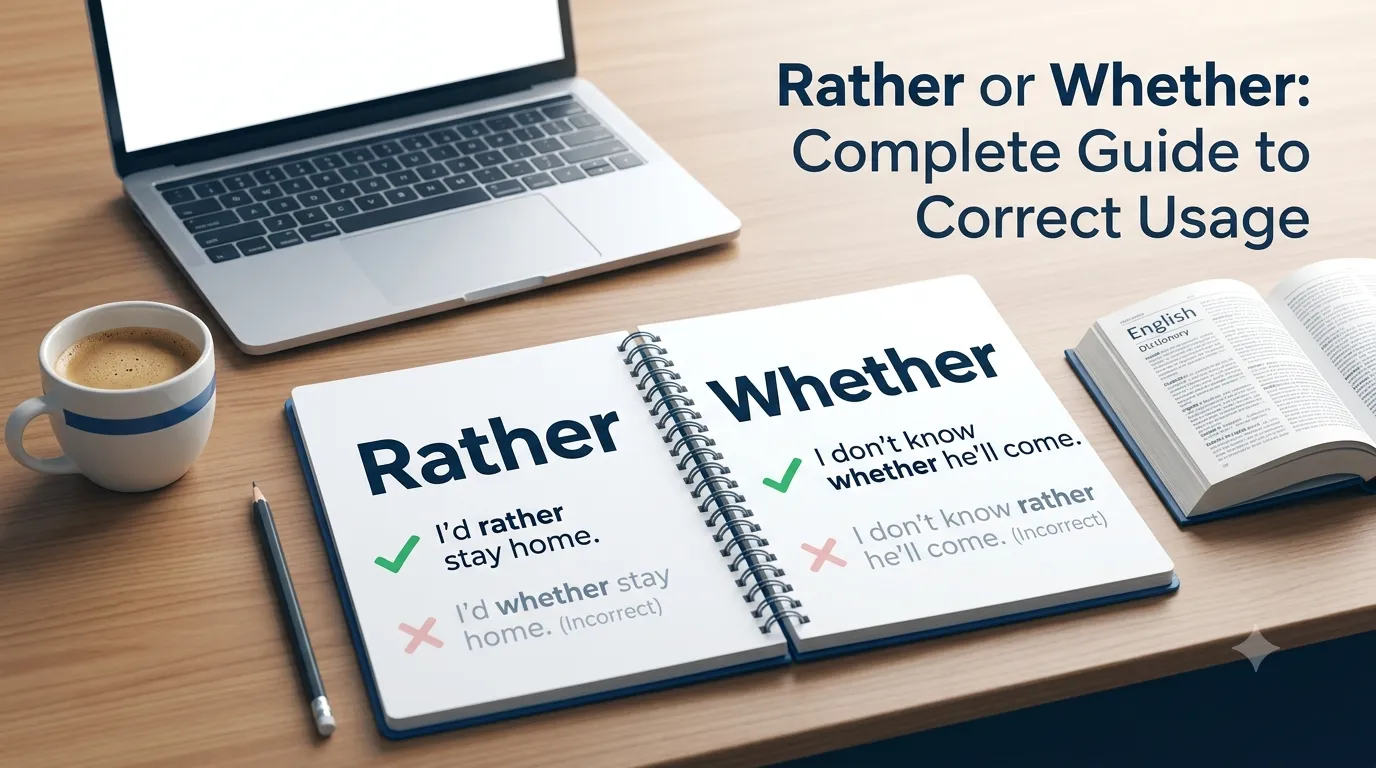
Rather and whether are completely different words with different jobs. Rather shows preference or degree, while whether introduces a choice or uncertainty between two or more possibilities.
Have you ever paused while writing a sentence and wondered, “Should I use rather or whether here?” You’re not alone. I made this mistake myself years ago while editing an email. I wrote, “I haven’t decided rather to attend the meeting.” It looked fine at first glance, but it wasn’t correct. The right word was whether.
That small mistake taught me an important lesson. Some English words sound similar or appear in similar sentence patterns, but they have very different meanings. Rather and whether are perfect examples.
Many students, writers, and even native speakers mix them up because both often appear before another action or idea. However, they cannot replace each other.
By the end of this guide, you’ll know exactly what each word means, when to use it, and how to avoid one of the most common grammar mistakes. You’ll also see plenty of real-life examples, practical tips, and easy comparison tables to help you remember the difference.
Rather or Whether: Quick Answer
The difference is simple:
- Rather means instead, preferably, or to a certain degree.
- Whether means if or which of two or more possibilities is true.
Examples
✅ I would rather stay home than go out.
✅ I’m not sure whether it will rain today.
Notice that rather expresses a preference, while whether introduces uncertainty or a choice.
The Origin and Background of Rather or Whether
Understanding where these words came from makes them easier to remember.
The Origin of Rather
The word rather comes from the Old English word hraþor, meaning more quickly or sooner.
Over hundreds of years, its meaning expanded. Today, it commonly expresses:
- Preference
- Degree
- Alternative
- Polite agreement
For example:
I’d rather watch a movie.
The meaning is clear—you prefer one option over another.
The Origin of Whether
The word whether comes from the Old English word hwæther, meaning which of two.
Its original purpose has stayed almost the same for centuries.
Today, whether introduces:
- Alternatives
- Choices
- Doubts
- Uncertainty
For example:
I don’t know whether she’ll arrive today.
The speaker is unsure.
Why Do People Confuse Rather and Whether?
There are several reasons.
They both appear before another idea.
Examples:
- I’d rather leave now.
- I don’t know whether to leave now.
The sentence structures look similar, but the meanings are completely different.
They sound slightly alike.
Fast speech sometimes makes the words seem similar, especially for English learners.
Both appear in formal writing.
You’ll often see both words in books, emails, reports, and conversations, making it easy to think they serve the same purpose.
Remember this simple rule:
Rather = Preference
Whether = Choice or uncertainty
That one sentence prevents most mistakes.
Rather or Whether Explained: Key Differences
Although these words sometimes appear in similar sentence positions, they do completely different jobs.
| Term | Meaning | When to Use | Context |
|---|---|---|---|
| Rather | Preferably, instead, to some extent | Showing preference or comparison | Everyday English, formal writing |
| Whether | If; expressing uncertainty or alternatives | Presenting two or more possibilities | Questions, decisions, formal writing |
When to Use Rather
Use rather when talking about preference.
Examples:
✅ I’d rather read a book.
✅ She would rather walk than drive.
✅ We rather enjoyed the concert. (British English)
It can also soften opinions.
Example:
That’s rather interesting.
Here it means fairly or quite.
When to Use Whether
Use whether whenever you’re talking about uncertainty.
Examples:
✅ I don’t know whether he’s coming.
✅ Please tell me whether you agree.
✅ We’re deciding whether to move.
In these examples, there isn’t a preference. There is uncertainty.
Rather vs Whether in Similar Sentences
Let’s compare them side by side.
Correct
I’d rather stay home.
Meaning:
I prefer staying home.
Correct
I don’t know whether to stay home.
Meaning:
I haven’t decided.
Incorrect
❌ I’d whether stay home.
This sentence is grammatically wrong.
Incorrect
❌ I don’t know rather to stay home.
This is also incorrect because rather cannot introduce uncertainty.
A Simple Memory Trick
Here’s an easy way to remember them forever.
Think of the letter P
Rather → Preference
Examples:
- I’d rather sleep.
- We’d rather leave early.
- She’d rather study.
Think of the letter U
Whether → Uncertainty
Examples:
- Whether it rains…
- Whether he agrees…
- Whether to buy it…
One word expresses what you want.
The other expresses what you don’t know.
Common Sentence Patterns
Rather
- Would rather + verb
- Rather than + noun
- Rather than + verb
- Rather + adjective (mostly British English)
Examples:
- I’d rather eat pizza.
- Rather than complain, help.
- She’d rather wait.
- It’s rather cold today.
Whether
- Whether + clause
- Whether or not
- Whether + infinitive
- Whether + question
Examples:
- I don’t know whether he called.
- Whether or not you agree, we must continue.
- I’m deciding whether to apply.
- Tell me whether this is correct.
Quick Practice
Which word fits each sentence?
- I’d ______ stay home tonight.
✅ rather
- I don’t know ______ she’ll arrive.
✅ whether
- We chose tea ______ than coffee.
✅ rather
- I’m unsure ______ this is the best option.
✅ whether
- She would ______ work remotely.
✅ rather
If you answered all five correctly, you’ve already mastered the biggest difference between these commonly confused words.
Which Should You Use?
Choosing between rather and whether becomes easy once you know what you’re trying to say.
Ask yourself one simple question:
Am I expressing a preference or a choice?
If you’re expressing a preference, use rather.
If you’re expressing uncertainty or alternatives, use whether.
Let’s look at different situations.
For Students
Use rather when talking about what you prefer.
Examples:
- I’d rather study at home.
- She would rather take notes by hand.
Use whether when discussing decisions or questions.
Examples:
- I don’t know whether the exam is tomorrow.
- We haven’t decided whether to join the club.
For Business Professionals
Clear communication matters in emails and reports.
Use rather to express preference politely.
Example:
We’d rather schedule the meeting next week.
Use whether when asking for confirmation.
Example:
Please let us know whether you can attend.
For Writers and Bloggers
Both words appear often in writing.
Choose rather when comparing ideas.
Example:
The article focuses on facts rather than opinions.
Choose whether when discussing possibilities.
Example:
Readers can decide whether the advice fits their situation.
For Everyday Conversation
Most people use these words naturally once they know the difference.
Examples:
✅ I’d rather stay home.
✅ I don’t know whether to stay home.
The meaning changes completely.
Best Choice for Global English
No matter where your readers live, the rule stays the same.
- Rather = preference
- Whether = uncertainty or alternatives
This applies to both American English and British English.
Common Mistakes with Rather or Whether
Many learners make the same errors. The good news is they’re easy to fix.
| ❌ Mistake | ✅ Correct |
|---|---|
| I’d whether stay home. | I’d rather stay home. |
| I don’t know rather to go. | I don’t know whether to go. |
| Whether than coffee, I’d like tea. | Rather than coffee, I’d like tea. |
| I’d rather if he came. | I’d rather he came. |
| Rather or not you agree… | Whether or not you agree… |
Mistake 1: Using “Whether” for Preference
Incorrect
I’d whether watch a movie.
Correct
I’d rather watch a movie.
Why?
You’re talking about what you prefer.
Mistake 2: Using “Rather” for Uncertainty
Incorrect
I don’t know rather she’ll call.
Correct
I don’t know whether she’ll call.
Why?
The speaker is uncertain.
Mistake 3: Mixing Up “Rather Than”
Many learners forget the complete expression.
Correct Examples
- I’d walk rather than drive.
- She chose coffee rather than tea.
- We invested rather than borrowed.
Mistake 4: Forgetting “Whether or Not”
Use this phrase when both outcomes are possible.
Examples:
- Whether or not you agree, we must continue.
- We’ll go whether or not it rains.
Mistake 5: Confusing Spoken English
In fast speech, people sometimes pronounce these words quickly.
That’s why it’s important to focus on the meaning, not just the sound.
Remember:
- Preference → rather
- Uncertainty → whether
Rather or Whether in Real World Examples
Seeing these words in real situations makes them much easier to remember.
Professional Email
We’d rather postpone tomorrow’s meeting until Friday.
Here, rather shows a preference.
Another example:
Please let us know whether you’re available next week.
Here, whether asks for confirmation.
News Headline
Experts debate whether interest rates will fall this year.
The outcome is uncertain.
Another headline:
Consumers choose quality rather than quantity.
The headline compares two options.
Social Media Post
I’d rather spend my weekend hiking than shopping.
This expresses personal preference.
Another example:
Still deciding whether to watch the new movie tonight.
The decision hasn’t been made.
Formal Report
The committee must determine whether additional funding is necessary.
Formal reports often use whether because they discuss decisions.
Another example:
The company invested in training rather than hiring more staff.
The report compares two choices.
Everyday Conversation
Friend 1:
Would you like pizza?
Friend 2:
I’d rather have pasta.
Parent:
Have you decided whether to apply?
Student:
Not yet.
These examples show how naturally both words appear in daily English.
Rather or Whether: Data, Trends & Usage
Although rather and whether are common English words, people usually search for them online because they are unsure which one fits a sentence.
Search Intent
The search intent is mainly informational.
People want to learn:
- Which word is correct
- When to use each one
- Common grammar mistakes
- Easy examples
- Rules for writing and speaking
Who Searches for This Topic?
The audience includes:
- English learners
- School and university students
- Bloggers
- Content writers
- Teachers
- Job seekers
- Professionals writing emails
Regions Where This Topic Is Popular
Questions about rather and whether are common in countries where English is widely learned, including:
- United States
- United Kingdom
- Canada
- Australia
- India
- Pakistan
- Philippines
- Nigeria
Learners preparing for IELTS, TOEFL, and other English exams also search for this topic regularly.
Why Does This Matter Today?
Clear writing has become more important than ever.
People send emails, write reports, publish blogs, and post on social media every day. Using rather and whether correctly helps your writing sound more natural, professional, and trustworthy.
Even a small grammar mistake can change the meaning of a sentence. Knowing the difference helps you communicate with confidence.
Standalone Comparison Table
| Term | Meaning | Region/Context | Best Used When |
|---|---|---|---|
| Rather | Preferably, instead, to some extent | American & British English | Showing preference, comparison, or degree |
| Whether | If, expressing uncertainty or alternatives | American & British English | Talking about choices, possibilities, or decisions |
By now, you should be able to recognize the difference at a glance:
- Rather tells readers what someone prefers.
- Whether tells readers that a decision or uncertainty exists.
Once you remember that simple distinction, choosing the correct word becomes almost automatic.
Frequently Asked Questions (FAQs)
Q1: What is the difference between rather and whether?
Rather shows preference, choice, or degree. Whether introduces uncertainty, alternatives, or possibilities. They have different meanings and cannot replace each other.
Examples:
- I’d rather stay home.
- I don’t know whether to stay home.
Q2: How do you use rather correctly?
Use rather when talking about what someone prefers or chooses instead of something else.
Examples:
- I’d rather drink coffee than tea.
- She would rather work from home.
- We chose quality rather than quantity.
Q3: How do you use whether correctly?
Use whether when discussing uncertainty or two or more possible outcomes.
Examples:
- I don’t know whether he’ll come.
- Tell me whether you agree.
- We’re deciding whether to move.
Q4: Is “rather than” grammatically correct?
Yes. Rather than is a common and correct English expression. It compares two alternatives or shows a preferred option.
Examples:
- I’d walk rather than drive.
- She studied rather than watched TV.
Q5: Is “whether or not” always necessary?
No. In many sentences, whether alone is enough.
For example:
- I don’t know whether she’ll come.
- I don’t know whether or not she’ll come.
Both are correct. Adding or not simply gives extra emphasis.
Q6: Can whether be replaced with if?
Sometimes, yes.
For example:
- I don’t know whether he’ll call.
- I don’t know if he’ll call.
Both are acceptable in casual English.
However, whether is usually better in formal writing and is required in some sentence structures.
Correct:
- We discussed whether to expand the business.
Using if here sounds less natural and may not be appropriate in formal contexts.
Q7: Which is correct: rather or whether?
Neither word is “more correct.” The correct choice depends on what you mean.
Choose rather if you’re expressing a preference.
Choose whether if you’re expressing uncertainty or alternatives.
A simple trick is to remember:
- Rather = Preference
- Whether = Uncertainty
Conclusion
The confusion between rather and whether is common, but it’s easy to avoid once you understand what each word does.
Here are the key points to remember:
- Rather expresses preference, comparison, or degree.
- Whether introduces uncertainty, alternatives, or choices.
- They are not interchangeable, even if they appear in similar sentence patterns.
- A quick meaning check before you write can prevent most mistakes.
The next time you’re unsure, ask yourself one question:
Am I talking about what someone prefers, or am I talking about a decision that hasn’t been made?
If it’s a preference, choose rather.
If it’s a choice or uncertainty, choose whether.
With a little practice, using these words correctly will become second nature. Clear grammar makes your writing easier to understand and leaves a stronger impression on your readers.
Now you know exactly how to use rather and whether. Try using both in your next email, essay, or conversation, and bookmark this guide whenever you need a quick grammar refresher. If you found it helpful, share it with someone who has ever mixed up these two words.

I have been working with English language content for over six years. I specialize in word comparisons and spelling differences that most people overlook. At WordsCombo, I help readers choose the right word every time.