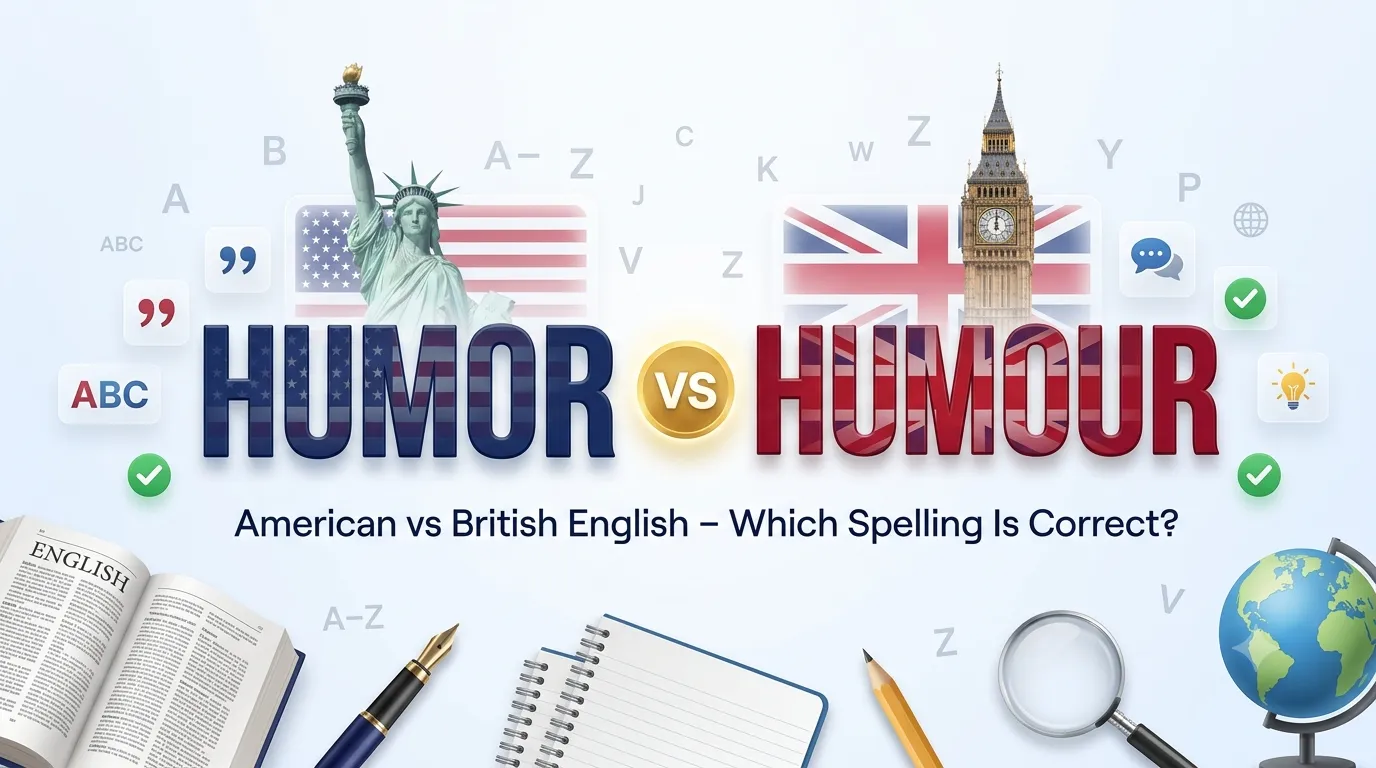
Humor and humour mean the same thing. Humor is the American English spelling, while humour is the British, Canadian, Australian, and most other Commonwealth English spelling.
A few years ago, I was editing an article for two different websites. One targeted readers in the United States. The other served readers in the United Kingdom. I noticed one small word kept changing throughout the document: humor became humour. At first, it looked like a simple spelling change. Then I realized many writers were confused about which version they should use.
If you’ve ever stopped while writing and wondered whether to type humor or humour, you’re not alone. Students, bloggers, business owners, and even experienced writers ask this question every day.
The good news is that both spellings are correct. The trick is knowing when to use each one.
By the end of this guide, you’ll understand the difference, learn where each spelling belongs, avoid common mistakes, and feel confident every time you write the word.
Humor or Humour: Quick Answer
Both humor and humour describe something funny, amusing, or the ability to make people laugh.
The only real difference is regional spelling.
- Humor → American English
- Humour → British English and Commonwealth English
Examples
- Americans write: She has a great sense of humor.
- British writers say: She has a great sense of humour.
The meaning stays exactly the same.
The Origin and Background of Humor or Humour
The word comes from the Latin word humor, meaning liquid or fluid.
Long ago, doctors believed the human body contained four important fluids called humours:
- Blood
- Yellow bile
- Black bile
- Phlegm
People believed these fluids controlled health and personality.
Later, the meaning changed. Writers began using the word to describe someone’s mood or temperament. Over time, it came to mean the ability to find things funny.
The spelling difference appeared much later.
When American English became more standardized, many words lost the extra “u.”
Examples include:
| American | British |
|---|---|
| Color | Colour |
| Honor | Honour |
| Favor | Favour |
| Humor | Humour |
This spelling style became common in the United States, while Britain kept the original forms.
Humor or Humour Explained
Although the meanings are identical, choosing the right spelling depends on your audience.
| Term | Meaning | When to Use | Region/Context |
|---|---|---|---|
| Humor | Funny quality or ability to laugh | American writing | United States |
| Humour | Funny quality or ability to laugh | British writing | UK, Canada, Australia, New Zealand and many Commonwealth countries |
Example using “humor”
“The movie’s humor made everyone laugh.”
Example using “humour”
“The author’s humour made the novel enjoyable.”
Both sentences mean exactly the same thing.
Which Version Should You Use?
Choosing the correct spelling is easy once you know your audience.
For American readers
Use humor.
This matches American dictionaries, schools, and publishers.
For British readers
Use humour.
It follows British spelling rules.
For Canadian readers
Both spellings appear, but humour is generally preferred in Canadian English.
For Australian and New Zealand readers
Use humour.
For global audiences
Either version works.
The most important rule is stay consistent throughout your writing.
Do not switch between the two spellings in the same article unless you are explaining the difference.
Common Mistakes with Humor or Humour
Many writers make small but avoidable errors.
| Mistake | Correct Version | Why It Happens |
|---|---|---|
| Mixing humor and humour in one article | Pick one spelling | Lack of consistency |
| Using humour for American clients | Humor | Audience mismatch |
| Using humor in British exams | Humour | Regional spelling rules |
| Thinking one spelling is wrong | Both are correct | Common misunderstanding |
| Changing spelling halfway through editing | Keep one style | Editing oversight |
Quick Tips
- Follow your audience.
- Follow your style guide.
- Stay consistent.
Humor or Humour in Real World Examples
Professional Email
Thank you for bringing such wonderful humor to today’s meeting.
British version:
Thank you for bringing such wonderful humour to today’s meeting.
News Headline
“Local comedian wins award for unique humor.”
British newspaper:
“Local comedian celebrated for clever humour.”
Social Media Post
“I love your sense of humor 😂”
British version:
“Your humour always makes my day.”
Formal Report
“Our advertising campaign uses light humor to improve customer engagement.”
British report:
“Our campaign uses light humour to improve customer engagement.”
Humor or Humour: Data, Trends & Usage
The keyword humor or humour attracts mostly informational search intent.
People searching for it usually want to know:
- Which spelling is correct
- Which version should they use
- Whether both words have the same meaning
- Which countries use each spelling
Regions with the highest interest
- United States → Humor
- United Kingdom → Humour
- Australia → Humour
- New Zealand → Humour
- Canada → Mostly Humour
- International businesses → Depends on target audience
Why this matters now
Global communication is growing every year. Websites, emails, and businesses often write for readers from different countries. Choosing the correct spelling helps build trust and professionalism.
Standalone Comparison Table
| Term/Variant | Meaning | Region/Context | Best Used When |
|---|---|---|---|
| Humor | Funny quality or comedy | United States | Writing for American audiences |
| Humour | Funny quality or comedy | UK, Canada, Australia, New Zealand | Writing for British or Commonwealth audiences |
| Sense of Humor | Ability to appreciate comedy | American English | US schools, media, business |
| Sense of Humour | Ability to appreciate comedy | British English | UK education, publishing, journalism |
Frequently Asked Questions
Q: What does humor or humour mean?
Both words describe the ability to make people laugh or the quality of being funny. They have identical meanings but different regional spellings.
Q: How do you use humor or humour correctly?
Use humor when writing American English. Use humour when writing British or Commonwealth English.
Q: Humor vs humour: what is the difference?
There is no difference in meaning. The only difference is spelling based on regional English.
Q: Is humor acceptable in formal writing?
Yes. Humor is perfectly acceptable in formal American writing. Humour is equally correct in formal British writing.
Q: Which version is correct humor or humour?
Both are correct. Your audience determines which spelling you should choose.
Q: Where does the word humor come from?
It comes from the Latin word humor, meaning “fluid.” Ancient medical theories connected body fluids, or humours, with personality and mood.
Q: Can humor or humour be used in academic writing?
Yes. Academic writing should follow the spelling style required by the institution or publication. Stay consistent throughout the document.
Conclusion
Choosing between humor and humour is much easier than many people think. Both spellings are correct, both have the same meaning, and both have a long history in the English language.
Remember these key points:
- Humor is the standard spelling in American English.
- Humour is the preferred spelling in British and Commonwealth English.
- Neither spelling is more correct than the other.
- Always write for your audience and keep your spelling consistent from beginning to end.
That simple habit makes your writing look polished, professional, and trustworthy.
Now you know exactly how to use humor or humour. Bookmark this guide so you never second guess the correct spelling again, and share it with anyone who has ever wondered which version to use.
Read more: Counselled or Counseled: Which Spelling Is Correct?

I studied English literature and have spent years editing content for blogs and digital platforms. I noticed most people struggle with choosing between two similar words. At WordsCombo, I make that choice simple and clear.