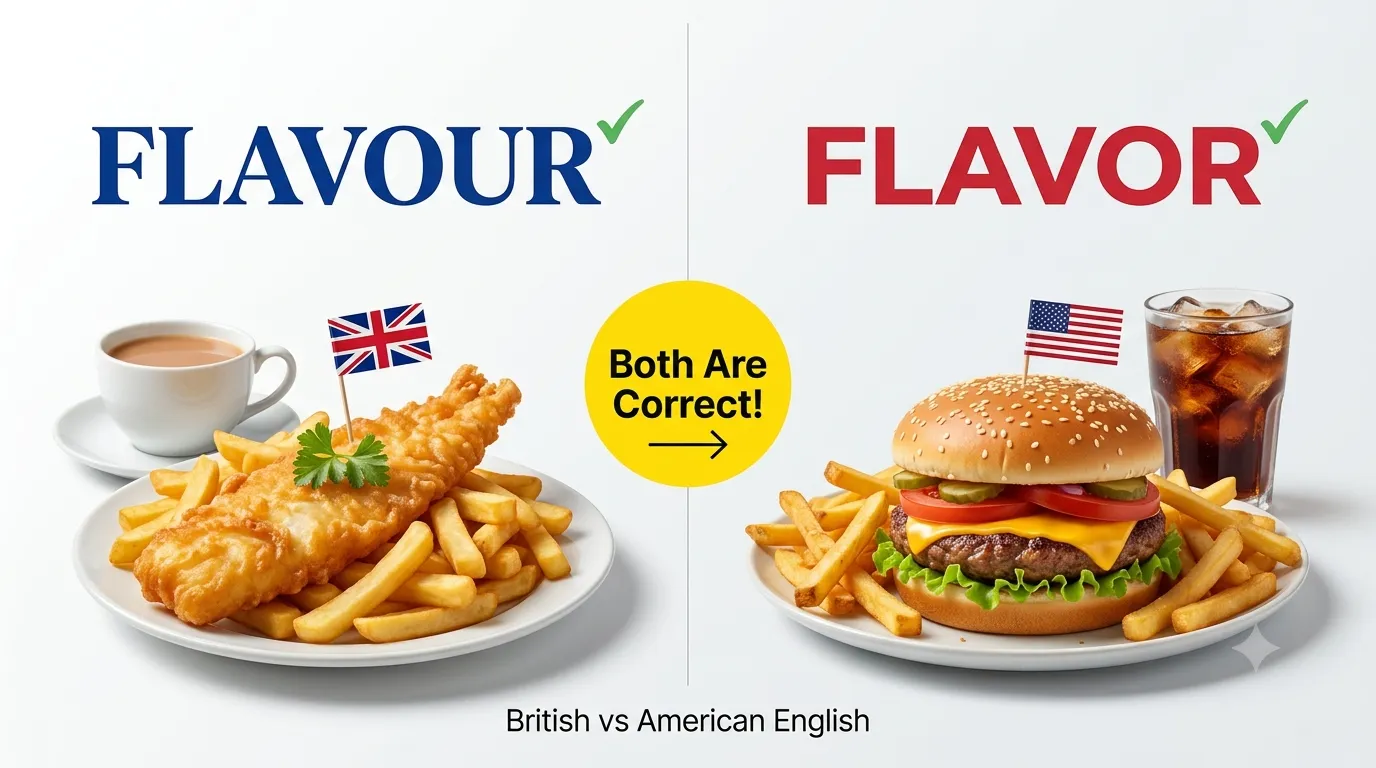
Flavour and flavor have the same meaning. Flavour is the correct British English spelling, while flavor is the correct American English spelling. Choose the version that matches your audience.
Have you ever typed flavour into a document only to see your spell checker underline it in red? Or maybe you wrote flavor and wondered if it would look wrong to readers in the UK.
I’ve faced this many times while writing articles for readers from different countries. Early in my writing career, I often switched between British and American English without noticing. One editor would change every flavor to flavour, while another would do the exact opposite. That experience taught me an important lesson: neither spelling is wrong. The key is knowing which audience you’re writing for.
Many people search for “flavour or flavor” because they want to avoid spelling mistakes in essays, emails, websites, or business writing. Others simply want to understand why English has two spellings for the same word.
The good news is that the answer is simple. In this guide, you’ll learn the difference, where each spelling is used, why the variation exists, and how to choose the right one every time.
Flavour or Flavor: Quick Answer
The difference between flavour and flavor is only the spelling.
- Flavour = British English
- Flavor = American English
Both words describe:
- The taste of food or drinks
- A particular quality or style
- A distinctive character or feeling
Examples
✅ British English:
- This soup has a rich flavour.
- The restaurant is famous for its spicy flavours.
✅ American English:
- This soup has a rich flavor.
- The restaurant is famous for its bold flavors.
The meaning stays exactly the same.
The Origin and Background of Flavour or Flavor
The word comes from the Old French word flaveur, which meant smell or taste.
Later, it entered Middle English as flavour. For many years, this was the standard spelling across English-speaking countries.
Things changed in the early 1800s when American dictionary writer Noah Webster introduced spelling reforms. His goal was to simplify English spelling.
As part of these reforms:
- colour → color
- honour → honor
- favour → favor
- flavour → flavor
These simplified spellings became standard in the United States, while Britain and many Commonwealth countries kept the traditional forms.
Today, both spellings are officially correct.
Flavour or Flavor Explained: Key Differences
The only difference is the spelling.
| Term | Meaning | When to Use | Region |
|---|---|---|---|
| Flavour | Taste or distinctive quality | British English writing | UK, Canada (often), Australia, New Zealand |
| Flavor | Taste or distinctive quality | American English writing | United States |
There is no difference in pronunciation.
Both are pronounced:
/ˈfleɪ.vər/
Meaning 1: Taste of Food
This is the most common meaning.
British:
- The curry has an amazing flavour.
- Fresh herbs improve the flavour of the soup.
American:
- The curry has amazing flavor.
- Fresh herbs improve the flavor of the soup.
Meaning 2: Character or Style
The word also describes the unique feeling or quality of something.
British:
- The city has a traditional flavour.
American:
- The city has a traditional flavor.
Meaning 3: Variety or Type
Sometimes flavour/flavor refers to different versions of a product.
Examples:
- Vanilla flavor
- Chocolate flavor
- Strawberry flavor
or in British English:
- Vanilla flavour
- Chocolate flavour
- Strawberry flavour
Again, only the spelling changes.
Countries That Prefer Flavour
Use flavour if your readers are mainly in:
- United Kingdom
- Australia
- New Zealand
- Ireland
- South Africa
- Many Canadian publications
- International schools using British English
Example:
“Our ice cream comes in twelve delicious flavours.”
Countries That Prefer Flavor
Use flavor if your audience is mainly in:
- United States
- American universities
- US companies
- American websites
- US-based blogs and magazines
Example:
“Our ice cream comes in twelve delicious flavors.”
Is One More Correct Than the Other?
No.
Both spellings are correct.
The right choice depends entirely on your audience.
Think of it this way:
- Writing for London? → Flavour
- Writing for New York? → Flavor
Neither spelling is better. They simply follow different English standards.
Why This Matters for SEO
If you own a website or blog, using the correct spelling can improve your content for your target audience.
For example:
- A UK food blog should naturally use flavour.
- A US recipe website should consistently use flavor.
Search engines understand that both spellings have the same meaning, but readers often trust content that matches their local spelling style.
Which Version Should You Use?
Choosing between flavour and flavor is easy once you know who will read your writing. The meaning never changes. Only the spelling does.
For Students
Use the spelling your school or university requires.
- British English course → flavour
- American English course → flavor
Always stay consistent throughout your assignment.
For Bloggers
Match your readers.
- A UK food blog should use flavour.
- A US recipe website should use flavor.
Using your audience’s preferred spelling makes your content feel more natural.
For Businesses
Follow your brand style guide.
For example:
- A British restaurant menu should use flavour.
- An American food company should use flavor.
Consistency helps build trust with customers.
For International Writing
If you’re writing for a global audience, choose one spelling style and use it everywhere.
Don’t mix:
❌ Our ice cream has amazing flavour and delicious flavors.
Instead, write:
✅ Our ice cream has amazing flavour. (British)
or
✅ Our ice cream has amazing flavor. (American)
Common Mistakes with Flavour or Flavor
Here are some mistakes people often make.
| Mistake | Correct Version | Why It Happens |
|---|---|---|
| Mixing flavour and flavor in one article | Pick one spelling and stay consistent | Writers switch between British and American English |
| Thinking flavor is incorrect | Flavor is correct in American English | Many people only learn British spelling |
| Thinking flavour is outdated | Flavour is still the standard British spelling | Confusion from American websites |
| Changing spellings randomly | Follow one style guide | Consistency is important |
| Assuming pronunciation changes | Pronunciation stays the same | Only the spelling is different |
Quick Tip
If your keyboard keeps changing flavour to flavor, check your language settings.
- English (UK) → flavour
- English (US) → flavor
Flavour or Flavor in Real-World Examples
Seeing both spellings in context makes the difference easier to remember.
1. Professional Email
British English
We have improved the flavour of our premium coffee blend based on customer feedback.
American English
We have improved the flavor of our premium coffee blend based on customer feedback.
2. News Headline
British
Local Bakery Wins Award for Traditional Bread Flavour
American
Local Bakery Wins Award for Traditional Bread Flavor
3. Social Media Post
British
Try our new mango flavour today! 🍦
American
Try our new mango flavor today! 🍦
4. Restaurant Menu
British
- Lemon Flavour Cheesecake
- Mint Flavour Tea
American
- Lemon Flavor Cheesecake
- Mint Flavor Tea
5. Product Packaging
British packaging:
Natural Orange Flavour
American packaging:
Natural Orange Flavor
6. Formal Report
British English:
Consumer surveys showed a strong preference for the new vanilla flavour.
American English:
Consumer surveys showed a strong preference for the new vanilla flavor.
Flavour or Flavor: Data, Trends & Usage
Both spellings are searched thousands of times each month because English learners, students, writers, and business owners want to know which version is correct.
Where is Flavour Most Common?
- United Kingdom
- Australia
- New Zealand
- Ireland
- South Africa
- Many Canadian publishers
These countries generally follow British English spelling rules.
Where is Flavor Most Common?
- United States
- American schools
- US universities
- American companies
- Most US media outlets
American English has become highly visible online, so many people encounter flavor even if they normally write British English.
Search Intent
People searching “flavour or flavor” usually have informational intent. They want to know:
- Which spelling is correct.
- Whether both spellings are acceptable.
- Which one they should use in writing.
- Whether the meanings are different.
Why This Matters Today
More people write for international audiences than ever before. Blogs, online stores, social media, and business websites often reach readers from different countries.
Choosing the correct spelling for your audience helps your writing look more professional and improves the reader’s experience.
Flavour vs Flavor: Standalone Comparison Table
| Term/Variant | Meaning | Region/Context | Best Used When |
|---|---|---|---|
| Flavour | Taste or distinctive quality | British English | Writing for UK, Australia, New Zealand, Ireland, and British English audiences |
| Flavor | Taste or distinctive quality | American English | Writing for the United States or American English readers |
Quick Memory Trick
A simple way to remember the difference is this:
- British English loves the letter “u.”
- colour
- favour
- honour
- flavour
- American English drops the “u.”
- color
- favor
- honor
- flavor
If you remember colour → color, you’ll also remember flavour → flavor.
Frequently Asked Questions (FAQs)
Q1: What does “flavour” or “flavor” mean?
Flavour and flavor both mean the taste of food or drink. They can also describe the unique character, style, or quality of something. The meaning is exactly the same in both spellings.
Q2: Is “flavour” or “flavor” correct?
Both spellings are correct. Flavour is the standard spelling in British English, while flavor is the standard spelling in American English. Choose the version that matches your audience.
Q3: What is the difference between flavour and flavor?
The only difference is the spelling. There is no difference in pronunciation or meaning. British English keeps the “u”, while American English removes it.
Q4: Should I use flavour or flavor in formal writing?
Yes. Both are acceptable in formal writing when used consistently. If you’re writing for a British audience, use flavour. If you’re writing for an American audience, use flavor.
Q5: Why do British and American English spell this word differently?
The spelling difference comes from the 19th century. American lexicographer Noah Webster promoted simpler spellings by removing the silent “u” from many words. Britain continued using the traditional spelling.
Q6: Which spelling is better for SEO?
Neither spelling is better overall. The best choice depends on your target audience.
- Targeting the UK, Australia, or New Zealand? Use flavour.
- Targeting the United States? Use flavor.
Using the spelling your readers expect improves user experience and builds trust.
Q7: Can I use both flavour and flavor in the same article?
It’s best not to. Mixing British and American spellings can make your writing look inconsistent and less professional. Pick one style and use it throughout the entire article.
Final Verdict: Flavour or Flavor?
By now, the difference between flavour and flavor should be clear. Both words have the same meaning, the same pronunciation, and the same purpose. The only thing that changes is the spelling.
If you’re writing for readers in the United Kingdom, Australia, New Zealand, or other countries that follow British English, choose flavour. If your audience is in the United States, use flavor. Neither version is more correct than the other. The right choice depends on who you’re writing for.
The most important rule is consistency. Once you choose one spelling, use it throughout your document, blog post, email, or website. This small detail makes your writing look polished and professional.
Whether you’re a student, content writer, business owner, or English learner, knowing this simple spelling difference will help you write with confidence.
Now you know exactly when to use flavour and when to use flavor. Bookmark this guide so you never second-guess the spelling again, and share it with someone who has asked the same question!
Key Takeaways
- ✅ Flavour is the British English spelling.
- ✅ Flavor is the American English spelling.
- ✅ Both words have the same meaning and pronunciation.
- ✅ Neither spelling is wrong.
- ✅ Match your spelling to your audience.
- ✅ Stay consistent throughout your writing.
Read more: Canceled or Cancelled: Easy Guide to Correct Usage

I studied English literature and have spent years editing content for blogs and digital platforms. I noticed most people struggle with choosing between two similar words. At WordsCombo, I make that choice simple and clear.