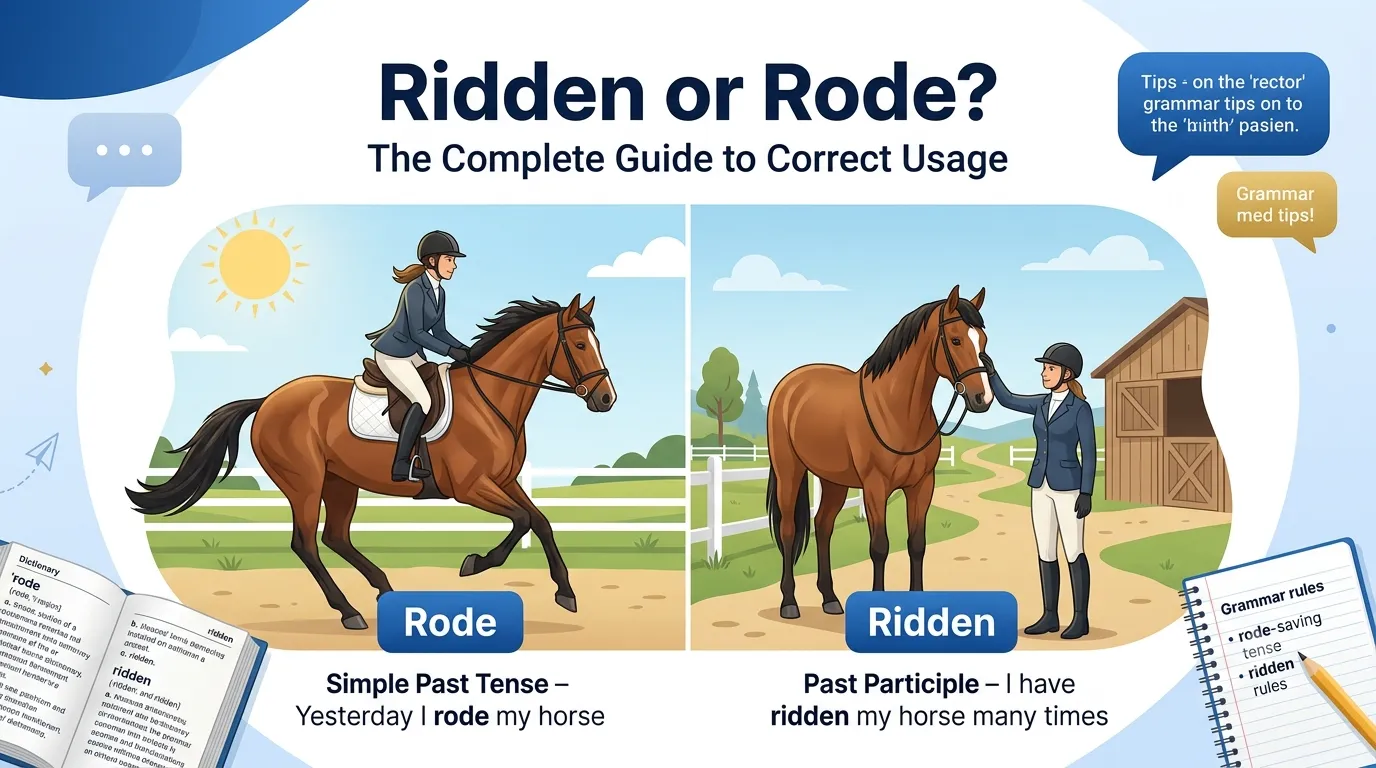
Ridden is the past participle of the verb ride, while rode is the simple past tense. Use rode for actions completed in the past and ridden only with a helping verb like has, have, or had.
A few years ago, I edited a student’s college essay that said, “I have rode horses since I was six.” It sounded natural to the writer. But one small word made the whole sentence incorrect.
That mistake is very common. I still see it in emails, school assignments, blog posts, and even business messages. Many English learners know that both ridden and rode come from the verb ride, but they are not sure when each one should be used.
The confusion happens because English has many irregular verbs. They do not follow the simple -ed pattern. Instead, each form changes in its own way. If you guess, you often pick the wrong word.
The good news is that this is one of the easiest grammar rules to master once you understand the pattern.
By the end of this guide, you will know exactly when to use ridden and rode, why people confuse them, and how to avoid the mistakes that even native speakers sometimes make.
Ridden or Rode: Quick Answer
Rode is the simple past tense of ride.
- I rode my bike yesterday.
- She rode the train to work.
Ridden is the past participle. It must be used with a helping verb.
- I have ridden a camel.
- They had ridden for hours before sunset.
Easy Rule to Remember
- Yesterday = rode
- Has, have, had = ridden
If you remember that one rule, you will avoid almost every mistake.
The Origin and Background of Ridden or Rode
The verb ride comes from the Old English word rīdan, which meant to travel on horseback.
Over hundreds of years, English changed, but many common verbs kept their irregular forms.
Today the three main forms are:
| Verb Form | Word |
|---|---|
| Base form | ride |
| Simple past | rode |
| Past participle | ridden |
English also has many similar irregular verbs.
- drive → drove → driven
- write → wrote → written
- speak → spoke → spoken
Notice the pattern. Many verbs ending with -en become past participles.
That is why ridden belongs in the same family as written and driven.
Ridden or Rode Explained: Key Differences
Although both words come from ride, they do different jobs.
Rode
Use rode when talking about an action that happened in the past.
Examples:
- I rode my bicycle to school.
- We rode horses during vacation.
- She rode the bus yesterday.
Ridden
Use ridden after a helping verb.
Examples:
- I have ridden horses before.
- She has ridden every roller coaster.
- They had ridden for miles.
Comparison Table
| Term | Meaning | When to Use | Region/Context |
|---|---|---|---|
| Rode | Simple past tense of ride | Finished action in the past | All English varieties |
| Ridden | Past participle of ride | With has, have, had, or had been | All English varieties |
Which Version Should You Use?
The answer depends on your sentence.
For Students
Use rode when writing about something you did yesterday or at another specific time.
Example:
I rode my bike to school.
For English Learners
Look for helping verbs.
If you see:
- has
- have
- had
- had been
then you almost always need ridden.
Example:
I have ridden a horse.
For Professionals
Formal writing follows exactly the same rule.
Business emails, reports, and academic papers all use:
- rode for simple past
- ridden with helping verbs
Best Recommendation
If the sentence contains has, have, or had, choose ridden.
Otherwise, when talking about a completed past event, choose rode.
Common Mistakes with Ridden or Rode
Many learners repeat the same errors.
Mistake 1
❌ I have rode a horse.
✅ I have ridden a horse.
Why?
“Have” requires the past participle.
Mistake 2
❌ Yesterday I have ridden my bike.
✅ Yesterday I rode my bike.
Why?
A finished past action uses the simple past.
Mistake 3
❌ She had rode the train.
✅ She had ridden the train.
Why?
“Had” must be followed by the past participle.
Mistake 4
❌ We were rode across town.
✅ We were ridden across town. (Rare usage.)
or
✅ We rode across town.
Mistake 5
❌ He has rode motorcycles for years.
✅ He has ridden motorcycles for years.
Ridden or Rode in Real-World Examples
Professional Email
I have ridden the company shuttle every day this week.
News Headline
Thousands rode public transport during the festival weekend.
Social Media Post
Finally rode my first mountain bike trail today! What an adventure!
Formal Report
Staff members had ridden company vehicles before the safety inspection began.
Everyday Conversation
- Have you ever ridden a horse?
- Yes, I rode one last summer.
Ridden or Rode: Data, Trends & Usage
Many people search for ridden or rode because irregular verbs are one of the hardest parts of English grammar.
Search Intent
Primary intent: Informational
People want to know:
- Which word is correct
- Which tense to use
- How to avoid grammar mistakes
- Whether native speakers use one more often
Who Searches Most?
- English learners
- Students
- Teachers
- Job seekers
- Content writers
- IELTS and TOEFL candidates
Regions
Searches come from:
- United States
- United Kingdom
- Canada
- Australia
- India
- Pakistan
- Philippines
Why It Matters Today
Clear grammar improves writing everywhere.
Whether you send emails, write essays, or publish online, using the correct verb form helps readers trust your writing.
Standalone Comparison Table
| Term/Variant | Meaning | Region/Context | Best Used When |
|---|---|---|---|
| Ride | Base verb | Universal | Present tense or infinitive |
| Rode | Simple past | Universal | Finished past actions |
| Ridden | Past participle | Universal | After has, have, had, or been |
Tips to Remember the Difference
Here are three simple tricks.
Trick 1
Remember the full pattern.
- Ride
- Rode
- Ridden
Say it out loud until it feels natural.
Trick 2
Look for helping verbs.
If you see:
- has
- have
- had
choose ridden.
Trick 3
Ask yourself one question.
Did it simply happen in the past?
If yes, use rode.
Practice Quiz
Choose the correct answer.
1.
I have _____ a horse before.
✅ ridden
2.
Yesterday we _____ bicycles to school.
✅ rode
3.
She had never _____ a motorcycle.
✅ ridden
4.
They _____ the subway home.
✅ rode
5.
Have you ever _____ an elephant?
✅ ridden
Frequently Asked Questions
Q: What does ridden mean?
A: Ridden is the past participle of ride. It is used with helping verbs such as has, have, and had.
Q: How do you use ridden correctly?
A: Use ridden only after a helping verb. For example, “She has ridden a horse before.”
Q: Ridden vs rode: what’s the difference?
A: Rode is the simple past tense. Ridden is the past participle. The first stands alone, while the second needs a helping verb.
Q: Is ridden acceptable in formal writing?
A: Yes. Ridden is the correct grammatical form in formal reports, academic papers, business emails, and professional communication.
Q: Which version is correct: ridden or rode?
A: Both are correct. The right choice depends on the sentence. Use rode for simple past actions and ridden after helping verbs.
Q: Where does ridden come from?
A: It comes from the Old English verb rīdan. English kept the irregular forms as the language evolved over many centuries.
Q: Can ridden be used when talking about bicycles?
A: Yes. Ridden works with any meaning of ride, including bicycles, horses, motorcycles, buses, trains, and amusement rides.
Conclusion
The difference between ridden and rode is actually simple once you know the rule.
Remember these key points:
- Ride is the base verb.
- Rode is the simple past tense.
- Ridden is the past participle.
- Ridden always follows a helping verb like has, have, or had.
Most grammar mistakes happen because people use rode after a helping verb. Once you learn to spot those helping words, choosing the correct form becomes easy.
Whether you are writing an essay, preparing for an English exam, sending a professional email, or simply trying to improve your grammar, using ridden and rode correctly makes your writing sound natural and confident.
Now you know exactly how to use ridden or rode. Bookmark this guide for quick reference, and share it with anyone who still mixes up these two common verb forms.

I have been working with English language content for over six years. I specialize in word comparisons and spelling differences that most people overlook. At WordsCombo, I help readers choose the right word every time.