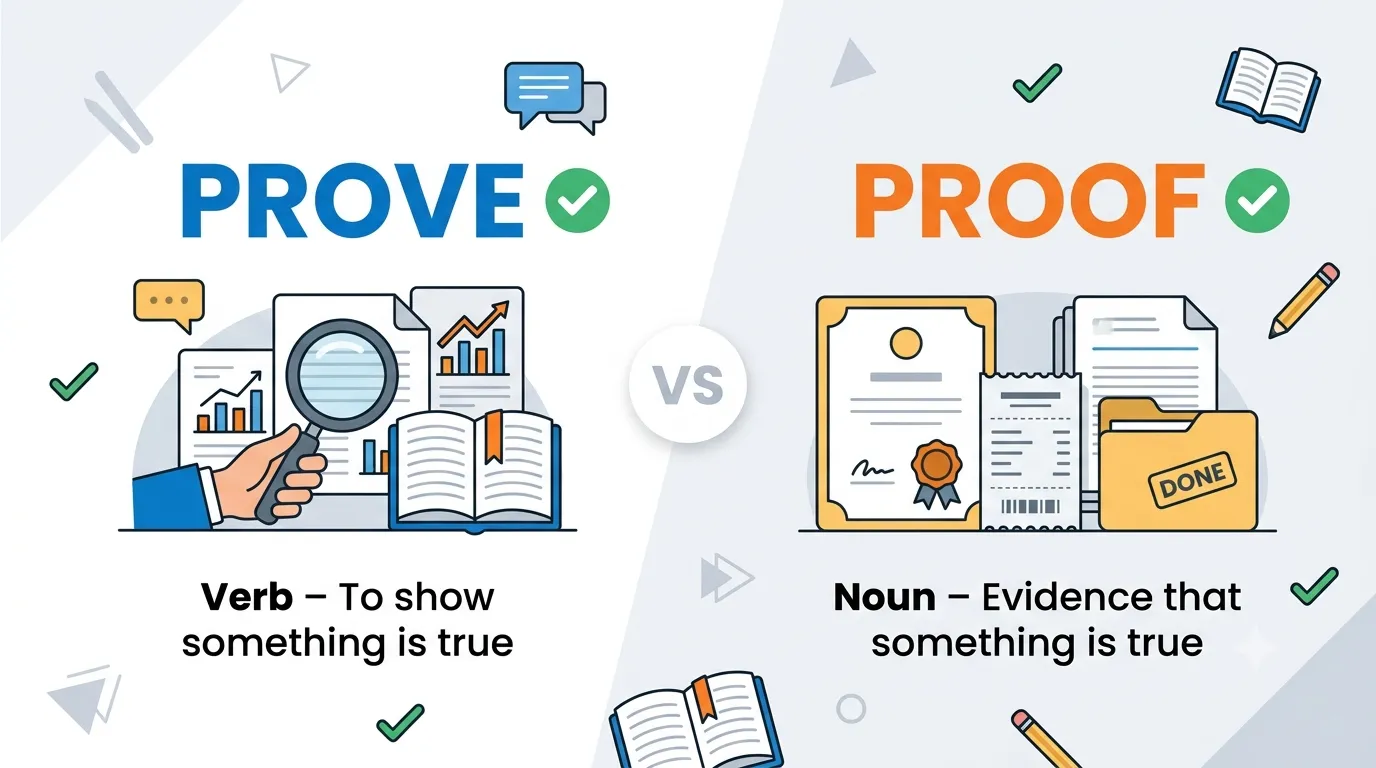
Prove is a verb. It means to show that something is true. Proof is usually a noun. It means the evidence or facts that show something is true.
A few years ago, I was helping a student prepare for an English exam. She proudly wrote, “I will proof my answer tomorrow.” She knew what she wanted to say, but she mixed up prove and proof. It is one of the most common English mistakes I see.
You may have done the same thing. These two words look alike. They sound similar. Yet they do very different jobs in a sentence. That is why many students, writers, and even professionals search for prove or proof.
The good news is that the difference is simple once you understand it. After that, you will rarely confuse them again.
By the end of this guide, you will know what each word means, when to use it, common mistakes to avoid, and plenty of real life examples. Let’s make this confusing pair easy.
Prove or Proof: Quick Answer
The easiest way to remember the difference is this:
- Prove is a verb. It is an action.
- Proof is a noun. It is the evidence.
Simple Examples
- I can prove my point with facts.
- The video is proof that the event happened.
A quick memory trick:
You prove something by giving proof.
The Origin Background of Prove or Proof
The words prove and proof come from the Old French word prover. That word meant “to test” or “to demonstrate.”
Over time, English gave each word a different job.
- Prove became the action of showing something is true.
- Proof became the thing that shows it is true.
This small change created two different parts of speech.
People often confuse them because they share the same root and appear in similar situations. You usually hear them together.
For example:
- The lawyer must prove the case.
- The lawyer needs proof.
Knowing their different roles makes choosing the correct word much easier.
Prove Explained: Key Differences or Variations
The biggest difference is grammar.
| Term | Meaning | When to Use | Region/Context |
|---|---|---|---|
| Prove | To show something is true | When talking about an action | Worldwide English |
| Proof | Evidence showing something is true | When talking about evidence | Worldwide English |
| Proofread | Check writing for mistakes | Editing documents | Worldwide English |
| Proof (printing) | A test copy before printing | Publishing and design | Publishing industry |
Examples
Prove
- Scientists must prove their ideas.
- Can you prove your claim?
Proof
- Do you have proof?
- The receipt is proof of payment.
Notice that prove tells us what someone does, while proof tells us what someone has.
Which Version Should You Use?
The right choice depends on what you want to say.
For Students
Use prove when writing about showing an answer is correct.
Example:
- Please prove your solution.
Use proof when talking about evidence.
Example:
- I need proof for my report.
For Professionals
Business writing often uses both.
Example:
- Please prove your statement with supporting proof.
For Academic Writing
Researchers usually write:
- The experiment failed to prove the theory.
- The data provides proof.
For Everyday English
A simple rule works almost every time.
- Doing something? Use prove.
- Talking about evidence? Use proof.
This rule works in nearly every situation.
Common Mistakes with Prove or Proof
Many learners make the same errors.
| Mistake | Correct Form | Why It Happens |
|---|---|---|
| I can proof it. | I can prove it. | Proof is not the action. |
| Please give me prove. | Please give me proof. | Prove is a verb. |
| This proves my proof. | This is proof. | Mixing verb and noun. |
| He proofed his claim. | He proved his claim. | Wrong verb choice. |
| I need to prove reading. | I need to proofread. | Confusing proof with proofreading. |
Easy Tip
If you can replace the word with show, use prove.
If you can replace it with evidence, use proof.
Prove or Proof in Real World Examples
Professional Email
Please provide proof of purchase so we can process your refund.
News Headline
New Study Proves Daily Exercise Improves Heart Health
Social Media Post
Finally got proof that hard work pays off!
Formal Report
The collected data proved the original hypothesis. The attached charts provide proof of the findings.
These examples show how naturally both words appear in everyday communication.
Prove or Proof: Data, Trends & Usage
The keyword prove or proof is searched by people who want to understand the difference between these similar English words.
Search Intent
- Primary intent: Informational
- Secondary intent: Educational and grammar help
Who Searches Most?
- English learners
- School and college students
- IELTS candidates
- Business professionals
- Content writers
- Teachers
Why It Matters Today
Clear writing matters more than ever. Emails, reports, assignments, and online posts all require correct grammar. Using prove and proof correctly helps your writing sound confident and professional.
Standalone Comparison Table
| Term/Variant | Meaning | Region/Context | Best Used When |
|---|---|---|---|
| Prove | Show something is true | Global English | Describing an action |
| Proof | Evidence or facts | Global English | Talking about evidence |
| Proofread | Check writing for errors | Publishing, education | Editing documents |
| Proven | Past participle or adjective | Global English | Describing something already demonstrated |
Frequently Asked Questions
Q: What does prove mean?
A: Prove means to show that something is true. It is always used as a verb because it describes an action.
Q: What does proof mean?
A: Proof means evidence or facts that support a claim. It is usually used as a noun.
Q: How do you use prove correctly?
A: Use prove when someone is showing, demonstrating, or confirming something. For example, “Can you prove your statement?”
Q: Prove vs proof what is the difference?
A: Prove is the action. Proof is the evidence. Think of it this way: you prove something by giving proof.
Q: Is proof acceptable in formal writing?
A: Yes. Proof is widely accepted in academic, legal, and professional writing when referring to evidence.
Q: Where do prove and proof come from?
A: Both words come from Old French and later entered English. They share the same origin but developed different grammatical roles.
Q: Can prove and proof be used in the same sentence?
A: Yes. For example: “The scientist used strong proof to prove the theory.”
Conclusion
The difference between prove and proof is easier than it first appears. Remember these key ideas:
- Prove is a verb. It describes the action of showing something is true.
- Proof is a noun. It means the evidence that supports a claim.
- A simple memory trick helps: You prove something by giving proof.
- Choosing the right word makes your writing clearer and more professional.
Once you understand their roles, you can use both words with confidence in school, work, and everyday conversations. Small grammar improvements often make a big difference in how your writing is understood.
Now you know exactly how to use prove and proof. Bookmark this guide so you never second guess these words again, and share it with someone who still mixes them up.

I have been working with English language content for over six years. I specialize in word comparisons and spelling differences that most people overlook. At WordsCombo, I help readers choose the right word every time.