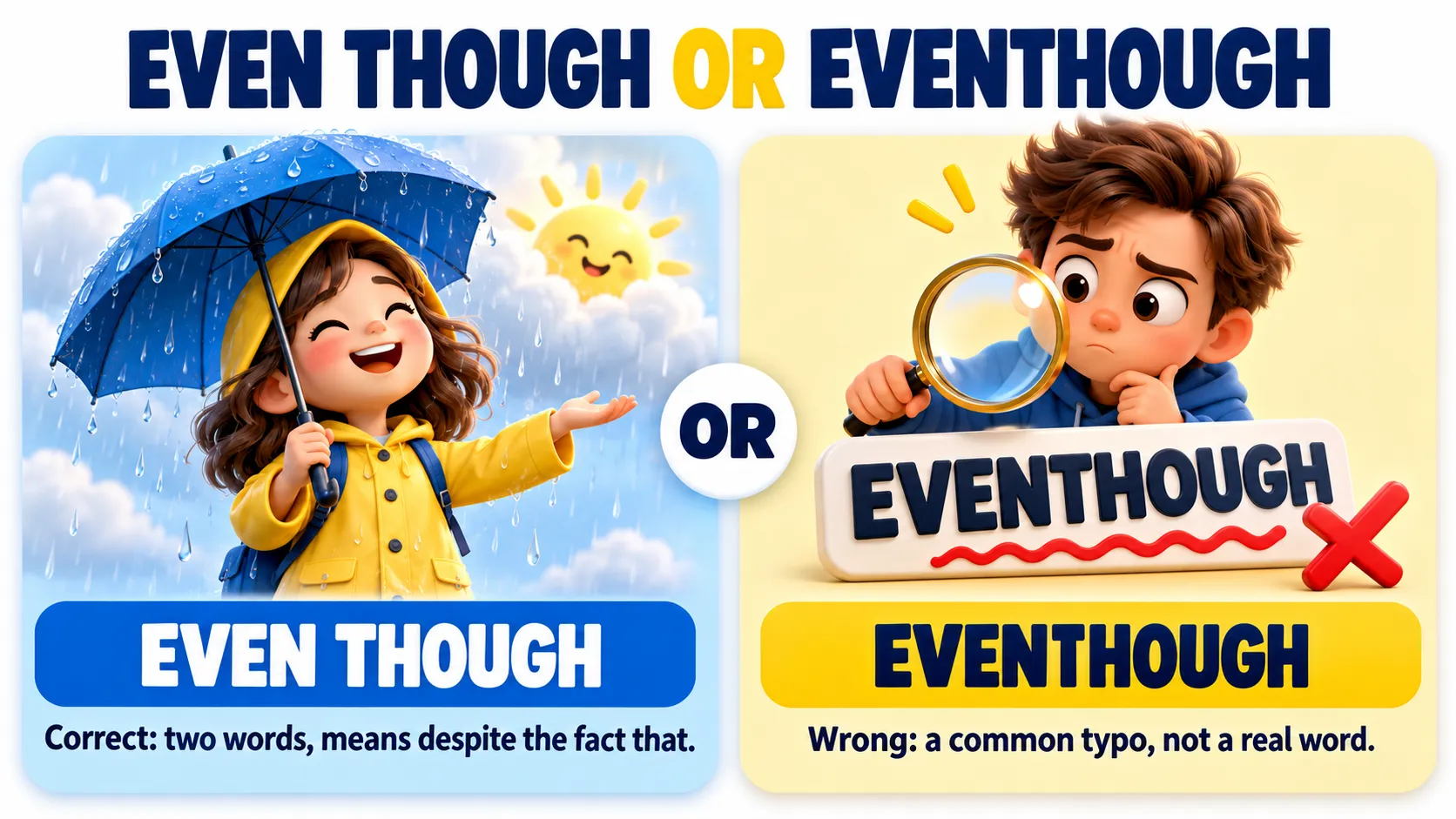
Eventhough or even though means choosing between a typo and the right spelling. The correct one is even though, which is two words and means “despite the fact that.”
A red squiggly line sits under one word in your client email, and you freeze before you hit send. The question is simple: eventhough or even though? Good news: the answer is just as simple, because only even though is correct, written as two words.
Eventhough is only a typo, so it never counts as a second spelling. Still, the slip is easy to make, since the two words sound like one when you speak. Here is how it happens, and how to stop it.
Quick Answer
The right spelling is even though. It has two words, but it links two ideas that seem to fight each other. Because “eventhough” is not a real word, spell checkers mark it right away.
Here are two examples, so you can see it in action:
- She walked to work, even though it was cold.
- Even though he studied hard, the test felt tough.
Each line holds an idea that clashes with the other one, which is why the pair works. That clash is the whole job of even though. As a result, you only use it when something happened in spite of a reason it should not have.
The Origin of Eventhough or Even Though
The word even once meant flat or level. Over time, it grew to mean “just” or “exactly,” which is how it started to add force to other words. Though comes from an old word that meant “however” or “despite.”
Once writers put them together, they got a stronger way to say “although.” So even though has been two words for hundreds of years.
Why the mix-up, then? Mainly, close cousins like although and nevertheless are one word, so the habit feels natural. Also, fast speech blends the sounds, so your ear hears one word. Finally, quick typing on a phone drops the space, and the typo then looks normal after you see it a few times.
Eventhough or Even Though Explained: Key Differences
Several small words look alike, so it helps to see them side by side.
| Term | Meaning | When to Use | Region/Context |
| Even though | Despite the fact that | Any writing, casual or formal | US and UK |
| Eventhough | Not a real word | Never | Common typo in quick typing |
| Although | Despite the fact that | Formal writing, sentence starts | US and UK |
| Even if | No matter whether | When the result is not sure yet | US and UK |
| Though | However, or despite | Casual talk, end of a sentence | US and UK |
Notice that although and even though mean the same thing. However, even though sounds a bit stronger, because the word even adds punch.
On the other hand, even if talks about things that might happen. For example, even if it rains tomorrow, we will still go. In short, even though is for facts, and even if is for maybes.
Which One Should You Use?
The choice is easy once you know your reader.
- Students and exam writers should use even though, because it is the only correct spelling.
- In business emails, use even though or although, since both sound polished.
- For texts and social posts, use even though, or try plain though for a casual feel.
- When you want a safe pick for any reader, choose even though, because it works everywhere.
Either way, never write eventhough, since it will always look like a typo.
Common Mistakes with Eventhough or Even Though
Most errors fall into four groups, but each one has a simple fix.
1. Writing it as one word
- Mistake: She stayed home eventhough she felt fine.
- Fix: She stayed home even though she felt fine.
- Why: Your ear hears one word, so your fingers type one word.
2. Using it for a maybe
- Mistake: Even though it rains tomorrow, we will go.
- Fix: Even if it rains tomorrow, we will go.
- Why: Both start with “even,” but only even if fits something that has not happened yet.
3. Adding an extra “but”
- Mistake: Even though he was late, but he got the job.
- Fix: Even though he was late, he got the job.
- Why: Writers think the contrast needs extra help, but the word already does that job.
4. Missing the comma
- Mistake: Even though I was tired I kept going.
- Fix: Even though I was tired, I kept going.
- Why: Speech pauses there, but writers forget to mark the pause.
Also, when even though sits in the middle of a sentence, you usually skip the comma.
Eventhough or Even Though in Real-World Examples
- Professional email: We can still send the draft by Friday, even though the deadline moved.
- News headline: Even Though Prices Fell, Shoppers Stayed Home
- Social post: Monday feels like a win, even though the alarm went off early.
- Formal document: The terms stay active until a new contract is signed, even though the current one ends in May.
Notice how each one keeps the two words apart. Also, the same pattern works in every setting, so you can trust it.
Eventhough or Even Though: Data, Trends and Usage
People in the US search this phrase mostly to check a spelling. In other words, the intent is quick and simple, because they want a yes or no before they get back to writing.
Students search it most, especially during school terms, because essays and exams make spelling matter. Meanwhile, workers search it before they send emails, and non-native speakers search it to learn how English joins ideas.
Here is the key insight: more writing happens on phones now, so small typos like this one spread faster. As a result, clear guides on even though stay useful all year.
Eventhough vs Even Though: Comparison at a Glance
| Term/Variant | Meaning | Region/Context | Best Used When |
| even though | Despite the fact that | All English, US and UK | You state a fact with a surprise |
| eventhough | A typo, not a word | Texts and fast typing | Never |
| although | Despite the fact that | Formal US and UK writing | You want a polished tone |
| even if | No matter whether | All English | Something may or may not happen |
| though | However, or despite | Casual US and UK speech | Short, relaxed sentences |
FAQ’s
Is it eventhough or even though?
The correct form is even though, written as two words. Eventhough is a common typo, so most spell checkers will flag it. Since the rule is short, it is easy to remember.
What does even though mean?
It means “despite the fact that.” You use it to show that one thing is true, but something else seems to clash with it. For example, “I went outside even though it was snowing.”
Can you start a sentence with even though?
Yes, you can, and it is very common. Once you do, add a comma after the first idea. For example, “Even though she was late, she smiled.”
Is even though the same as although?
They mean almost the same thing. However, even though sounds a bit stronger, while although feels a touch more formal. So you can swap them in most sentences without trouble.
Is eventhough ever acceptable in formal writing?
No, it is not. Because it is a spelling error, it can make a report or email look rushed. Still, a quick proofread fixes it in seconds.
Where does even though come from?
It joins even, which adds force, with though, which means “however.” Since the pair has stayed two words for hundreds of years, the one-word form never took hold. In short, eventhough is only a modern typo.
Do you need a comma before even though?
Usually not. Because the sentence flows without a pause when even though sits in the middle, you skip the comma, as in “I stayed even though I was tired.” However, you do need a comma after the first idea when even though starts the sentence.
Final Thoughts on Eventhough or Even Though
So, which is right: eventhough or even though? Even though wins, and it always takes two words. It means “despite the fact that,” and it fits emails, essays, and posts alike.
Remember three quick rules. First, never write eventhough, because it is a typo. Second, use even if for things that might happen, since they are not facts yet. Third, add a comma once even though starts the sentence. Finally, remember that although is a close cousin, though a bit more formal.
Pick even though every time, so your writing looks sharp. One tiny space makes a big difference. Save this page, share it with a friend, and send your next message with confidence.
Curious about similar words? Explore Realy or Really.
SEO & Image Metadata
SEO Meta Title: Eventhough or Even Though? The Correct Spelling
SEO Meta Description: Typing eventhough or even though? Only one is right. Learn the correct spelling, simple examples, and common mistakes so your writing looks sharp every time.

I started writing about English word differences after years of teaching students who kept making the same mistakes. My focus is on making spelling rules feel simple and easy to remember. At WordsCombo, I turn confusing word pairs into clear comparisons.