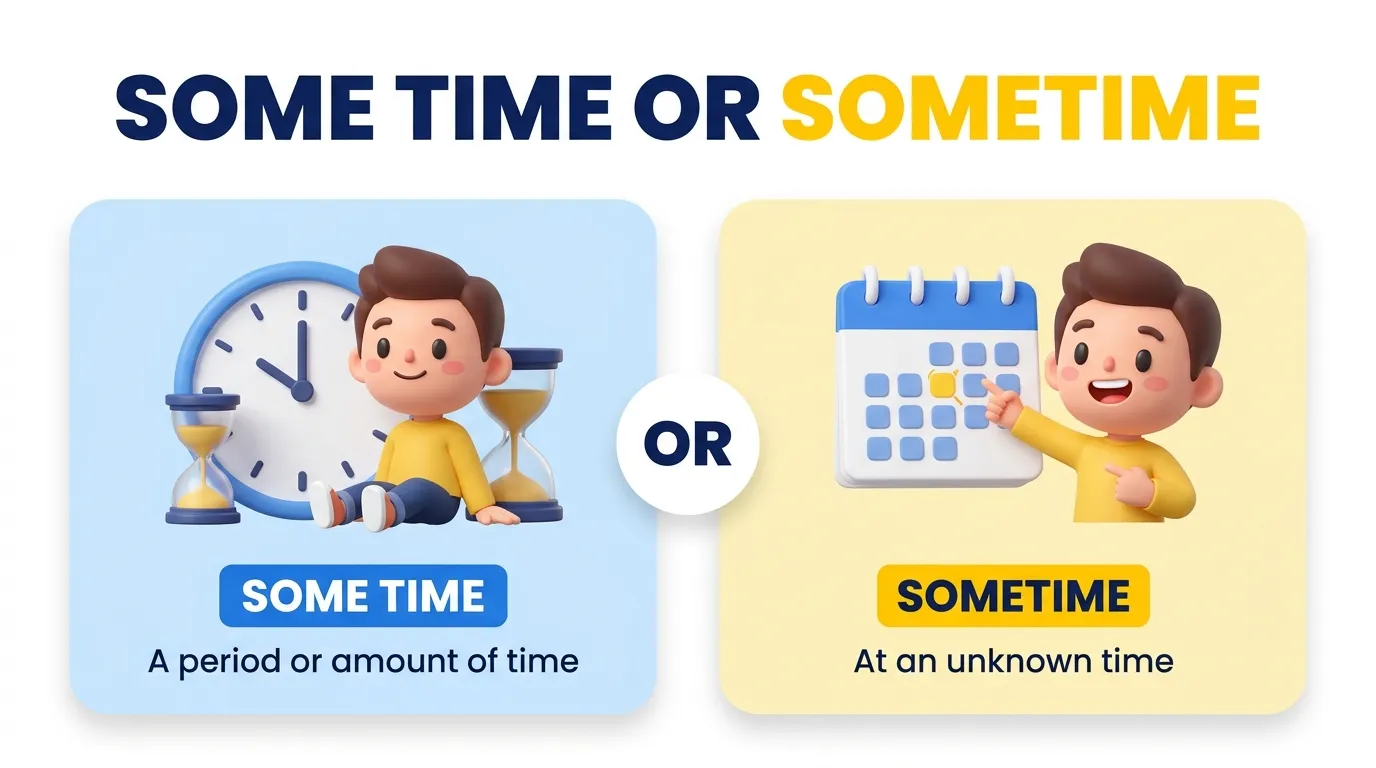
Some time means a period of time, while sometime means at an unknown or unplanned time in the past or future. The related word sometimes means now and then.
You are about to send an email that says, “Can we meet sometime next week?” Then you pause. Should it be “some time” instead? This small spelling choice can make you stop and check your work. The good news is that each form has a clear use. Some time or sometime depends on whether you mean a length of time or a point in time. Once you learn this simple rule, you can write emails, school papers, and work messages with more confidence.
Some Time or Sometime: Quick Answer
Use some time when you mean a period of time. Choose sometime when you mean an unknown or unplanned point in time.
For example, “I need some time to finish my report” means you need a period to work. However, “I will finish my report sometime tomorrow” means you will finish it at an unknown time tomorrow.
Remember, sometimes has a third meaning. It tells you that something happens now and then, not every time.
The Story Behind Some Time and Sometime
The words some and time have long been used together to talk about time in English. Over time, the joined form sometime gained its own meaning as a word for an unknown point in time.
However, the two forms still look and sound much alike. This is why writers often mix them up.
The difference comes down to how the words work in a sentence. When you write some time, you talk about an amount or period of time. When you write sometime, you point to an unknown moment.
The word sometimes adds another choice. It means “on some occasions,” so it tells you how often something happens rather than when it happens.
Some Time or Sometime Explained: Key Differences
The easiest way to choose the right form is to think about what you want to say.
- Some time: A period or amount of time.
- Sometime: An unknown or unplanned point in time.
- Sometimes: On some occasions, but not always.
For example, “We spent some time at the park” tells you how long you stayed. “We will visit the park sometime next week” tells you when the visit may happen, but not the exact time.
Likewise, “We sometimes visit the park” means you go there now and then.
| Term | Meaning | When to Use | Region/Context |
| Some time | A period of time | When you need or spend time | Standard English |
| Sometime | An unknown point in time | When the exact time is not known or planned | Standard English, including American English |
| Sometimes | Now and then | When something does not happen every time | Standard English |
A Simple Trick to Remember the Difference
Try replacing the word with a phrase that has the same meaning.
- If a period of time fits, use some time.
- If at an unknown time fits, use sometime.
- If now and then fits, use sometimes.
For example, “I need some time to think” works because you need a period to think. On the other hand, “Let’s talk sometime tomorrow” works because the exact time is not set.
Which One Should You Use?
The right choice depends on your sentence and what you want to say.
- For schoolwork: Use some time when you mean a period. For example, “I spent some time reading my book.”
- For work emails: Choose sometime when suggesting a flexible meeting time. For example, “Could we talk sometime this week?”
- For everyday messages: Use sometimes when talking about habits. For example, “I sometimes watch movies after dinner.”
- For formal writing: Keep the same meaning-based rule because all three forms are correct when used properly.
If you are not sure, replace the word with “a while,” “at an unknown time,” or “now and then.” The phrase that makes sense will help you pick the right form.
Common Mistakes with Some Time or Sometime
Even strong writers can mix up these forms because they look so similar. However, a few simple checks can help you avoid the most common errors.
Mistake: Writing “sometime” when you mean a period
Incorrect: “I need sometime to finish this task.”
Correct: “I need some time to finish this task.”
The sentence is about how much time you need, so the two-word form is the better choice.
Mistake: Using “some time” for an unplanned moment
Incorrect: “Let’s have lunch some time next Tuesday.”
Better: “Let’s have lunch sometime next Tuesday.”
Here, you are talking about an unknown time on Tuesday. The one-word form fits this meaning.
Mistake: Using “sometime” instead of “sometimes”
Incorrect: “I sometime forget where I put my keys.”
Correct: “I sometimes forget where I put my keys.”
Because forgetting happens on some occasions, you need the word that shows frequency.
Mistake: Thinking the two-word form is always wrong
Incorrect idea: “Sometime is always the correct spelling.”
Correct rule: Both some time and sometime are correct, but they have different meanings.
For example, “It took some time to cook dinner” describes a period. Meanwhile, “We will cook dinner sometime tomorrow” points to an unknown time.
Mistake: Ignoring the meaning of the whole sentence
Incorrect: Choosing a form just because it looks familiar.
Correct approach: Read the full sentence and ask whether you mean a period, a point, or a repeated action.
This quick check works because the meaning, not the spelling alone, tells you which form to use.
Some Time or Sometime in Real-World Examples
Real examples make these words easier to remember. Here is how you can use them in different settings.
Professional Email
“Could we schedule a short call sometime this afternoon?”
This works because the exact meeting time is not set. However, if you need to ask for a longer period to complete a task, write, “I need some time to review the file.”
News Headline
“City Council May Meet Sometime Next Week”
The headline points to an unknown meeting time. The word sometime fits because no exact time has been given.
Social Media Post
“I sometimes take a walk after dinner to clear my mind.”
Here, sometimes describes a habit that happens on some occasions. It does not point to one planned moment.
Formal Document
“The team spent some time reviewing the new plan.”
This sentence describes a period spent on the task. In a formal report, the two-word form makes the intended meaning clear.
Everyday Conversation
“Let’s catch up sometime soon.”
This is a friendly way to suggest meeting without choosing a date or time. Either person can suggest a more exact plan later.
Some Time or Sometime: Data, Trends and Usage
People look up some time or sometime when they want to check spelling, improve their grammar, or write more clearly. The search often comes from a simple need, such as finishing an email, editing a school paper, or checking a work message.
In American English, all three forms are used in everyday writing. However, each answers a different question.
- Some time answers “How long?”
- Sometime answers “When?”
- Sometimes answers “How often?”
For example, a student might search for the correct form while writing an essay. Meanwhile, a worker may check it before sending a meeting request.
The key lesson is that one small space, or one extra letter, can change the meaning. Therefore, learning these forms helps you write clear messages and avoid simple grammar errors.
Some Time or Sometime: Comparison at a Glance
Use this table as a quick guide whenever you need to choose between the three forms.
| Term/Variant | Meaning | Region/Context | Best Used When |
| Some time | A period or amount of time | Standard English | You mean a while |
| Sometime | An unknown point in time | Standard English | You mean at an unplanned time |
| Sometimes | On some occasions | Standard English | You mean now and then |
A helpful tip is to remember that some time is about length, sometime is about a point, and sometimes is about frequency. Once you know which meaning you need, the choice becomes much easier.
Frequently Asked Questions
Is it some time or sometime?
Both forms are correct, but they have different meanings. Use some time for a period and sometime for an unknown point in time.
What is the difference between some time and sometime?
Some time means a period, such as the time needed to finish a job. In contrast, sometime means at an unknown time, such as “I will call you sometime tomorrow.”
Is sometime one word or two words?
It depends on the meaning you want. Write sometime as one word when you mean an unknown point in time, but use some time when you mean a period.
Is sometime correct in formal writing?
Yes, sometime is correct in formal writing when it means an unknown point in time. However, use some time when you mean a period, and sometimes when you mean on some occasions.
What is the difference between sometime and sometimes?
Sometime points to one unknown moment in the past or future. Meanwhile, sometimes means that something happens now and then, but not every time.
Where did the word sometime come from?
Sometime grew from the English words “some” and “time.” Over time, the joined form came to mean an unknown point in time, while the two-word phrase kept its meaning of a period.
Should I write “I will call you sometime” or “I will call you some time”?
In everyday American English, “I will call you sometime” is the clearest choice when you mean an unknown future moment. However, “I will call you in some time” can mean after a period has passed, though “in a while” often sounds more natural.
Final Thoughts on Some Time or Sometime
Choosing some time or sometime is easy when you focus on the meaning. Use some time when you mean a period, such as the time needed to finish a task. Choose sometime when you mean an unknown moment in the past or future. Also, remember that sometimes means now and then.
These three forms are all correct, but they cannot always replace one another. Before you send an email or finish a school paper, check what your sentence means. This small habit can help you avoid common spelling mistakes and make your writing clearer.
Now, try these rules in your next sentence and build your grammar skills one word at a time!
Curious about similar words? Explore Mrs or Ms to learn more about common spelling and grammar mistakes.

I have been working with English language content for over six years. I specialize in word comparisons and spelling differences that most people overlook. At WordsCombo, I help readers choose the right word every time.