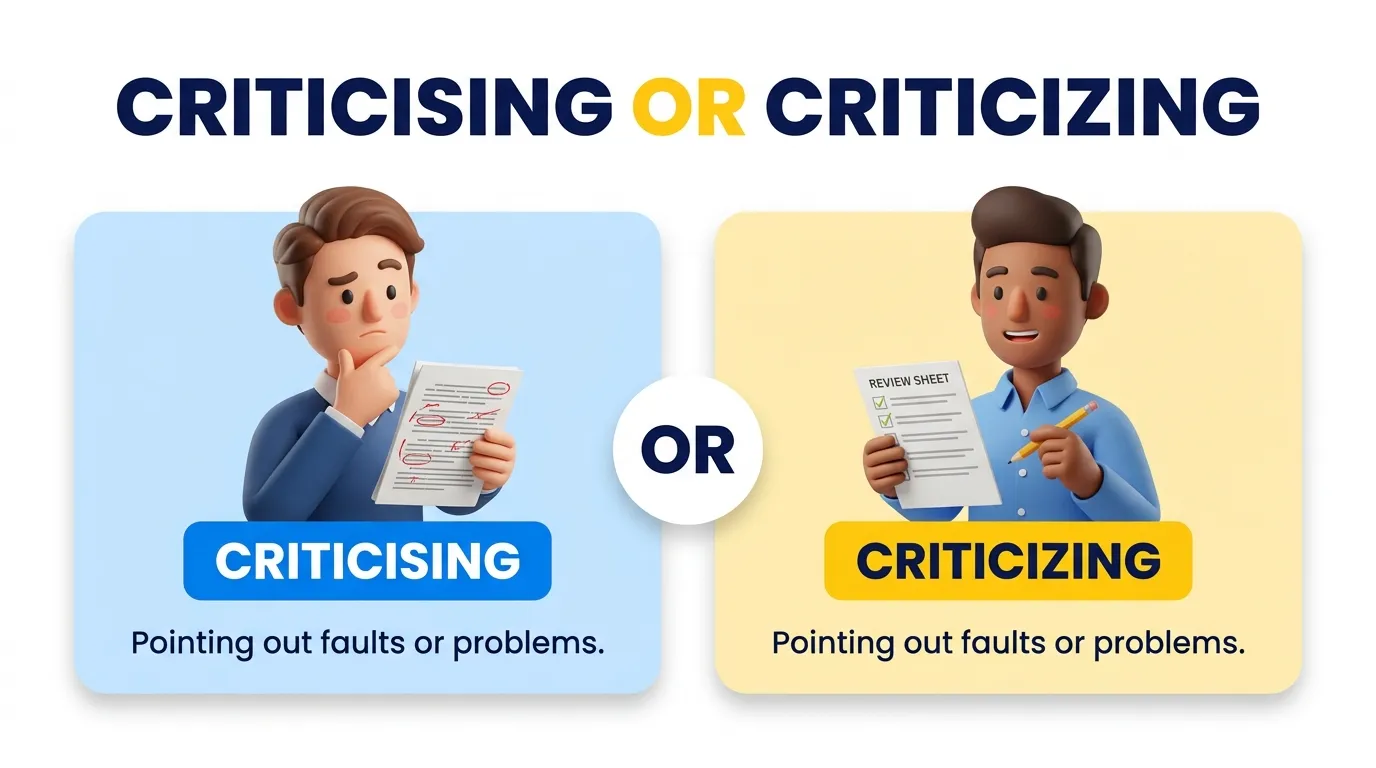
Criticising and criticizing are both correct spellings of the same word. Use criticizing in American English and criticising in British English.
When you finish an email to your boss, a red squiggly line under criticising can make you pause. Is it a spelling mistake, or is your computer set to the wrong language? The answer depends on where you write. Criticising or criticizing has the same meaning, but the spelling changes by region. Both forms describe pointing out faults or saying what you think is wrong. Once you know which form fits your readers, you can write with confidence and avoid common spelling errors.
Criticising or Criticizing: Quick Answer
Both criticising and criticizing are correct. However, American English uses criticizing, while British English uses criticising.
Here are two simple examples:
- American English: She is criticizing the new plan.
- British English: She is criticising the new plan.
The meaning stays the same in both sentences. Only the spelling changes.
The Origin of Criticising and Criticizing
The word criticize comes from the word critic, which refers to someone who judges or gives an opinion about something. Both words are linked to older Greek words about judging and making choices.
Over time, English developed different spelling habits in different places. British English often keeps the letter s in words such as criticise, while American English commonly uses z in criticize.
As a result, both forms became accepted in their own regions. The same pattern appears in words such as organise and organize, as well as realise and realize.
Neither spelling is wrong by itself. The best choice depends on your audience and the style of English you follow.
Criticising or Criticizing Explained: Key Differences
The main difference between these words is regional spelling. Both come from the same base word and describe the act of finding fault, judging something, or sharing a negative opinion.
However, the ending can also change when you use other forms of the word.
- Criticize: The base form used in American English.
- Criticise: The base form used in British English.
- Criticizing: The present participle in American English.
- Criticising: The present participle in British English.
- Criticized: The past form commonly used in American English.
- Criticised: The past form commonly used in British English.
For example, you might write, “The editor is criticizing the article” in the United States. In the United Kingdom, you would usually write, “The editor is criticising the article.”
A Simple Comparison Table
| Term | Meaning | When to Use | Region/Context |
| Criticising | Pointing out faults or problems | British spelling | UK and many British English settings |
| Criticizing | Pointing out faults or problems | American spelling | USA |
| Criticise | Base form of the verb | British spelling | UK |
| Criticize | Base form of the verb | American spelling | USA |
| Criticised | Past form of the verb | British spelling | UK |
| Criticized | Past form of the verb | American spelling | USA |
Both spellings are understood in most English-speaking places. Still, choosing the right regional form helps your writing look clear and consistent.
Which One Should You Use?
The right choice depends on who will read your work. If you write for an American audience, use criticizing. If you write for a British audience, use criticising.
Here is a simple guide:
- For American readers: Use criticizing because it follows common US spelling rules.
- For British readers: Use criticising because it follows common UK spelling rules.
- For school assignments: Follow the spelling rules your teacher asks you to use.
- For work documents: Match your company’s writing style, especially if it has offices in different countries.
- For international websites: Choose one spelling style and use it throughout your content.
If you are unsure, check the language setting in your writing app. That setting can help you spot spelling choices that do not match your intended audience.
Common Mistakes with Criticising or Criticizing
These spellings can be confusing, especially when you read British and American content together. However, a few simple rules can help you avoid errors.
Using the British Spelling for a US Audience
Mistake: The manager is criticising the team’s work.
Correction: The manager is criticizing the team’s work.
This correction fits standard American English. The original spelling is still correct in British English, so the problem is the audience, not the word itself.
Mixing Both Spelling Styles
Mistake: She is criticizing the plan, but he criticised the report.
Correction: She is criticizing the plan, but he criticized the report.
Both versions of the verb are correct. However, using one spelling style throughout your writing makes the text look more polished.
Changing the Meaning of the Word
Mistake: Criticizing always means saying something bad about a person.
Correction: Criticizing can mean pointing out faults or giving an opinion about the good and bad parts of something.
For example, a teacher may criticize an essay to help a student improve. The word does not always mean a personal attack.
Spelling the Word with the Wrong Ending
Mistake: He is criticisng the new design.
Correction: He is criticising the new design.
The correct British spelling includes the letter i before the n. In American English, write criticizing.
Treating One Form as Always Wrong
Mistake: Criticising is never correct in English.
Correction: Criticising is a valid spelling, especially in British English.
The confusion often comes from spell-check tools set to American English. Therefore, check your language settings before changing a word that may already be correct.
Criticising or Criticizing in Real-World Examples
The best way to learn a spelling is to see how it works in everyday writing. These examples show how to use the word in different settings.
Professional Email
American English:
Subject: Feedback on the Draft
“Thank you for reviewing the report. I appreciate you criticizing the weak points because your feedback helps me improve the final draft.”
British English:
“Thank you for reviewing the report. I appreciate you criticising the weak points because your feedback helps me improve the final draft.”
Both examples are suitable for work. The spelling changes, but the message stays the same.
News Headline
American English: Local Leaders Are Criticizing the New Road Plan
British English: Local Leaders Are Criticising the New Road Plan
News headlines often use short, direct words. In either version, the spelling should match the publication’s usual style.
Social Media Post
American English: “People are criticizing the new update, but I think it needs more time.”
British English: “People are criticising the new update, but I think it needs more time.”
Social media posts can be casual. Still, using the right spelling helps your message fit your readers.
Formal Document
American English: “The review found that several team members were criticizing the proposed changes.”
British English: “The review found that several team members were criticising the proposed changes.”
Formal reports should follow a consistent spelling style. As a result, readers can focus on the meaning instead of differences in spelling.
Criticising or Criticizing: Data, Trends and Usage
People who search for criticising or criticizing usually want to know which spelling is correct. Many also want to check whether the difference comes from American or British English.
The main search intent is informational. Readers are looking for a quick answer, clear examples, and a rule they can use in their own writing.
These groups may care most about the difference:
- Students: They want to use the right spelling in essays and schoolwork.
- Writers and editors: They need to keep spelling consistent across articles and reports.
- English learners: They may see both forms in books, websites, and lessons.
- SEO writers: They want to match the spelling used by their target audience.
- Office workers: They need clear and correct spelling in emails and documents.
American English commonly favors criticizing, while British English commonly favors criticising. However, British spelling guides do not all follow the same rules for every word ending in -ise or -ize.
This is why the safest choice is to follow your chosen style guide. Rather than treating one spelling as a mistake, think about your audience and keep your writing consistent.
Criticising or Criticizing: Comparison at a Glance
Use this table whenever you need to choose the right spelling. It covers the main forms and their usual settings.
| Term/Variant | Meaning | Region/Context | Best Used When |
| Criticising | Pointing out faults | British English | Writing for UK readers |
| Criticizing | Pointing out faults | American English | Writing for US readers |
| Criticise | Base verb form | British English | Talking about giving criticism |
| Criticize | Base verb form | American English | Writing in US English |
| Criticised | Past tense | British English | Describing past criticism |
| Criticized | Past tense | American English | Describing past criticism |
Remember, both spellings are correct. The key is to choose the form that suits your readers and use it consistently.
Frequently Asked Questions
Is criticising or criticizing correct?
Both criticising and criticizing are correct English spellings. However, criticizing is the usual American form, while criticising is common in British English.
What is the difference between criticising and criticizing?
There is no difference in meaning or grammar between the two forms. The only difference is the spelling, which depends on the style of English you follow.
Is criticising acceptable in formal writing?
Yes, criticising is acceptable in formal writing that follows British English conventions. However, American reports and business documents usually use criticizing.
Which spelling should I use in American English?
Use criticizing when writing for an American audience. This spelling matches the usual US form, so it is the best choice for American schoolwork, business emails, and website content.
Why do British and American English spell the word differently?
British and American English developed different spelling habits over time. As a result, some words use s in one style and z in the other, such as criticising and criticizing.
Is criticising the same as criticizing someone unfairly?
No, the spelling does not tell you whether the criticism is fair. Both words can describe fair feedback or unfair fault-finding, depending on the situation and the speaker’s intent.
How do you spell criticizing in a sentence?
In American English, write, “The coach is criticizing the team’s performance.” In British English, write, “The coach is criticising the team’s performance.” Both sentences are correct.
Final Thoughts on Criticising or Criticizing
Choosing between criticising or criticizing is easy once you know the difference. Both words have the same meaning, and neither spelling is wrong. The main difference is the English style you use.
For American readers, choose criticizing. For British readers, criticising is a common choice. Also, remember to keep related words, such as criticized and criticised, consistent with your chosen style.
Now you can write emails, articles, reports, and school assignments with greater confidence. Before you publish your next piece, check your audience and language settings. Choose the right spelling for your readers, stay consistent, and keep improving your writing.
Curious about similar spelling differences? Explore Socializing or Socialising.

I studied English literature and have spent years editing content for blogs and digital platforms. I noticed most people struggle with choosing between two similar words. At WordsCombo, I make that choice simple and clear.