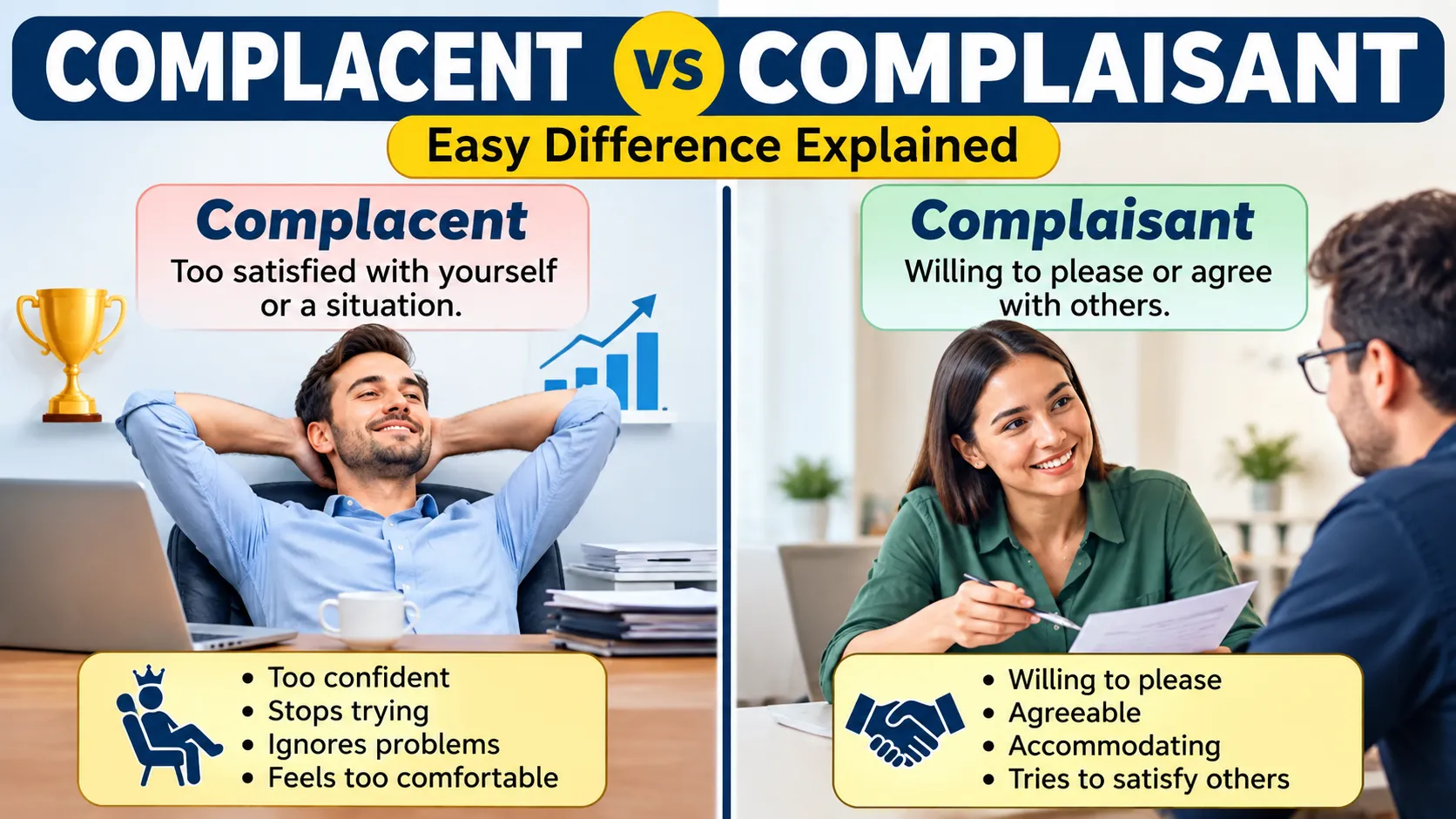
Complacent or complaisant are different words. Complacent means too satisfied with yourself or a situation, while complaisant means willing to please others or agree with them.
Have you ever written a sentence and stopped because one word did not look right?
I have seen this problem many times while helping students improve their English. Complacent and complaisant are a classic example. They look almost like twins. They sound close, too. Yet their meanings are quite different.
One word describes a person who is too comfortable or self satisfied. The other describes someone who is eager to please or willing to agree.
That small difference can change your whole sentence.
For example, if you say, “The manager was complacent,” you suggest that the manager was too satisfied and failed to notice a problem. If you say, “The manager was complaisant,” you suggest that the manager was willing to please others or accept their wishes.
So, which word should you use?
This guide gives you a simple way to remember the difference. You will learn the meanings, history, examples, common mistakes, and best uses of both words. By the end, you should never need to guess between complacent or complaisant again.
Complacent or Complaisant
The easiest way to remember the difference is this:
- Complacent = too satisfied with yourself or a situation
- Complaisant = willing to please or agree with others
Example 1: Complacent
After winning several games, the team became complacent.
The team became too confident. It stopped working as hard as before.
Example 2: Complaisant
The host was complaisant and agreed to change the dinner time.
The host was willing to please the other person.
Here is a quick memory trick:
Complacent = comfortable.
Both words begin with com and describe a state of being. Think of a person who is comfortable enough to stop trying.
Complaisant = please.
Think of someone who is happy to please other people.
That simple link can help you choose the right word fast.
The Origin and Background of Complacent and Complaisant
These words are easy to confuse because they have related histories.
Complacent comes from Latin roots connected with the idea of being pleasing or satisfying. Over time, its meaning developed into the modern sense of being self satisfied, often in a way that causes a person to overlook problems.
Today, complacent often carries a negative meaning.
For example:
The company became complacent after years of strong sales.
The company was too satisfied with its success. It may have stopped looking for risks or new ideas.
Complaisant also has roots connected with pleasing. It came through French and developed the sense of being obliging, agreeable, or eager to please.
The two words therefore share a distant connection with the idea of pleasing. But English gave them different jobs.
That is why spelling alone cannot help you.
The extra i in complaisant is not just a spelling detail. It marks a word with a different meaning.
There is another reason for the confusion. Complaisant is less common in everyday English than complacent. Many readers know one word well but rarely see the other.
Complacent vs. Complaisant: Key Difference Explained
The main difference is simple:
Complacent describes an attitude toward yourself or a situation.
Complaisant describes an attitude toward other people.
Look at this comparison:
| Term | Meaning | When to Use | Region/Context |
|---|---|---|---|
| Complacent | Too satisfied and unaware of possible problems | When someone has become too comfortable or confident | Common in modern English |
| Complaisant | Willing to please, agree, or accommodate others | When someone is agreeable or eager to satisfy others | Formal or less common English |
| Self satisfied | Pleased with yourself | When stressing personal satisfaction | Common everyday English |
| Agreeable | Pleasant and willing to cooperate | When describing a cooperative person | Common everyday English |
Complacent in a sentence
The safety team became complacent after years without an accident.
The problem is not that the team wanted to please someone. The problem is that it became too relaxed and confident.
Complaisant in a sentence
She was complaisant and accepted the customer’s request.
Here, the person is willing to please or accommodate someone else.
A useful contrast
Consider these two sentences:
Mark was complacent about his job.
Mark felt too secure. He may not have worked hard enough.
Mark was complaisant with his boss.
Mark was willing to agree with or please his boss.
The meanings are very different.
Which Version Should You Use?
Your choice depends on what you want to say.
For students and beginners → Use complacent when describing overconfidence
If you mean:
- too comfortable
- too confident
- satisfied with current success
- not worried enough about problems
use complacent.
Example:
Don’t become complacent after one good exam result.
For formal or advanced writing → Use complaisant when you mean willing to please
Use complaisant when a person is:
- agreeable
- accommodating
- obliging
- eager to satisfy another person
Example:
The assistant was complaisant when the client asked for changes.
For global and neutral English → Choose the clearer word when possible
Complaisant is correct, but it is uncommon for many readers.
If your goal is simple communication, words such as agreeable, accommodating, or willing to please may be clearer.
By contrast, complacent is common and useful in business, education, news, and everyday writing.
Common Mistakes with Complacent or Complaisant
1. Mistake: Using complaisant for overconfidence
❌ The successful company became complaisant about its position.
If you mean the company became too comfortable with success, this is wrong.
✅ The successful company became complacent about its position.
Why? The sentence describes self satisfaction, not a desire to please others.
2. Mistake: Using complacent for a person who agrees easily
❌ She was complacent and accepted every request.
If you mean she was willing to satisfy others, use complaisant.
✅ She was complaisant and accepted every request.
Why? The focus is on her willingness to please.
3. Mistake: Thinking the words are spelling variants
❌ “Complacent” is the common spelling of “complaisant.”
✅ They are two separate words with different meanings.
This is one of the biggest traps. Neither word is simply a different spelling of the other.
4. Mistake: Assuming complacent means happy
❌ He was complacent because he felt happy about his success.
Complacent can involve satisfaction, but it usually suggests too much satisfaction.
Better:
He became complacent after his early success.
The word often carries a warning.
5. Mistake: Using complaisant when you mean pleasant
Complaisant does not simply mean “nice.”
It suggests a willingness to please, cooperate, or accommodate.
If you only mean someone is pleasant, use pleasant, friendly, or agreeable.
Complacent or Complaisant in Real World Examples
Seeing these words in different settings makes the difference easier to remember.
Professional email
We should not become complacent about our current results. There are still several areas that need attention.
Here, complacent warns against becoming too comfortable.
News headline
Complacent Businesses Risk Losing Customers to New Competitors
The word works well because it suggests businesses have become too comfortable.
Social media post
One good result is great, but don’t get complacent. Keep learning and improving.
This is a natural use of complacent in everyday communication.
Formal document
The committee remained complaisant toward the requests of the local residents.
Here, complaisant means willing to accommodate or please the residents.
Because complaisant is less common, the sentence has a more formal tone.
Complacent or Complaisant: Data, Trends & Usage
There is a clear difference in how often these words appear in modern English.
Complacent is far more familiar to most readers. It appears often in:
- business writing
- news reports
- workplace discussions
- education
- sports
- personal development
- political and social commentary
It is especially useful when someone has stopped improving because they feel safe or successful.
Complaisant has a narrower role. It appears more often in formal, literary, or advanced writing. Many people understand it only from context.
This creates an interesting search pattern. People often search “complacent or complaisant” because they recognize the two spellings but are unsure which meaning fits.
The topic is therefore mainly informational search intent. Readers usually want three things:
- The correct meaning.
- The correct spelling.
- A simple way to remember the difference.
The practical lesson is clear: do not choose the word because it looks right. Choose it because its meaning fits your sentence.
Complacent vs. Complaisant: Standalone Comparison
| Term/Variant | Meaning | Region/Context | Best Used When |
|---|---|---|---|
| Complacent | Too pleased or comfortable with yourself or a situation | Common modern English | Someone is too relaxed about success or risk |
| Complaisant | Willing to please or accommodate others | Formal or less common English | Someone readily agrees or tries to satisfy others |
| Self satisfied | Pleased with your own success | Everyday English | You want a very clear alternative to complacent |
| Agreeable | Pleasant and willing to cooperate | Everyday English | You want a simple alternative to complaisant |
| Accommodating | Willing to help or adjust for others | Professional and everyday English | Someone makes an effort to meet another person’s needs |
A Simple Memory Trick
If you still mix them up, use this rule:
Complacent = comfortable.
Imagine someone sitting back after success. They think everything is fine. They stop trying.
The team became complacent.
Complaisant = please.
Imagine someone saying, “Sure, I’ll do that if it makes you happy.”
She was complaisant toward her clients.
So remember:
Complacent looks inward. Complaisant looks toward others.
That is not a perfect grammar rule, but it is an excellent memory aid.
Frequently Asked Questions
Q: What does complacent mean?
A: Complacent means too satisfied or comfortable with yourself or a situation. It often suggests that someone has stopped noticing risks or problems.
Q: What does complaisant mean?
A: Complaisant means willing to please, agree, or accommodate other people. It often describes someone who is agreeable or obliging.
Q: What is the difference between complacent and complaisant?
A: Complacent means overly self satisfied. Complaisant means willing to please others. The first often describes overconfidence, while the second describes cooperation or accommodation.
Q: Is complacent acceptable in formal writing?
A: Yes. Complacent is common and fully acceptable in formal writing. It is widely used in business, academic, professional, and news writing.
Q: Is complaisant acceptable in formal writing?
A: Yes. Complaisant is correct, but it is less common. In simple writing, agreeable or accommodating may be easier for readers to understand.
Q: Which is correct, complacent or complaisant?
A: Both are correct words. The correct choice depends on your meaning. Use complacent for excessive self satisfaction and complaisant for willingness to please others.
Q: Where do complacent and complaisant come from?
A: Both words have roots connected with the idea of pleasing. Their meanings developed in different directions, which is why they now describe different attitudes.
Q: Can I use complacent to describe a person?
A: Yes. You can describe someone as complacent when they are too confident or comfortable. For example: “The manager became complacent after years of success.”
Q: Can complaisant be used for customer service?
A: Yes. Complaisant can describe someone who is willing to satisfy or accommodate customers. However, helpful, accommodating, or responsive may sound more natural in everyday business English.
Conclusion
The difference between complacent or complaisant is much easier once you focus on meaning rather than spelling.
Remember these three points:
- Complacent means too satisfied or comfortable.
- Complaisant means willing to please or accommodate others.
- Complacent is much more common in modern everyday and professional English.
If someone stops trying because they think everything is fine, they are complacent.
If someone readily agrees because they want to please another person, they are complaisant.
When in doubt, ask yourself one simple question: Is the person too comfortable, or are they trying to please someone?
Too comfortable? Choose complacent.
Trying to please? Choose complaisant.
Once you learn that small distinction, this common word choice problem becomes easy. Bookmark this guide so you never second guess complacent or complaisant again.
Read more: Marshal or Martial: The Complete Easy Guide

I have been working with English language content for over six years. I specialize in word comparisons and spelling differences that most people overlook. At WordsCombo, I help readers choose the right word every time.