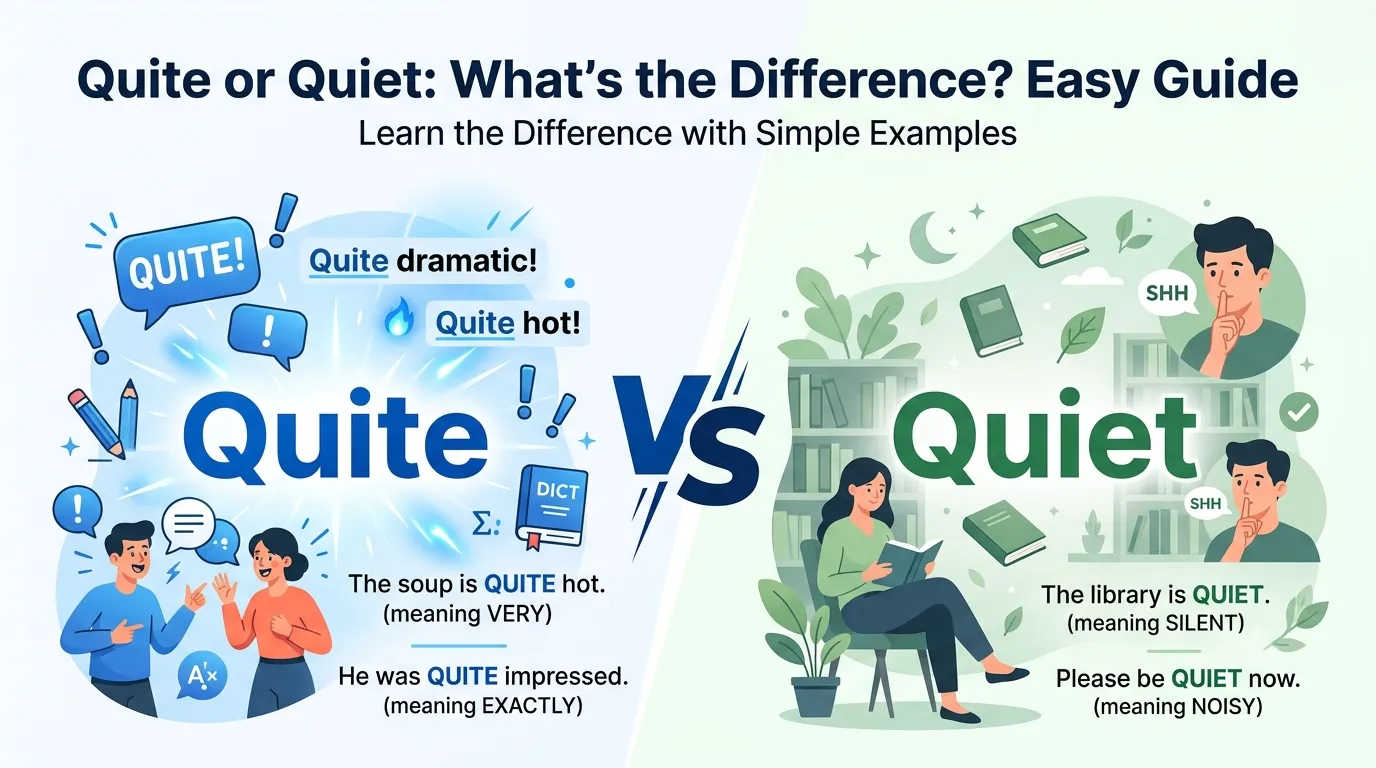
Quite means fairly, completely, or very, while quiet means silent or making little noise. Although they look similar, they have completely different meanings and are never interchangeable.
A few years ago, I was proofreading an email from one of my English students. She wanted to write, “The library is very quiet today.” Instead, she wrote, “The library is very quite today.” It was only one letter off, but the meaning changed completely.
That tiny mistake is one of the most common spelling errors in English. Even native speakers sometimes pause and wonder whether they need quite or quiet. The words look almost identical, sound somewhat alike, and are only different because of two letters switching places.
The good news is that the difference is actually simple once you know what each word means.
By the end of this guide, you’ll know exactly when to use quite and when to use quiet. You’ll also learn an easy trick to remember the difference, avoid common mistakes, and feel more confident every time you write.
Let’s start with the quick answer.
Quite or Quiet: Quick Answer
Although they look alike, quite and quiet have different jobs in English.
- Quite is an adverb. It changes the strength of another word. It often means fairly, rather, completely, or very, depending on the sentence.
- Quiet is usually an adjective. It describes a person, place, or thing that makes little or no noise.
Examples
✅ The movie was quite interesting.
✅ Please be quiet during the meeting.
Notice that one talks about degree, while the other talks about sound.
The Origin and Background of Quite or Quiet
One reason these words confuse people is that they come from similar-looking historical spellings, but they developed different meanings over time.
The origin of quite
The word quite comes from the Latin word quietus, meaning free, complete, or finished. Through Old French and Middle English, its meaning changed to express completely or entirely. Today, it can also mean fairly or rather, depending on context.
Examples:
- That’s quite surprising.
- I’m quite sure you’re right.
The origin of quiet
The word quiet also traces back to the Latin quietus, but it kept its original idea of rest, calmness, and silence.
Today, it describes something with little or no noise.
Examples:
- The classroom became quiet.
- We enjoyed a quiet evening at home.
Although both words share ancient roots, modern English gives them completely different meanings.
Quite or Quiet Explained: Key Differences
The easiest way to remember them is to think about what they’re describing.
- Quite changes how much.
- Quiet describes how noisy something is.
| Word | Meaning | Part of Speech | When to Use | Example |
|---|---|---|---|---|
| Quite | Fairly, rather, completely, very | Adverb | To strengthen or modify another word | She is quite happy. |
| Quiet | Silent, calm, making little noise | Adjective (sometimes noun or verb) | To describe silence | The room is quiet. |
Using Quite
Use quite before adjectives or adverbs.
Examples:
- The exam was quite easy.
- She’s quite confident.
- It was quite expensive.
- The answer is quite clear.
Using Quiet
Use quiet to describe people, places, animals, or situations.
Examples:
- The baby is quiet now.
- We found a quiet hotel.
- Please stay quiet.
- The forest was wonderfully quiet.
Easy Memory Trick
Think of this simple clue:
Quiet has the word “QUIET” hiding the idea of silence.
If you’re talking about noise, use quiet.
If you’re talking about how much, use quite.
Which Version Should You Use?
Choosing the right word depends on what you’re trying to say.
For students
Use quite when describing how much something is.
Example:
- The homework was quite difficult.
Use quiet when talking about silence.
Example:
- The classroom stayed quiet.
For business writing
Use quite carefully.
In American English, quite often means very.
In British English, it sometimes means fairly, which can sound less strong.
Example:
- The proposal is quite good.
Some readers may understand this differently depending on where they live.
Use quiet whenever discussing noise levels.
Example:
- Please keep the office quiet during meetings.
For everyday conversations
Ask yourself one question:
Am I talking about silence or about degree?
- Silence → quiet
- Degree or intensity → quite
That simple question prevents almost every mistake.
Common Mistakes with Quite or Quiet
Many learners accidentally swap these words because they type quickly or rely on spell check.
Here are the mistakes you should avoid.
| Incorrect | Correct | Why |
|---|---|---|
| The room is quite. | The room is quiet. | You’re describing silence. |
| I’m quiet happy. | I’m quite happy. | You need an adverb before “happy.” |
| Please stay quite. | Please stay quiet. | You’re asking someone not to make noise. |
| It was quiet interesting. | It was quite interesting. | You’re describing degree. |
| The children became quite. | The children became quiet. | They stopped making noise. |
Why do people confuse them?
- They are only one letter apart.
- Their pronunciation is similar.
- Fast typing causes the letters e and t to get mixed up.
- Spell check sometimes misses the mistake because both are real English words.
Quick proofreading tip
Whenever you write quite or quiet, stop for one second and ask:
Am I talking about silence or about intensity?
If it’s silence, choose quiet.
If it’s intensity, choose quite.
Quite or Quiet in Real-World Examples
Learning grammar rules is helpful, but seeing words in real situations makes them much easier to remember. Here are examples of quite and quiet in everyday writing.
1. Professional Email
Subject: Meeting Room Reminder
Please keep the meeting room quiet during presentations so everyone can hear the speaker clearly.
2. News Headline
The Town Stayed Quiet After the Heavy Storm
Here, quiet describes the calm and lack of noise after the storm.
3. Social Media Post
The sunset was quite beautiful today. 🌅
In this sentence, quite strengthens the adjective beautiful.
4. Business Report
Customer satisfaction was quite high during the second quarter.
Quite modifies the adjective high.
5. School Conversation
Teacher: Please stay quiet while your classmates finish the test.
6. Daily Conversation
- This coffee is quite hot.
- The park is very quiet in the morning.
- I’m quite excited about the trip.
- We enjoyed a quiet weekend at home.
These examples show that quite usually describes how much, while quiet describes how much noise there is.
Quite or Quiet: Data, Trends & Usage
Although quite and quiet are common English words, people search for “quite or quiet” because they are often confused in writing.
Search Intent
Primary Intent: Informational
Most users want to know:
- Which spelling is correct?
- What is the difference?
- Which word fits their sentence?
- How can they remember the correct one?
Who Searches for This Topic?
The keyword is especially popular among:
- English learners
- Students
- Teachers
- Content writers
- Bloggers
- Business professionals
- Job seekers
- Proofreaders
Where Is the Confusion Most Common?
Searches frequently come from countries where English is widely learned, including:
- United States
- United Kingdom
- Canada
- Australia
- India
- Pakistan
- Philippines
Why Does This Matter Today?
More people write emails, social media posts, blog articles, and online messages than ever before. A simple spelling mistake can change the meaning of a sentence or make writing look less professional.
Learning the difference between quite and quiet helps you write with confidence and avoid embarrassing mistakes.
Quite vs Quiet Comparison Table
| Term | Meaning | Region/Context | Best Used When |
|---|---|---|---|
| Quite | Fairly, rather, completely, or very | Used worldwide | You want to describe degree or intensity |
| Quiet | Silent, calm, making little noise | Used worldwide | You want to describe silence or little noise |
Quick Tips to Remember
Here are a few simple tricks that work.
- Quiet = No Noise
- Quite = How Much
- If you’re talking about sound, choose quiet.
- If you’re strengthening another word, choose quite.
- Read your sentence aloud. It often becomes obvious which word fits.
Easy Memory Sentence
The quiet library was quite peaceful.
This sentence uses both words correctly.
Frequently Asked Questions (FAQs)
Q1. What is the difference between quite and quiet?
Quite means fairly, rather, or very. It modifies another word. Quiet means silent or making little noise and describes a person, place, or thing.
Q2. Is “quite” or “quiet” correct?
Both words are correct. The right choice depends on your meaning. Use quite for degree and quiet for silence.
Q3. How do I remember the difference between quite and quiet?
Remember this simple rule:
- Quiet = silence
- Quite = intensity
If you’re talking about noise, use quiet. If you’re talking about how much, use quite.
Q4. Can “quite” mean “very”?
Yes. In many situations, especially in American English, quite can mean very.
Example:
The movie was quite exciting.
However, in British English, it may sometimes mean fairly instead of very, depending on the context.
Q5. Is “quiet” an adjective?
Yes. Quiet is most commonly an adjective.
Examples:
- A quiet street
- A quiet child
- A quiet evening
It can also be used as a noun or a verb in some situations.
Q6. Can I use “quite” in formal writing?
Yes. Quite is acceptable in formal writing, academic papers, business reports, and professional emails. Just make sure it expresses the meaning you intend.
Q7. Why do people confuse quite and quiet?
People confuse these words because:
- They are almost spelled the same.
- Their pronunciation is similar.
- Both are very common in English.
- They differ by only two letter positions.
Reading carefully before sending or publishing your writing can help prevent this mistake.
Conclusion
The difference between quite and quiet is much easier than it first appears. Even though the words look almost identical, they have completely different meanings.
Remember these key points:
- Quite means fairly, rather, completely, or very.
- Quiet means silent or making little noise.
- Quite modifies another word.
- Quiet describes people, places, or things.
A simple way to remember them is to ask yourself one question:
Am I talking about silence or about degree?
If the answer is silence, choose quiet.
If the answer is degree or intensity, choose quite.
Once you practice this rule a few times, choosing the correct word will become natural.
Now you know exactly how to use quite and quiet. Bookmark this guide so you never mix them up again, and share it with someone who often confuses these two words.

I started writing about English word differences after years of teaching students who kept making the same mistakes. My focus is on making spelling rules feel simple and easy to remember. At WordsCombo, I turn confusing word pairs into clear comparisons.