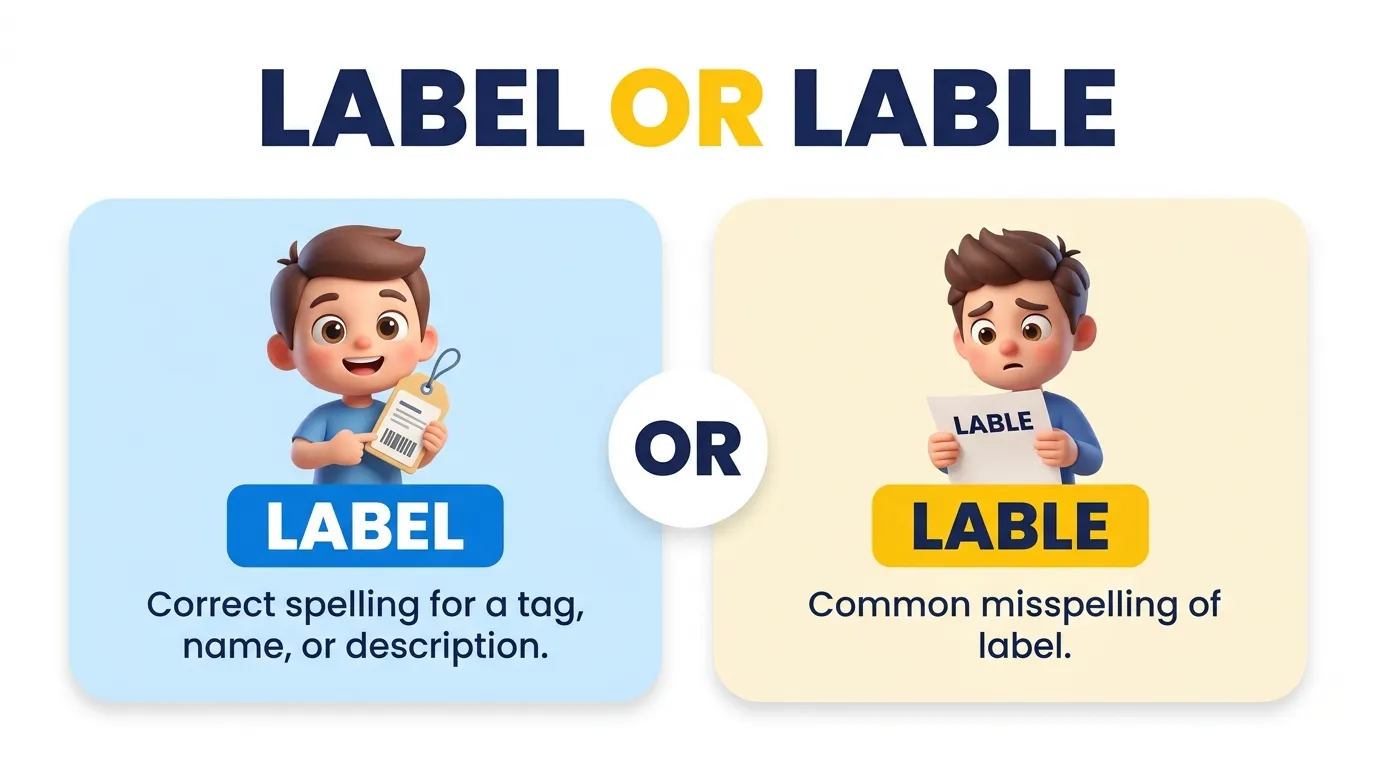
Label is the correct spelling. Lable is a common misspelling and is not standard English.
You are about to send a client email when you notice the red squiggly line under “lable.” The word looks almost right, but something feels off.
The correct spelling is label in both American and British English. Lable is incorrect. The main difference comes later, with forms such as labeled and labelled.
Label or Lable: Quick Answer
Label can be a noun or a verb. As a noun, it can mean a tag, name, or description. As a verb, it means to mark or name something.
For example, a bottle can have a label, and you can label a box before sending it.
The Origin of Label or Lable
The word label entered English through French and was connected with the idea of a small tag or strip.
Its meaning later grew beyond physical tags. Today, a label can also be a name, category, description, or classification.
Lable, however, never became a standard English spelling. The mistake is easy to make because the word can sound similar to words that end in “-le.”
So, the spelling rule is simple: remember label, not lable.
Label or Lable Explained: Key Differences
There is only one correct choice for the base word: label.
The confusion becomes more interesting when the word changes form. American and British English can use different spellings for some forms of label.
| Term | Meaning | When to Use | Region/Context |
| label | Tag, name, or description | Base word | US and UK English |
| lable | Misspelling of label | Do not use | Not standard English |
| labeled | Past form of label | Use in American English | US English |
| labelled | Past form of label | Use in British English | UK English |
| labeling | Present action of adding a label | Use in American English | US English |
| labelling | Present action of adding a label | Use in British English | UK English |
The important point is that label stays the same in both major English varieties. Only some endings change.
Label or Lable: Comparison at a Glance
| Term/Variant | Meaning | Region/Context | Best Used When |
| label | Correct base word | US and UK | Normal writing |
| lable | Incorrect spelling | None | Never |
| labeled | Past form | US English | American writing |
| labelled | Past form | UK English | British writing |
| labeling | Ongoing action | US English | American writing |
| labelling | Ongoing action | UK English | British writing |
Which One Should You Use?
For American English, use label, labeled, and labeling.
For British English, use label, labelled, and labelling.
For formal writing, always choose label when you need the base word. Avoid lable, even in casual writing, because it is simply a spelling error.
For students and ESL learners, learning the base spelling first makes the other forms easier to remember.
For business and online writing, match the spelling style of your target readers. This keeps your content consistent and professional.
Common Mistakes with Label or Lable
Writing “lable” instead of “label”
Mistake: The product lable is damaged.
Correction: The product label is damaged.
The error often happens because the letters are easy to reverse or omit during fast typing.
Using “labelled” in American English
Mistake: The files were labelled for a US report.
Better for US English: The files were labeled for a US report.
British English normally keeps the double l in this form.
Mixing “labeling” and “labelling”
American English uses labeling, while British English commonly uses labelling.
Neither form changes the spelling of the base word. The choice depends on the English style you are following.
Label or Lable in Real-World Examples
Instead of repeating the same basic example, here are a few contexts where the word has a different job:
Professional email: “Please label the folders with the project names.”
News headline: “New Rules Require Clear Food Labels.”
Formal document: “Each sample must be labeled before testing.”
Social media: “Check the care label before washing the shirt.”
These examples show that label can describe a physical tag, a written name, or the action of marking something.
Label or Lable: Data, Trends & Usage
Searches for label or lable mainly show a spelling-check intent. People often search the two forms when they are writing an email, assignment, product description, or online post.
The word also has strong everyday use because labels appear on products, files, clothing, food, charts, and digital content.
A second search intent involves labeled or labelled. Here, the question is not whether the base word is correct. Instead, people want to know which regional spelling fits their audience.
That distinction matters for writers who publish for both American and British readers. Once you know the base word is label, the related forms become much easier to handle.
Frequently Asked Questions About Label or Lable
Is label or lable correct?
Label is correct. Lable is a misspelling and should not be used in standard English.
Is lable a real English word?
No. Lable is not a standard English word, so use label instead.
Is label spelled the same in American and British English?
Yes. The base word is label in both. The difference appears in some forms, such as labeled and labelled.
Why is lable a common mistake?
The spelling can be confusing because the word is short and its sound does not clearly show the letter order. Fast typing can also lead to the e being misplaced or left out.
Is label formal or informal?
Label works in both formal and informal writing. You can use it in reports, emails, schoolwork, product descriptions, and everyday messages.
Is it labeled or labelled?
Labeled is the usual American spelling. Labelled is the usual British spelling.
Is it labeling or labelling?
American English uses labeling. British English commonly uses labelling.
Final Thoughts on Label or Lable
The correct spelling is label, not lable. The base word stays the same in American and British English, so this part is easy to remember.
The main regional difference appears in forms such as labeled versus labelled and labeling versus labelling. Choose the version that matches your audience.
For everyday writing, remember one simple rule: label is correct, lable is not. Use the correct form in your next email, assignment, product page, or document, and keep your spelling clear and consistent.
Curious about similar spelling mistakes? Explore Clutz or Klutz.

I started writing about English word differences after years of teaching students who kept making the same mistakes. My focus is on making spelling rules feel simple and easy to remember. At WordsCombo, I turn confusing word pairs into clear comparisons.